
TL;DR:
- Denver’s fire alarm regulations are complex, combining local codes, international standards, and NFPA guidelines.
- Permits and licensed contractors are mandatory for installation, modification, and maintenance of fire alarm systems.
- Regular inspections, monitoring, and proper maintenance are essential to ensure compliance and prevent penalties.
Working fire alarms cut fire death risk by over 50%, yet many commercial buildings in Denver operate with systems that fall short of current code. Fire alarm regulations in Colorado’s capital are detailed, frequently updated, and enforced with real consequences. Property managers and building owners often struggle to keep up, especially when codes reference multiple overlapping standards. This guide breaks down exactly what applies to your building: the governing codes, permit requirements, monitoring rules, inspection schedules, and what happens when you miss a step. Whether you’re managing a new build or an older property, getting this right protects lives and your bottom line.
Table of Contents
- Understanding Denver fire alarm regulations: The code foundation
- Permits, licensing, and approved contractors: What you need to know
- Fire alarm monitoring rules and exceptions
- Inspection, testing, maintenance, and nuisance alarms
- What most property managers miss about Denver fire alarm rules
- Protect your compliance with expert fire safety support
- Frequently asked questions
Key Takeaways
| Point | Details |
|---|---|
| Codes and standards apply | Denver follows the 2025 Denver Fire Code with NFPA 72 setting the technical standard for fire alarm systems. |
| Permits are mandatory | All commercial fire alarm projects require city permits and licensed contractors for legal compliance. |
| Monitoring is largely required | Most properties must use licensed central station monitoring unless qualified for rare exceptions. |
| Annual inspection is essential | At minimum, fire alarms in Denver require annual inspections to stay compliant and minimize risk. |
| Avoid nuisance alarms | Poor maintenance leads to false alarms and penalties, so regular ITM is both required and practical. |
Understanding Denver fire alarm regulations: The code foundation
Denver’s fire alarm rules don’t come from a single document. They draw from several layers of code, each with a specific role. Understanding how these layers fit together is the first step to staying compliant.
The primary authority is the 2025 Denver Fire Code, which amends the 2024 International Fire Code with Denver-specific provisions. Chapter 9, Section 907 of that code covers fire alarm and detection systems in detail, addressing everything from when a system is required to how it must be installed and monitored. Denver’s local amendments add requirements that go beyond what the base IFC requires, so you can’t rely on a national standard alone.
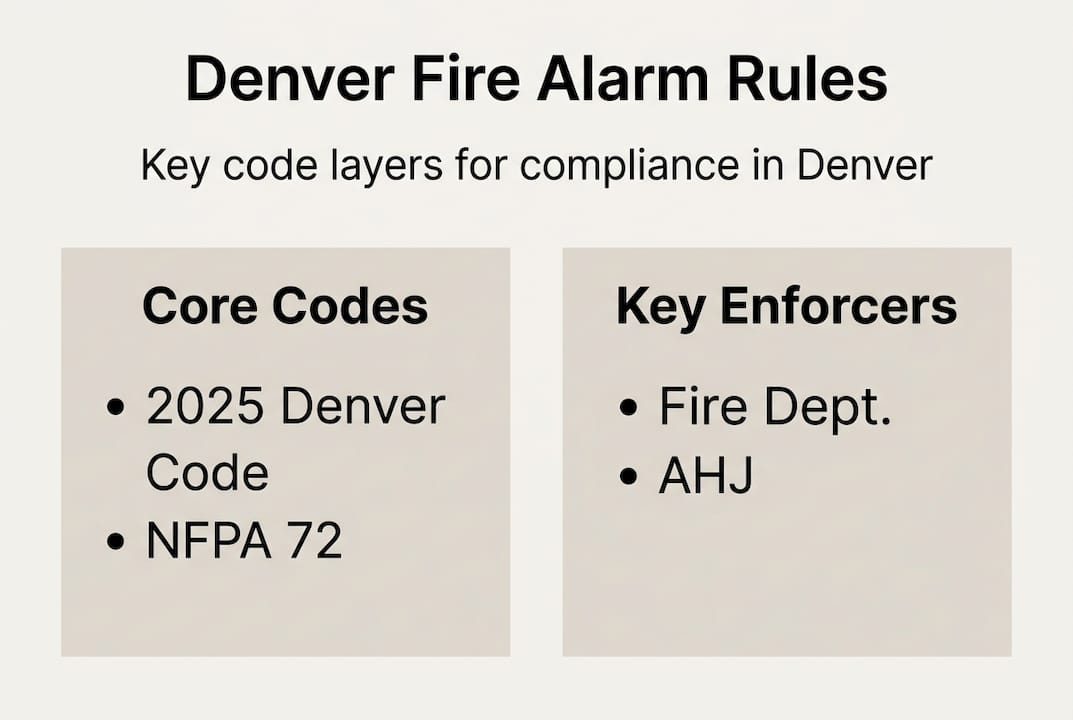
On the technical side, fire alarm systems in commercial buildings must comply with NFPA 72 for design, installation, and signaling. NFPA 72 is the National Fire Alarm and Signaling Code, and it governs the nuts and bolts: detector placement, wiring methods, signal transmission, and documentation. Think of the Denver Fire Code as the “when and where” and NFPA 72 standards as the “how.”
Enforcement falls to the Denver Fire Department and the Authority Having Jurisdiction, commonly called the AHJ. The AHJ has broad discretion to interpret and apply code requirements to specific building conditions. That means two similar buildings can face different requirements based on occupancy type, construction details, or past inspection history.
Here’s a quick overview of the key regulatory layers:
| Code or standard | Role | Enforced by |
|---|---|---|
| 2025 Denver Fire Code | Local requirements and amendments | Denver Fire Department / AHJ |
| 2024 International Fire Code | Base code framework | AHJ |
| NFPA 72 | Technical design and installation | AHJ / licensed contractors |
The areas most commonly regulated include:
- System type: Whether your building needs a manual, automatic, or combination system
- Monitoring: Whether your system must connect to a licensed central station
- Permitting: Required before any installation, modification, or significant maintenance
- Enforcement: Inspections, penalties, and certificate of occupancy requirements
For a broader look at how these codes interact in practice, the Denver fire protection guide from Pre Action Fire covers real-world application across building types. Staying current with NFPA code compliance is equally important as codes update on a regular cycle.
Permits, licensing, and approved contractors: What you need to know
Knowing the foundation, the next step is ensuring every project uses proper permitting and licensed professionals. This is where many property owners run into trouble, often by assuming a general contractor or handyman can handle fire alarm work.
Permits are required for installation, modification, or significant maintenance of fire alarm systems under the 2025 Denver Fire Code. You can’t legally start work without one, and any work done without a permit is subject to stop-work orders and fines. Permits also trigger required inspections, which are your proof of compliance.
On the licensing side, Denver Fire Department licenses are required for design, installation, modification, inspection, and testing of fire alarm systems. This applies to the contractor and, in many cases, the monitoring station. Hiring someone without the right license puts your building at risk of failed inspections and potential liability if a fire occurs.
Here’s the standard process for a compliant fire alarm project:
- Confirm system requirements with the AHJ based on your occupancy type and building size
- Hire a licensed contractor with Denver Fire Department credentials and verifiable experience
- Pull the required permit before any work begins
- Complete installation per NFPA 72 and the approved plans
- Schedule the inspection with the Denver Fire Department
- Receive sign-off and retain all documentation on-site
Pro Tip: Ask your contractor for their Denver Fire Department license number before signing any contract. A legitimate company will provide it without hesitation. If they can’t, walk away.
“Using unlicensed workers for fire alarm work isn’t just a code violation. It voids your system’s warranty, can invalidate your insurance coverage, and leaves you personally liable if the system fails during an emergency.”
For properties going through new construction or major renovation, fire system certification is a required milestone before occupancy. For ongoing operations, working with a provider experienced in Denver commercial fire protection ensures you’re not caught off guard by inspection failures. The full 2025 Denver Fire Code is publicly available and worth bookmarking as a reference.
Fire alarm monitoring rules and exceptions
Having ensured your contractor is licensed, let’s clarify which businesses require professional alarm system monitoring and the few exceptions that apply.
Section 117 of the Denver Fire Code adds specific monitoring requirements: central alarm stations must be licensed, annual permits are required for monitoring operations, and the monitoring system must automatically notify the Denver Fire Department when an alarm activates. This isn’t optional for most commercial occupancies.
Monitoring is required for most commercial fire alarm systems per IFC 907.6.6 and NFPA 72, particularly for business occupancies with high occupant loads, high-hazard uses, and assembly spaces. The NFPA guidelines define the technical standards for how that monitoring signal must be transmitted and received.
| Occupancy type | Monitoring required? | Notes |
|---|---|---|
| Business (high occupant load) | Yes | Per IFC 907.6.6 |
| Assembly | Yes | Includes restaurants, venues |
| High-hazard | Yes | Mandatory, no exceptions |
| Small low-risk business | Possible exception | AHJ discretion applies |
| Single-tenant low-rise | Possible exception | Must confirm with AHJ |
Key monitoring obligations include:
- Central station must hold a current Denver Fire Department license
- Annual monitoring permit required, renewed each year
- Automatic notification to Denver Fire Department upon alarm activation
- Documentation of monitoring agreement kept on-site
Pro Tip: Don’t assume your current monitoring provider is licensed in Denver. Licensing requirements changed with the 2025 code cycle. Verify your provider’s credentials annually.
For properties in the metro area, fire alarm monitoring in Denver requires a provider who understands local licensing requirements, not just national standards. The fire protection guide covers how monitoring integrates with your overall system design.
Inspection, testing, maintenance, and nuisance alarms
Now that monitoring obligations are clear, ongoing compliance is a matter of regular inspection, testing, and maintenance. Staying ahead of these requirements also protects you from one of the most underestimated risks: nuisance alarms.
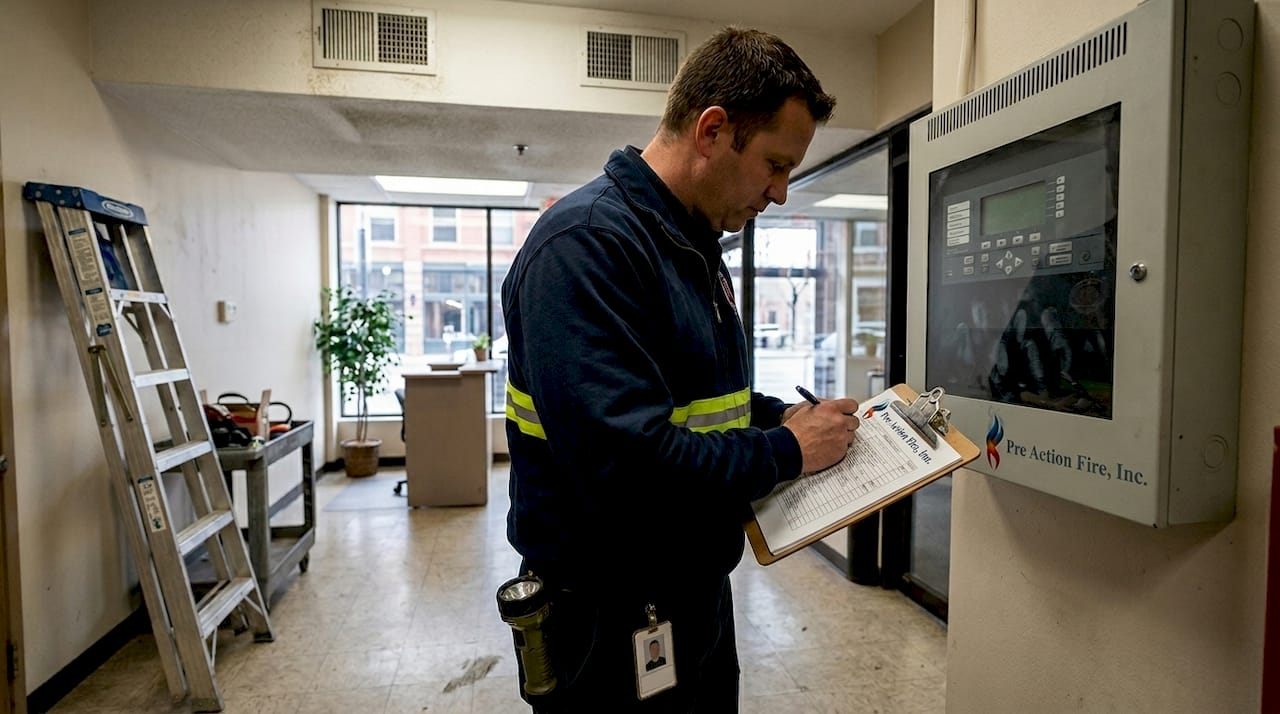
NFPA 72 Chapter 14 requires annual inspections as a minimum, and Denver enforces this requirement strictly. Some components, like batteries, pull stations, and notification appliances, may require more frequent checks depending on the system type and occupancy. Skipping or delaying inspections is one of the fastest ways to accumulate violations.
Here’s a practical maintenance schedule for most commercial systems:
- Monthly: Visual check of control panel indicators and accessible devices
- Quarterly: Test select initiating devices per NFPA 72 Table 14.3.1
- Semi-annually: Inspect and test notification appliances and battery condition
- Annually: Full system inspection and testing by a licensed contractor, with written report
Nuisance alarms are a separate but related problem. Nuisance alarms are defined as activations caused by malfunction, improper installation, or lack of maintenance, and Denver imposes penalties for repeated occurrences. Beyond the fines, nuisance alarms erode trust with occupants and can cause the fire department to deprioritize your building’s calls.
“A nuisance alarm isn’t just an inconvenience. It’s documented evidence that your system isn’t being maintained properly, and that record follows your property.”
The good news is that regular ITM prevents 25% of detector failures, which means a consistent maintenance program directly reduces your risk of both false alarms and real system failures. Scheduling Denver fire safety inspections with a qualified provider keeps your records current and your system reliable. For a detailed breakdown of what’s required each year, the NFPA inspection compliance guide is a practical resource.
Key risks of skipping ITM:
- Failed annual inspection and potential permit suspension
- Increased nuisance alarm penalties
- Voided insurance claims after a fire event
- Personal liability for property managers if negligence is established
What most property managers miss about Denver fire alarm rules
After years of working with commercial properties across the Denver metro, we’ve noticed a pattern. Most compliance failures don’t come from ignorance of the big rules. They come from underestimating the small ones.
Property managers often focus on the initial installation and then treat the system as a set-it-and-forget-it asset. That mindset is expensive. Unlicensed contractors offer lower bids, but the downstream costs of failed inspections, permit resubmissions, and insurance disputes far exceed any upfront savings. We’ve seen buildings spend three times the original quote fixing work that wasn’t done correctly the first time.
Addressable fire alarm systems are another area where cutting corners backfires. Older conventional systems can’t pinpoint which device triggered an alarm, which means longer response times and more nuisance events. Addressable systems identify the exact device, making troubleshooting faster and reducing false activations significantly.
Many owners also underestimate how cumulative penalties work. One missed inspection might cost a few hundred dollars. Two years of gaps, combined with nuisance alarm fees and a lapsed monitoring permit, can easily reach thousands. Insurance carriers are paying attention too, and a pattern of regulatory gaps can affect your premiums or coverage terms.
The smarter approach is treating fire alarm compliance as an ongoing operational process, not a one-time project. Partnering with a licensed provider for commercial fire protection advice gives you a consistent point of contact who knows your building’s history and can flag issues before they become violations.
Protect your compliance with expert fire safety support
Navigating Denver’s fire alarm regulations is manageable when you have the right team behind you. From pulling permits and verifying contractor licenses to scheduling annual inspections and maintaining monitoring agreements, the details add up fast.
Pre Action Fire, Inc. has served the Denver Metro Area since 2009, and our NICET-certified technicians handle every step of the compliance process for commercial property owners. Whether you need Denver fire alarm monitoring that meets current licensing requirements or a thorough fire safety inspection to close out the year in good standing, we make it straightforward. Contact us to schedule a consultation and let us take the guesswork out of staying compliant.
Frequently asked questions
What fire codes apply to commercial buildings in Denver?
Denver uses the 2025 Denver Fire Code, which amends the 2024 International Fire Code with local provisions, and references NFPA 72 for all fire alarm technical standards.
Who can install and maintain my building’s fire alarm system?
Only contractors holding a current Denver Fire Department license can legally install, modify, or maintain commercial fire alarm systems in Denver.
Are all fire alarm systems in Denver required to be monitored?
Most commercial systems require monitoring by a licensed central station; exceptions are narrow and must be confirmed directly with Denver’s AHJ before assuming they apply.
How often does my Denver property need fire alarm inspections?
Annual inspections by a licensed contractor are required at minimum, with certain components needing more frequent testing per NFPA 72 Chapter 14 schedules.
What are nuisance alarms and what penalties apply?
Nuisance alarms are false activations caused by malfunction or poor maintenance; Denver imposes penalties for repeated occurrences to push property owners toward proper system upkeep.