
TL;DR:
- Effective evacuation plans define clear exit routes, assembly points, and roles to protect lives during emergencies. Regular updates, hazard-specific strategies, and trained personnel ensure plans are operational and compliant with safety regulations.
Evacuation plans are formal administrative controls that define exit routes, assembly points, and emergency procedures to protect lives during a crisis. Every safety officer and facility manager in a commercial or industrial setting needs to understand the role of evacuation plans not just as a regulatory checkbox, but as a living operational system. OSHA and NFPA both mandate written evacuation procedures for most workplaces, and the gap between a compliant document and a plan that actually works under pressure is wider than most facilities realize. This article breaks down the key components, regulatory obligations, hazard-specific strategies, and implementation practices that separate effective plans from paper exercises.
What are the key components and roles in an effective evacuation plan?
An effective evacuation plan defines who does what, where everyone goes, and how information moves during an emergency. Evacuation plans formalize exit routes, assembly points, and emergency procedures to reduce confusion and injury. That structure is what prevents a fire or chemical release from turning into a stampede.
The core elements of any well-built plan include:
- Clearly marked evacuation routes: Primary and secondary exit paths posted at eye level throughout the facility, maintained free of obstructions at all times. Fire exit maintenance is a legal requirement, not a suggestion.
- Designated assembly areas: Safe gathering points outside the building where headcounts can be taken and accountability confirmed.
- Alarm and notification systems: Both audible and visible signals to reach all occupants, including those in high-noise environments or with hearing impairments. Choosing between audible and visible alarms depends on the specific facility layout and occupant needs.
- Assigned evacuation wardens: Personnel responsible for guiding occupants, sweeping areas, and reporting to the incident commander.
- Provisions for individuals needing assistance: Dedicated procedures for employees or visitors with mobility limitations.
OSHA recommends at least one warden per 20 employees for effective guidance. That ratio matters because a single warden covering 80 people in a large warehouse cannot physically confirm everyone has exited safely.
Command structure is equally critical. Effective evacuation requires a chain of command with at least three levels of authority to maintain leadership continuity if primary responders are unavailable. This means designating a primary evacuation coordinator, a secondary, and a tertiary, all trained and documented.

Pro Tip: Post the chain of command alongside evacuation maps at every warden station. When the primary coordinator is off-site during an incident, the backup needs to act without hesitation.
Why are evacuation plans vital for regulatory compliance and business continuity?
Evacuation plans fulfill legal mandates under OSHA 29 CFR 1910.38 and align with NFPA 101, the Life Safety Code. Non-compliance exposes facilities to citations, fines, and civil liability following an incident. Beyond the legal exposure, a poorly executed evacuation can halt operations for days or weeks while investigations proceed.
Regulations in 2026 mandate evacuation plans as both life-safety and business continuity necessities, requiring clear communication protocols and provisions for individuals needing assistance. That dual function is often underappreciated. Facilities that treat evacuation planning as a pure compliance exercise miss the operational continuity angle entirely.
The business continuity benefits of solid evacuation planning include:
- Faster return to operations: A well-executed evacuation with documented headcounts allows incident commanders to confirm all-clear faster, reducing downtime.
- Reduced liability exposure: Documented plans, training records, and drill logs demonstrate due diligence in any post-incident legal review.
- Insurance implications: Many commercial insurers factor emergency preparedness documentation into underwriting decisions.
- Regulatory audit readiness: OSHA inspectors can request evacuation plans during routine inspections, not just after incidents.
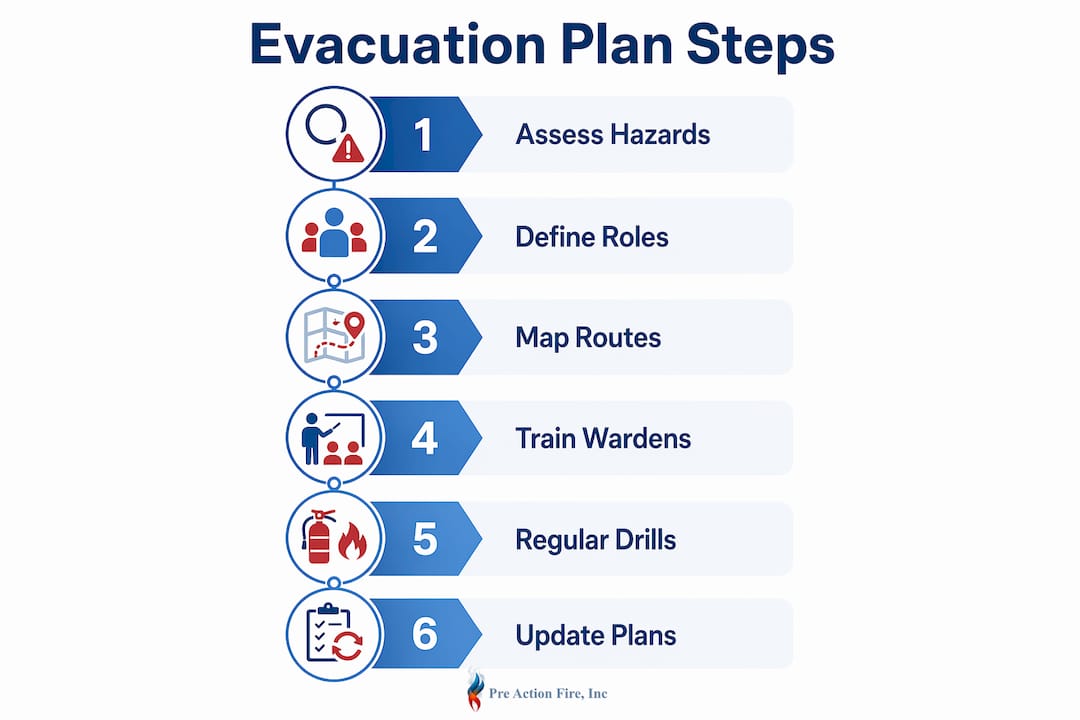
Documentation and regular updates are non-negotiable. A plan written in 2019 that has never been revised does not reflect current headcounts, floor layouts, or hazard profiles. Facilities should review and update their evacuation plans at minimum annually, and after any significant change to the building, workforce, or operations.
How do hazard-specific strategies improve safety in complex industrial environments?
Generic evacuation plans fail in industrial facilities because the hazards are not generic. A warehouse storing flammable chemicals faces a fundamentally different threat profile than a multi-story office building. Evacuation modeling research recommends modular plans for compound hazards like fire, seismic activity, and chemical spills, assuring stable decision logic across varying threats.
Building a hazard-specific evacuation strategy requires a structured approach:
- Conduct a site-specific risk assessment. Identify every credible hazard: fire, explosion, toxic release, structural failure, severe weather. Map each hazard to the areas of the facility it affects most directly.
- Develop modular response modules. Each hazard type gets its own response logic. A chemical spill may require shelter-in-place before evacuation, while a fire demands immediate exit. Modular plans allow coordinators to activate the right response without confusion.
- Account for overlapping hazards. A seismic event can trigger a gas line rupture and a fire simultaneously. Managers should treat facilities as dynamic networks requiring flexible evacuation responses, not single-scenario scripts.
- Integrate climate and environmental risk factors. The CCCM Cluster Guide emphasizes that evacuation planning must integrate climate risk factors, shifting from generic to proactive approaches. Facilities in flood-prone or wildfire-adjacent areas need plans that account for external access route failures.
- Validate the plan against real layout constraints. Walk every evacuation route physically. Identify bottlenecks, locked doors, and areas where alarm signals are weak. Common fire hazards in commercial facilities often cluster near the same exits workers rely on for evacuation.
Pro Tip: Run a tabletop exercise with your wardens using a compound-hazard scenario before your next live drill. Discovering decision gaps in a conference room is far less costly than discovering them during an actual incident.
What best practices make evacuation plans effective in emergencies?
The difference between a plan that works and one that fails under pressure comes down to preparation, not paperwork. Regular training, drills, and digital emergency management tools improve plan effectiveness and employee preparedness, turning static documents into dynamic, actionable systems. Training reduces evacuation time and improves compliance across the board.
Managing non-employees in your evacuation
Site-specific plans must account for non-employees unfamiliar with layouts or alarms, such as contractors and delivery staff. General plans fail in industrial facilities with complex hazards without these adjustments. Every visitor, contractor, and temporary worker who enters your facility should receive a brief safety orientation that covers the nearest exit, the assembly point location, and the alarm signal they will hear.
Assembly point selection and management
Assembly points must be safely distanced at least 500 feet from hazards and include documented headcounts, particularly accommodating individuals with mobility challenges. That 500-foot standard exists because smoke, debris, and emergency vehicle access all require buffer space. A parking lot directly adjacent to the building entrance does not qualify.
The table below compares two common approaches to assembly point management:
| Factor | Fixed single assembly point | Multiple designated zones |
|---|---|---|
| Headcount accuracy | Easier to consolidate | Requires zone-by-zone reporting |
| Hazard flexibility | Limited if primary zone is compromised | Allows rerouting away from active hazard |
| Visitor management | Simpler to direct unfamiliar occupants | Requires clear signage for each zone |
| Large facility suitability | Poor for facilities over 50,000 sq ft | Recommended for complex or multi-building sites |
Technology and communication tools
Digital emergency management platforms allow real-time headcount tracking, two-way communication with wardens, and instant notification to off-site personnel. Effective fire safety communication for facility managers goes beyond the alarm signal. It includes pre-incident notification systems, mass text alerts, and post-evacuation status reporting. Facilities that rely solely on a horn and a paper roster are operating with a significant gap in their response capability.
Key Takeaways
Effective evacuation planning combines clear structure, site-specific hazard logic, trained personnel, and regular updates to protect lives and maintain regulatory compliance.
| Point | Details |
|---|---|
| Warden ratios matter | OSHA recommends one warden per 20 employees to maintain effective guidance during evacuation. |
| Three-level command structure | Designate primary, secondary, and tertiary coordinators so leadership never fails during an incident. |
| Modular hazard planning | Build separate response modules for fire, chemical, and seismic events to handle compound threats. |
| Non-employee protocols | Brief every contractor and visitor on exits and assembly points before they enter the facility. |
| Assembly point standards | Place assembly areas at least 500 feet from hazards and document headcounts with accessibility in mind. |
The plan on the wall is not the plan that saves lives
The most common failure I see in industrial and commercial facilities is not a missing evacuation plan. It is a plan that was written once, laminated, posted on a wall, and never touched again. The building changed. The headcount grew. A new chemical process moved into Bay 4. The plan did not move with any of it.
The second failure is visitor blindness. Facilities spend real effort training their permanent workforce and then completely ignore the contractor who shows up every tuesday to service the HVAC system. That contractor has no idea where the assembly point is, does not recognize the alarm tone, and has never walked the exit route. One incident is all it takes to expose that gap.
What actually works is treating the evacuation plan as an operational document, not a compliance artifact. That means quarterly warden refreshers, annual full-scale drills, and a formal review trigger any time the facility layout or occupancy changes. It also means integrating your alarm system design with your plan. Poorly placed alarms create dead zones where occupants never hear the signal. Alarm placement is not an afterthought. It is part of the evacuation architecture.
The facilities that perform best in real emergencies are the ones that practice discomfort. They run drills at inconvenient times. They simulate the primary warden being unavailable. They test the backup routes. That level of preparation is not excessive. It is the standard every safety officer should hold.
— Results
How Preactionfire supports your evacuation compliance strategy
A well-designed evacuation plan depends on alarm systems that actually reach every occupant in every corner of your facility.

Pre Action Fire has served commercial and industrial facilities across the Denver Metro Area since 2009, with NICET-certified technicians who design and maintain fire alarm systems built to NFPA standards. From alarm device placement and notification device compliance to full system inspections, Preactionfire ensures your communication infrastructure supports the evacuation plan you have worked to build. Contact Preactionfire to schedule a compliance review for your facility.
FAQ
What is the role of evacuation plans in workplace safety?
Evacuation plans define exit routes, assembly points, and emergency procedures to reduce confusion and injury during a crisis. They also assign roles and responsibilities so every occupant knows exactly what to do when an alarm sounds.
How many evacuation wardens does a facility need?
OSHA recommends at least one evacuation warden per 20 employees. Larger or more complex facilities may require additional wardens to cover multiple floors, zones, or shifts.
What should an evacuation plan include for contractors and visitors?
Site-specific plans must include dedicated visitor control methods, because non-employees are unfamiliar with facility layouts and alarm signals. A brief safety orientation at entry is the minimum standard.
How often should evacuation plans be updated?
Evacuation plans should be reviewed and updated at least annually and after any significant change to the building layout, occupancy, or hazard profile.
What distance is required for a safe assembly point?
Assembly points should be located at least 500 feet from the facility or identified hazard zones, with documented headcount procedures and accessibility provisions for occupants with mobility limitations.