
Maintain at least an 18-inch vertical clearance from sprinkler deflectors to the top of storage unless a documented exception applies. This single rule, drawn from OSHA and NFPA, drives most sprinkler head clearance violations found during inspections. Related figures for in-rack and sidewall sprinklers tighten in specific configurations, and NFPA 13’s obstruction rules, including the three-times rule, add another layer that catches contractors off guard when beams, ducts, or light fixtures sit near a head. Testing evidence and specific code provisions can justify exceptions, but the burden of proof falls on the property owner.
TL;DR:
- The minimum clearance between sprinkler deflectors and stored material is 18 inches, with tighter clearances for in-rack sprinklers, usually around 6 inches.
- Obstructions like ducts, beams, or fixtures must comply with the three-times rule, where the horizontal distance from the obstacle to the sprinkler equals three times its maximum dimension, capped at 24 inches.
- Exceptions for reduced clearance exist only when documented through fire testing or specific NFPA provisions, and approval relies on proper documentation held on file.
- Sprinkler layouts should be coordinated early in design to prevent costly modifications, with physical measurement and clear marking of clearance planes during construction.
- Routine inspections under NFPA 25 continuously verify clearance compliance, as violations often result from head modifications or storage changes after the initial installation.
Table of Contents
- What Are the Minimum Sprinkler Head Clearance Requirements?
- How Does the Three-Times Rule Work for Sprinkler Obstructions?
- What Storage Clearance Exceptions Does OSHA Allow?
- When Do Ducts and Beams Require Repositioned or Extra Sprinklers?
- Best Practices for Coordinating Sprinkler Clearance During Design
- How Do Inspections Enforce Sprinkler Clearance Over Time?
- Pre Action Fire’s Field Perspective on Clearance Errors
- Sprinkler Inspections and Retrofit Support From Pre Action Fire
- Sources
- FAQ
What Are the Minimum Sprinkler Head Clearance Requirements?
The 18-inch figure is the number every fire protection professional should know cold. OSHA’s interpretation of 29 CFR 1910.159©(10) requires 18 inches of vertical clearance between sprinkler deflectors and the top of stored material, and the CFR text itself states the same figure in plain language: “The minimum vertical clearance between sprinklers and material below shall be 18 inches (45.7 cm).” That’s the baseline for general storage, but it’s not the only number that matters.
Sprinkler head positioning changes with the sprinkler type and hazard classification. Here’s what actually shows up on a code-compliant drawing:
- 18 inches minimum vertical clearance between deflectors and top of storage for standard ceiling-level sprinklers, per OSHA and referenced NFPA storage guidance.
- 6 inches is a commonly cited in-rack sprinkler clearance, since in-rack heads work at storage level rather than from the ceiling, according to industry technical guidance on obstruction clearances.
- Sidewall sprinklers require a minimum clearance measured from the adjacent wall, but the exact distance depends on the sprinkler’s listing and NFPA 13’s obstruction tables for the specific model installed.
- In ordinary hazard occupancies with wider sprinkler spacing, obstruction tables often recommend larger deflector clearances than the baseline 18-inch rule, sometimes significantly more.
Every one of these numbers lives in a different part of the code, which is exactly why so many punch lists get built around clearance violations. NFPA 13 governs the physical geometry of obstructions and sprinkler discharge patterns. OSHA governs the employer’s duty to maintain storage clearance. NFPA 25 governs how that clearance gets verified over time. A contractor who only checks one of the three will eventually get flagged by an AHJ who checks all three.
Pro Tip: Keep a laminated clearance reference card in every site binder listing the sprinkler type installed at each area of the building. Sidewall, in-rack, and standard spray heads all carry different numbers, and relying on memory during a walkthrough is how violations slip past.
How Does the Three-Times Rule Work for Sprinkler Obstructions?
NFPA 13 doesn’t treat every obstruction the same way. It classifies obstructions as either suspended (ducts, light fixtures, cable trays hanging below the ceiling) or floor-mounted (tall storage racks, partial-height walls), and the geometry rules differ depending on hazard classification and obstruction type, according to NFPA’s own guidance on the topic.
The three-times rule is the shorthand every fire protection engineer uses in the field. The required horizontal distance from an obstruction to the nearest sprinkler equals three times the obstruction’s maximum dimension, capped at 24 inches. A duct that’s 8 inches deep needs 24 inches of horizontal clearance under the rule (8 times 3 equals 24), while a 4 inch conduit only needs 12 inches. Once the obstruction’s dimension pushes the calculated distance past 24 inches, the cap takes over regardless of how large the obstruction gets.
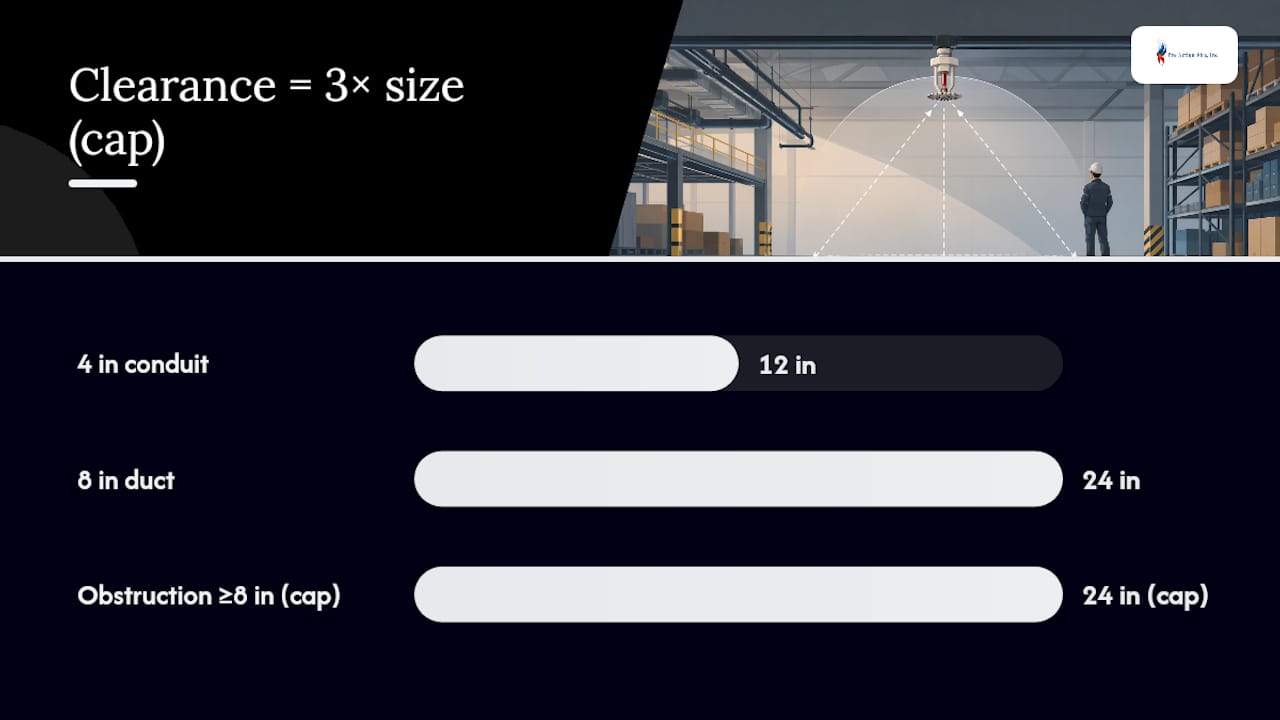
NFPA 13’s tables and figures show this relationship as an umbrella shape radiating out from the sprinkler deflector. Picture the deflector as the tip of an umbrella: obstructions inside that umbrella block water distribution and need mitigation, while anything outside the umbrella’s edge is generally clear.
A few scenarios illustrate how this plays out on an actual job:
- A structural beam sitting less than 1 foot below and away from a sprinkler typically requires the deflector to sit level with the bottom of the beam, not above it, to keep the spray pattern from being blocked.
- A wide duct crossing directly under a sprinkler line usually forces either a repositioned head or an added sprinkler on the downstream side of the duct.
- Light fixtures mounted flush with the ceiling rarely trigger the rule, but pendant-style fixtures that drop several inches often do.
Reading these tables gets easier once you stop thinking in absolutes and start thinking in ratios. The obstruction’s size relative to its distance from the deflector, not its size alone, determines compliance.
What Storage Clearance Exceptions Does OSHA Allow?
OSHA treats the 18-inch clearance as a horizontal plane that runs across the entire storage area, not a spot check at a single sprinkler head. That distinction matters when an AHJ walks a warehouse floor: a single tall pallet poking through the plane in one aisle is a violation even if every other rack in the building measures clean, based on OSHA’s own clarification of the regulation.

NFPA 25 reinforces this by folding storage-top clearance into its inspection and maintenance cycle rather than treating it as a one-time installation checkbox. Facility teams get re-checked on this plane every time an NFPA 25 inspection runs, which means seasonal inventory shifts, new racking, or a forklift operator stacking pallets a foot too high can create a violation between scheduled inspections.
Exceptions exist, but they carry real evidentiary weight. Three scenarios commonly justify a deviation from the flat 18-inch rule:
- Wall-adjacent shelving that sits against a perimeter wall may qualify for reduced clearance under specific NFPA provisions, since the wall itself limits fire spread laterally.
- Library and archive stacks using aisle-mounted sprinklers instead of ceiling-only coverage can meet code with different clearance math, provided the aisle sprinkler placement follows NFPA 13’s stack-specific criteria.
- Documented large-scale fire testing that demonstrates a reduced clearance still controls a fire scenario can support a variance, but the burden of proof sits entirely with the property owner or design team, not the inspector.
None of these exceptions are self-executing. An AHJ won’t assume a wall-adjacent rack qualifies just because it looks close to a wall. The design team needs to document the specific NFPA provision being invoked and keep that paperwork on file, because the next inspector who walks the floor won’t have context on a verbal agreement made three years earlier.
When Do Ducts and Beams Require Repositioned or Extra Sprinklers?
Structural and mechanical elements interfere with sprinkler performance in two distinct ways: they either block the spray pattern before it reaches the fire, or they delay heat from reaching the sprinkler’s thermal element long enough to trigger activation. A wide HVAC duct running below a ceiling-mounted sprinkler line does both. It shadows the area beneath it from spray coverage, and it traps rising heat before that heat ever reaches the sprinkler head above.
Here’s the general decision sequence contractors and engineers follow when an obstruction shows up on a reflected ceiling plan:
- Measure the obstruction’s maximum dimension and calculate the three-times distance to determine if the existing sprinkler layout already clears it.
- Check whether the obstruction sits within the discharge umbrella using NFPA 13’s applicable table for the hazard classification and sprinkler type in use.
- Reposition the sprinkler if a simple relocation clears the obstruction without compromising area coverage.
- Add a supplemental sprinkler below the obstruction when repositioning alone won’t restore full spray distribution, which NFPA 13 often calls for beneath ducts, wide beams, and structural transitions.
- Recalculate hydraulics for the affected zone, since adding a head changes flow demand and may require larger branch line piping.
That last step trips up more projects than any other part of this process. Adding a single sprinkler below a duct sounds minor until the hydraulic calculation shows the branch line needs to jump a pipe size to maintain the required density, which can mean reopening finished ceiling sections that were already signed off.
Pro Tip: Run obstruction checks against the reflected ceiling plan before framing inspection, not after. Once drywall goes up, adding a supplemental sprinkler means cutting into finished work instead of adjusting a pipe run that’s still open.
Best Practices for Coordinating Sprinkler Clearance During Design
Most sprinkler head clearance issues that show up during final inspection were preventable months earlier. They trace back to a design phase where the fire protection layout got finalized before the mechanical and structural drawings settled into their final form.
The fix starts with sequencing. Reflected ceiling plans, structural drawings, and MEP layouts need to reach the fire protection designer early enough that sprinkler head height and spacing decisions account for ducts, beams, and light fixtures before pipe gets ordered. Waiting until 90% construction documents to run this coordination check is how projects end up with change orders for repositioned heads.
On-site verification deserves the same rigor as the paper design. A few habits separate crews that pass inspection cleanly from crews that don’t:
- Physically measure the deflector plane at multiple points across a storage area, not just at the highest visible rack.
- Mark the 18-inch plane on racking or walls with tape or paint during the storage layout phase, so warehouse staff have a visual reference after occupancy.
- Confirm sprinkler type (upright, pendent, sidewall) against the design drawings before final connection, since a substituted head can quietly violate obstruction rules the original spec accounted for.
- Document every code-based decision, including which NFPA provision supports an exception, and keep that record with the AHJ approval on file.
Bring in a fire protection engineer when a project involves high-piled storage, mixed hazard classifications, or any request for an exception to the standard 18-inch plane. A customized sprinkler layout review catches these conflicts before they become expensive rework, and that review costs far less than a failed inspection after racking is already loaded.
How Do Inspections Enforce Sprinkler Clearance Over Time?
Sprinkler head clearance isn’t a one-time installation milestone. NFPA 25 folds storage-top clearance verification directly into its routine inspection and maintenance schedule, which means a building that passed its initial fire marshal walkthrough can still drift out of compliance six months later if a warehouse manager restacks inventory without checking the plane.
Facility teams responsible for maintaining compliance between formal inspections should build a short recurring checklist:
- Verify the 18-inch plane at every storage area during quarterly walkthroughs, not just at the annual NFPA 25 inspection.
- Photograph any racking or stock that appears close to the deflector plane and flag it before the next scheduled inspection.
- Keep documentation for any approved clearance exception accessible on-site, including the specific NFPA provision cited.
- Train warehouse staff on the visual clearance markers so restacking doesn’t silently create a violation.
When an AHJ finds a noncompliant condition, the outcomes typically follow a predictable path: a correction notice with a deadline, a re-inspection requirement, and in persistent cases, an occupancy restriction on the affected storage area until clearance is restored. Getting ahead of that sequence with a structured inspection workflow is far less disruptive than responding to a violation notice after the fact.
Pre Action Fire’s Field Perspective on Clearance Errors
Painted-over sprinkler heads and forgotten storage growth cause more clearance violations than bad design ever does. A head gets painted during a tenant improvement, the thermal element response gets altered, and nobody flags it until an inspector does. Late MEP changes are the other repeat offender. A duct gets rerouted after the fire protection layout is locked, and nobody re-runs the three-times rule against the new obstruction.
The fix sequence that actually works: measure the plane, mark it physically, segregate any storage that’s already too high, then decide between adding a supplemental sprinkler or notifying the AHJ before they find it first. Call in a NICET-certified technician when the obstruction geometry gets complicated or when a documented exception needs engineering justification behind it.
— Results
Sprinkler Inspections and Retrofit Support From Pre Action Fire
Specialized fire protection technicians walk the storage area, measure the actual deflector heights against current racking, and document any exception with the specific NFPA provision an AHJ will want to see on file.

Fire protection specialists handle sprinkler inspection, installation, and retrofit work in the region, along with AHJ documentation that turns a verbal exception into paperwork that holds up at the next inspection. If a recent racking change, a tenant improvement, or an upcoming NFPA 25 inspection has you second-guessing your clearance compliance, schedule a sprinkler evaluation and get a technician on-site before a violation notice forces the timeline.
Sources
- Clarification of OSHA regulation 29 CFR 1910.159©(10), Sprinkler spacing.
- 29 CFR 1910.159 — Sprinkler spacing (Code of Federal Regulations)
- NFPA 13: Suspended or Floor Mounted Vertical Obstructions
- NFPA 13 Sprinkler Obstruction Rules: Clearance Distances & Requirements – Industrial Monitor Direct
FAQ
What Is the Minimum Clearance for a Sprinkler Head?
The minimum vertical clearance is 18 inches between a sprinkler deflector and the top of storage below it, per OSHA’s interpretation of 29 CFR 1910.159©(10). In-rack sprinklers commonly use a tighter 6-inch clearance since they operate at storage level rather than from the ceiling.
What Are the OSHA Sprinkler Clearance Requirements?
OSHA requires 18 inches of vertical clearance between sprinkler deflectors and material stored below, treated as a horizontal plane across the entire storage area rather than a single-point measurement, according to the CFR text. Employers bear the responsibility for maintaining that plane as storage levels change.
What Clearance Does NFPA 25 Require Between a Sprinkler and Top of Storage?
NFPA 25 doesn’t set a separate clearance figure. It enforces the same 18-inch OSHA plane through its routine inspection and maintenance schedule, requiring facility teams to verify and document that clearance during each scheduled inspection.
What Is the 18-Inch Rule for Sprinklers?
The 18-inch rule requires at least 18 inches of vertical clearance between sprinkler deflectors and the top of storage, based on OSHA’s interpretation of federal regulation. Exceptions apply only with documented large-scale fire testing or specific NFPA provisions, such as wall-adjacent shelving or library stack configurations.
When Do Ducts or Beams Require an Extra Sprinkler Head?
An extra sprinkler is typically required when an obstruction like a wide duct or beam sits close enough to block the discharge pattern under NFPA 13’s three-times rule, and simply repositioning the existing head won’t restore full coverage. Adding a head usually triggers a hydraulic recalculation for the affected branch line.