
Most fire alarm components need a functional test at least once a year, but the real schedule is more layered than that. Batteries, waterflow switches, and supervisory devices often require semiannual or quarterly checks, while smoke detector sensitivity testing runs on its own timeline: within one year of installation, then every other year unless the system is continuously monitored. Only qualified personnel can perform this work, and every result has to be logged under NFPA 72 Chapter 14 for the testing itself and Chapter 7 for documentation.
TL;DR:
- Regular testing of fire alarm control units, initiating devices, notification appliances, batteries, and supervisory devices is necessary, with specific frequencies as outlined by NFPA 72.
- Smoke detector sensitivity must be checked within one year of installation and periodically afterwards using calibrated methods or system monitoring, with extended intervals possible if automatic sensitivity monitoring is active.
- Initial system acceptance testing must cover 100% of devices and functions, with reacceptance requiring full testing after hardware changes and partial sampling after programming updates.
- Qualified personnel with appropriate training, certification, and calibrated equipment are mandatory for all testing, and detailed device-level records must be maintained for compliance and inspection.
- Sensitivity testing is frequently neglected during inspections, increasing the chance of citations, so proper documentation and timely repairs are critical for ensuring AHJ approval.
Table of Contents
- How Often Do You Need to Test Each Fire Alarm Device?
- What Testing Is Required When You Install or Modify a System?
- Who Is Qualified to Perform NFPA 72 Testing?
- What Records Does NFPA 72 Require You to Keep?
- What Do AHJs Catch Most Often During Inspections?
- How Pre Action Fire Approaches Annual ITM
- Get Your Fire Alarm System AHJ-Ready
- Sources
- FAQ
How Often Do You Need to Test Each Fire Alarm Device?
Two different obligations get confused constantly: inspection and testing. A visual inspection under Table 14.3.1 confirms a device is physically present, unobstructed, and undamaged. A functional test under Table 14.4.3.2 confirms the device actually operates and signals correctly. You need both, and skipping the visual check because the functional test passed is one of the more common shortcuts that gets flagged during an authority having jurisdiction (AHJ) review.
Device-level frequencies vary more than most facility teams expect:
- Fire alarm control units: functional test annually, visual inspection semiannually.
- Initiating devices (smoke detectors, heat detectors, duct detectors, beam detectors): functional test annually.
- Notification appliances (horns, strobes, speakers): functional test annually.
- Batteries: load-tested annually, with a shorter voltage/physical check performed semiannually. Facilities running older battery banks should review NFPA-compliant battery replacement practices before a load test exposes a failing cell.
- Waterflow switches and supervisory devices: tested semiannually, per Inspect Point’s breakdown of Table 14.4.3.2.
- Supervising station transmission equipment: tested at intervals tied to the technology, sometimes quarterly depending on the signaling method.
Smoke detector sensitivity testing sits outside all of that. It is not a functional test and can’t be satisfied by triggering the alarm with canned smoke. NFPA 72 requires sensitivity to be checked within a year after installation and on a periodic basis thereafter, using a calibrated test method, a listed field calibration unit, or a detector’s own built-in sensitivity-monitoring capability. If the detector is part of a system with continuous automatic sensitivity monitoring, the interval can be extended, which is a detail contractors frequently skip when they only budget time for the annual functional visit.
Notification appliance testing has its own measurement standards. Audible devices need sound-pressure readings taken with a calibrated meter to confirm they meet the audibility levels required for the space. Visual appliances get checked for candela output and placement. Voice systems require intelligibility verification, not just a volume check, since a strobe that flashes and a speaker that’s simply loud enough don’t satisfy the code if occupants can’t understand the message.
What Testing Is Required When You Install or Modify a System?
A brand-new system doesn’t get a partial test. NFPA 72 requires acceptance testing to cover 100 percent of devices and functions before the system is turned over, and the AHJ must be notified in advance so an inspector can witness the test if they choose.
- Initial acceptance: every device and every function gets tested, full stop. No sampling.
- Reacceptance after device changes: if you add or replace initiating devices, notification appliances, or control-unit hardware, you retest the affected functions, and in many cases that means 100 percent of what changed.
- Reacceptance after software changes: when site-specific programming changes, you test every affected function plus a 10 percent sample of the unaffected devices, capped at 50 devices, according to the reacceptance rules in Chapter 14. That sampling rule exists so a minor programming tweak doesn’t force a full-building retest every time.
- Test method: silent tests, walk tests, or off-hours testing are all permitted as long as the system is fully restored to normal operation before the technician leaves the building.
Who Is Qualified to Perform NFPA 72 Testing?
NFPA 72 doesn’t hand you a license number to check. It requires that ITM be performed by people with the training, experience, and manufacturer familiarity to do the work correctly, which shows up in practice as a mix of NICET certification, factory-authorized training, and state or local contractor licensing. The specific combination the AHJ expects varies by jurisdiction, which is exactly why verifying a contractor’s credentials before signing a service agreement matters more than assuming “they do fire alarms” is enough.
Before hiring or renewing a service contract, ask for:
- Current NICET certification levels for the technicians who will actually be on-site, not just the sales team.
- A copy of the company’s state or municipal contractor license.
- Proof of liability insurance covering the scope of work.
- Sample test reports from comparable buildings, so you can see the level of detail before you’re stuck with theirs.
- A list of the calibrated equipment they bring: sensitivity test kits, sound-level meters, and battery load testers.
Pro Tip: Keep a one-page qualification summary in your procurement file for every fire alarm contractor. When an AHJ or insurance auditor asks who performed last year’s test, you want an answer in thirty seconds, not a phone call to a vendor who may not answer that day.
Understanding what certified technicians actually do on-site makes it easier to spot a report that’s missing something, even if you’re not the one holding the meter.
What Records Does NFPA 72 Require You to Keep?
Chapter 7 is where testing turns into paperwork, and paperwork is where most AHJ citations actually happen, not on the roof with the horn/strobe. A compliant inspection or test report needs to identify the system, list every device tested with its specific location, record the pass/fail result for each device individually, name the technician and their credentials, note any corrective action taken, and flag any impairment that occurred during the visit.
Retention rules aren’t uniform across every record type:
- Periodic test records: keep until the next equivalent test, plus one year.
- Multi-year test cycle records: keep for the length of that cycle, plus one year.
- Original system documentation (as-built drawings, sequence of operations, equipment data sheets): retained permanently for the life of the system.
A few habits separate facilities that sail through an AHJ visit from ones that don’t. Keep device-level logs rather than a single summary line that says “system tested, no issues.” Close the loop on every corrective action with a date and a name attached. And use one consistent floor-by-floor report format year over year, because a clear device-level record form is the single biggest factor in whether an AHJ accepts a report on the first pass.
What Do AHJs Catch Most Often During Inspections?
Sensitivity testing is the most frequently skipped requirement in the entire code, largely because contractors bundle only the annual functional test into their standard visit and treat sensitivity as an upsell rather than a baseline obligation. Rotating heat-detector sample testing, inconsistent device-level reporting, and poor coordination between waterflow-device testing under NFPA 72 and the sprinkler-side requirements in NFPA 25 round out the list of repeat offenders.
Before an AHJ visit, walk through this checklist from All Day Power Washing:
- Pull the as-built drawings and sequence of operations so you’re not searching for them while the inspector waits.
- Confirm every device ID in your report matches a physical label in the field.
- Verify battery load-test records are current and show actual voltage readings, not just a checkmark.
- Confirm supervising-station test logs show successful transmission tests at the required intervals.
One insight worth internalizing: sensitivity testing gets skipped more often than any other single NFPA 72 requirement, which means it’s disproportionately likely to be the item that turns a routine inspection into a citation. If a device fails and can’t be repaired immediately, document the impairment and consider whether a fire watch is warranted until it’s resolved. Reading up on the warning signs of a failing fire alarm system between annual visits also helps catch problems before an inspector does.
How Pre Action Fire Approaches Annual ITM
A typical annual ITM visit starts before anyone touches a panel. Pre-visit prep means pulling last year’s report, checking for outstanding corrective actions, and confirming which devices are due for sensitivity testing versus a standard functional check. From there, technicians work floor by floor, logging results device by device rather than summarizing a whole zone as “pass.”
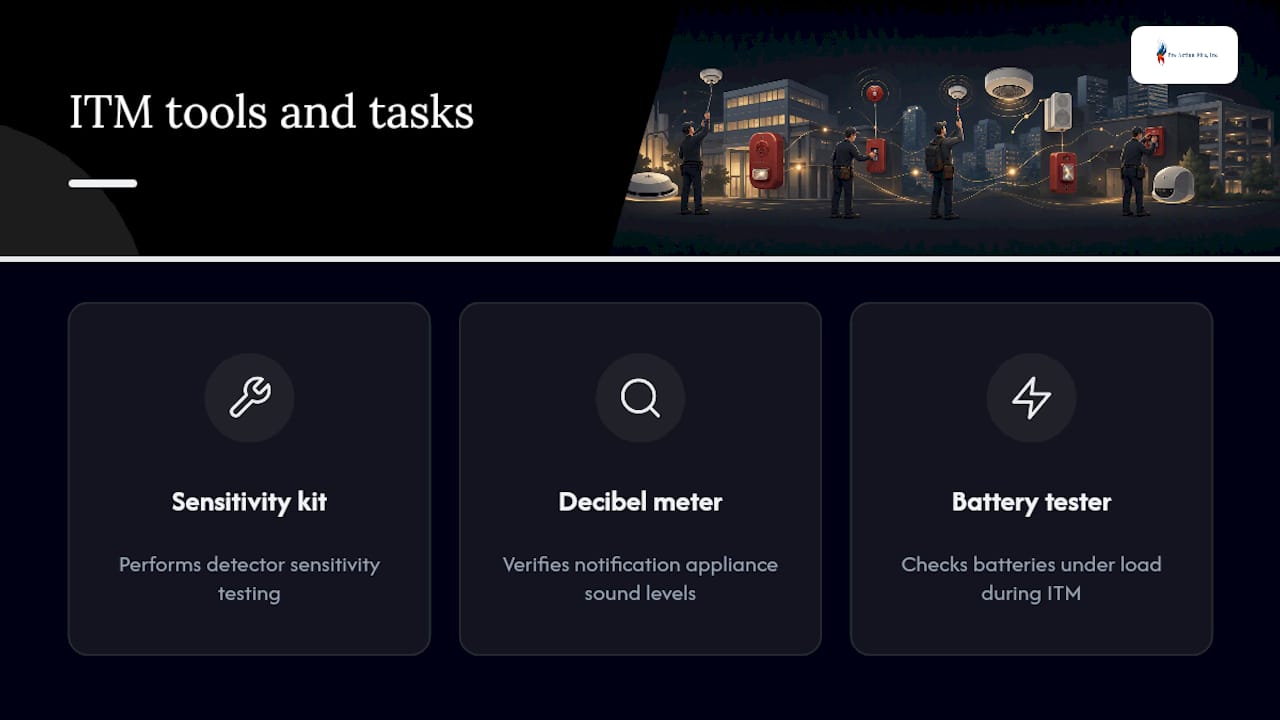
Field technicians carry NICET certification and the calibrated equipment required for the work: sensitivity test kits, decibel meters for notification appliance verification, and battery load testers. That combination matters more than any single credential, because a technician can be certified and still show up without the right tool for the job.
What clients receive at the end of a visit is a device-level test form, a Record of Completion, and, where something failed, a documented corrective-action plan with a follow-up date attached rather than a vague note to “monitor.”
Get Your Fire Alarm System AHJ-Ready
Preactionfire is the alternative to guessing whether last year’s inspection report will actually pass this year’s audit. If you’re a facilities manager juggling multiple buildings, sensitivity testing schedules, and battery replacement cycles across a portfolio, matching each device to its correct interval by hand is where most compliance gaps start.
Pre Action Fire’s services map directly onto the requirements covered here: annual inspection, testing, and maintenance; acceptance and reacceptance testing after installs or upgrades; sensitivity verification on the correct two-year cycle; and device-level reporting built for AHJ submission, not just internal filing. Technicians are NICET-certified and bring the calibrated equipment each test actually calls for, from sensitivity kits to load testers, so the report you get matches what an inspector expects to see. The company has served commercial and industrial properties across the Denver Metro area with fire alarm compliance work since 2009.
If your last inspection report left you guessing whether you’d pass an audit, schedule a fire alarm system assessment and get a device-by-device compliance check before your next renewal deadline arrives.
Sources
- NFPA 72 National Fire Alarm and Signaling Code (product / chapter overview)
- Fire alarm inspection requirements under NFPA 72 · Inspect Point
- Excerpt: Chapter 14 – Inspection, Testing, and Maintenance (table and reacceptance rules)
FAQ
What Are the Requirements for NFPA 72 Compliance?
Compliance means testing devices on the schedules set in Table 14.4.3.2, performing sensitivity testing on smoke detectors within one year of installation and on a periodic basis thereafter, using qualified personnel, and documenting every result under Chapter 7.
Is NFPA 72 Required by Law?
NFPA 72 itself is a consensus standard, but it becomes legally enforceable once a state or local jurisdiction adopts it into its fire code, which is why the specific edition in force depends on your local AHJ.
What Version of NFPA 72 Does California Use?
The adopted edition varies by California jurisdiction and updates over time as the state revises its fire code, so confirm the current edition directly with your local AHJ or fire marshal rather than assuming the newest national edition applies statewide.
Which Chapter of NFPA 72 Contains Requirements for Inspection and Testing?
Chapter 14 covers inspection, testing, and maintenance schedules and methods, while Chapter 7 sets the documentation and record retention requirements that go with them.