
A layered, three-tier strategy that meets NFPA 75 and NFPA 76, ties detection directly to HVAC interlocks, and combines pre-action sprinklers with targeted rack-level suppression is the baseline for fire protection for data centers in the United States. That is not a suggestion — it is what the standards require and what insurers and AHJs expect to see documented.
Here is what you should confirm or schedule today:
- Verify NFPA 75 coverage. Confirm your facility has a documented fire risk assessment on file. NFPA 75 requires one as the foundation for all protection decisions.
- Check pre-action valve logic. Confirm that pre-action piping is dry, that the valve is supervised, and that the control panel is programmed to the correct detection-plus-heat sequence.
- Test HVAC interlocks. Verify that your fire alarm system triggers HVAC shutdown or damper closure on alarm. Smoke spread through an active air-handling system is one of the fastest paths to widespread equipment corrosion.
- Confirm underfloor and ceiling detection. Both zones require automatic detection per NFPA 75/76. If either is missing, that is a code gap.
- Review rack-level protection. For high-value or high-density racks, confirm whether pre-engineered in-rack suppression is specified and whether it is still correctly positioned after any recent rack layout changes.
The core trade-off every facility manager faces is this: water-based systems protect life and building structure at lower cost but carry real equipment damage risk. Clean agents protect equipment with minimal residue but cost more to install, recharge, and maintain. The right answer for most large data halls is both, layered by zone and risk level, with three distinct protection levels working together rather than any single system carrying the full load.
Key Takeaways
A layered, NFPA 75/76-aligned strategy combining building, room, and rack protection is the required baseline for U.S. data center fire protection, and post-deployment change control is where most facilities lose compliance.
| Point | Details |
|---|---|
| Three-tier protection is required | Building, room, and rack protection must work together; no single system covers all data center fire scenarios. |
| NFPA 75 requires a documented risk assessment | The risk assessment is the foundation for all protection decisions and the document AHJs and insurers will request. |
| HVAC interlocks are high-impact | Tying detection to HVAC shutdown limits smoke spread and corrosion damage, often more than suppression alone. |
| Post-deployment changes break compliance | Containment retrofits, BESS additions, and HVAC retuning require fire protection review before implementation, not after. |
| Preactionfire for Denver-area data centers | NICET-certified technicians, NFPA-aligned commissioning, and 24/7 monitoring for commercial and industrial facilities. |
Table of Contents
- Why data center fire protection is different from standard commercial buildings
- Which U.S. codes and standards actually govern data center fire protection?
- What are the three levels of protection a data center needs?
- How do aspirating detectors and spot detectors compare for data centers?
- What suppression system is right for a data center?
- How does hot/cold aisle containment change your fire protection design?
- What does commissioning, testing, and monitoring actually require?
- How does fire risk management connect to insurance and business continuity?
- How do you choose a fire protection contractor for a data center?
- What do practitioners miss after a data center fire system goes live?
- A practitioner’s perspective on what AHJs actually inspect
- Preactionfire: local NFPA-aligned design and service for data centers
- Sources
Why data center fire protection is different from standard commercial buildings
Standard commercial fire protection is designed primarily around life safety. Data centers demand something more: protection for equipment worth millions of dollars, continuous uptime, and the kind of smoke and corrosion control that a standard wet-pipe sprinkler system simply does not provide.
The hazard profile is distinct. High electrical loads, dense cable bundles in trays and underfloor plenums, lithium-ion battery energy storage systems (BESS), and the constant high-velocity airflow of HVAC and containment systems all create fire pathways that a typical office building does not have. A small arc fault in a cable tray can smolder for hours before a standard spot detector responds. By then, smoke has traveled through the underfloor plenum and contaminated equipment far from the ignition point.
A UL white paper on NFPA 75 frames the business case with a striking number: the average total cost per data center downtime incident is high. That figure covers direct losses, recovery costs, and business impact — and it does not account for reputational damage or regulatory exposure.
Typical fire scenarios in a data hall include:
- Underfloor plenum ignition from cable insulation or power distribution units, where smoke spreads laterally before rising to ceiling detectors
- Cable tray fires that propagate horizontally across a room faster than vertical spread
- UPS or battery room events, including thermal runaway in lithium-ion systems, which produce intense heat and toxic gases that standard suppression may not control
- Containment bypass, where hot-aisle or cold-aisle enclosures channel smoke into areas that ceiling detectors cannot reach quickly
The combination of high asset value, continuous-operation requirements, and these specific hazard pathways is exactly why data center fire safety demands its own standards and its own design logic.
Which U.S. codes and standards actually govern data center fire protection?
NFPA is the primary framework, but it does not enforce itself. Local AHJs (Authorities Having Jurisdiction) determine which editions are adopted and whether local amendments apply. That distinction matters enormously in practice.
NFPA 75 is the core standard for fire protection of information technology equipment. It requires a documented fire risk assessment as the starting point, sets minimum detection and suppression requirements for IT equipment areas, and permits engineered alternatives when the risk assessment supports them and the AHJ accepts the documentation.
NFPA 76 covers telecommunications facilities — facilities providing telephone, data, and internet transmission to the public. If your data center serves as a carrier-class or colocation facility, NFPA 76 likely applies alongside or instead of NFPA 75. NFPA 76 places tighter requirements on detection sensitivity and HVAC monitoring because service continuity is the primary design objective.
The other standards you need to know:
- NFPA 13 governs sprinkler system design and installation. All sprinkler work in a data center, including pre-action systems, must comply with NFPA 13’s spacing, obstruction, and hydraulic requirements.
- NFPA 72 covers fire alarm and detection systems — panel programming, notification appliance placement, monitoring connections, and alarm verification sequences.
- NFPA 2001 sets requirements for clean agent fire suppression systems, including total-flooding design concentrations, agent quantities, and safety provisions for occupied spaces.
- NFPA 70 (the National Electrical Code) governs electrical installations, which directly affect ignition risk from wiring, UPS systems, and power distribution.
- NFPA 855 addresses stationary energy storage systems. Any lithium-ion BESS installation in or adjacent to a data hall triggers specific compartmentalization and suppression requirements under NFPA 855 that go well beyond standard IT room protection.
- IBC (International Building Code) sets construction type, occupancy classification, and egress requirements that interact with fire protection design at the building level.
Pro Tip: Submit your fire risk assessment and system design documents to the AHJ before finalizing specifications. Early submittal review catches conflicts between local code adoptions and your design assumptions before they become expensive change orders. Check the NFPA rules that apply to your facility and bring that documentation to your first AHJ meeting.
State and local adoption of NFPA editions varies. Some jurisdictions are one or two editions behind the current NFPA cycle. Never assume the current published edition is the enforced edition in your jurisdiction without confirming with the AHJ directly.
What are the three levels of protection a data center needs?
Building, room, and rack protection are not interchangeable. Each addresses a different threat, operates at a different scale, and carries different cost and maintenance implications. The three levels work as a system — removing any one of them creates a gap the others cannot fully cover.
Building-level protection
Building-level protection is primarily about life safety and structural integrity. It includes fire-rated construction (walls, floors, ceilings), passive fire protection at penetrations, building-wide wet-pipe or pre-action sprinklers in non-IT spaces, and means of egress. Compartmentation between the data hall and adjacent spaces — mechanical rooms, battery rooms, office areas — limits fire spread and buys time for suppression and evacuation. Compartmentation examples show how rated assemblies and fire doors work together to contain a fire to its zone of origin.
Room-level protection
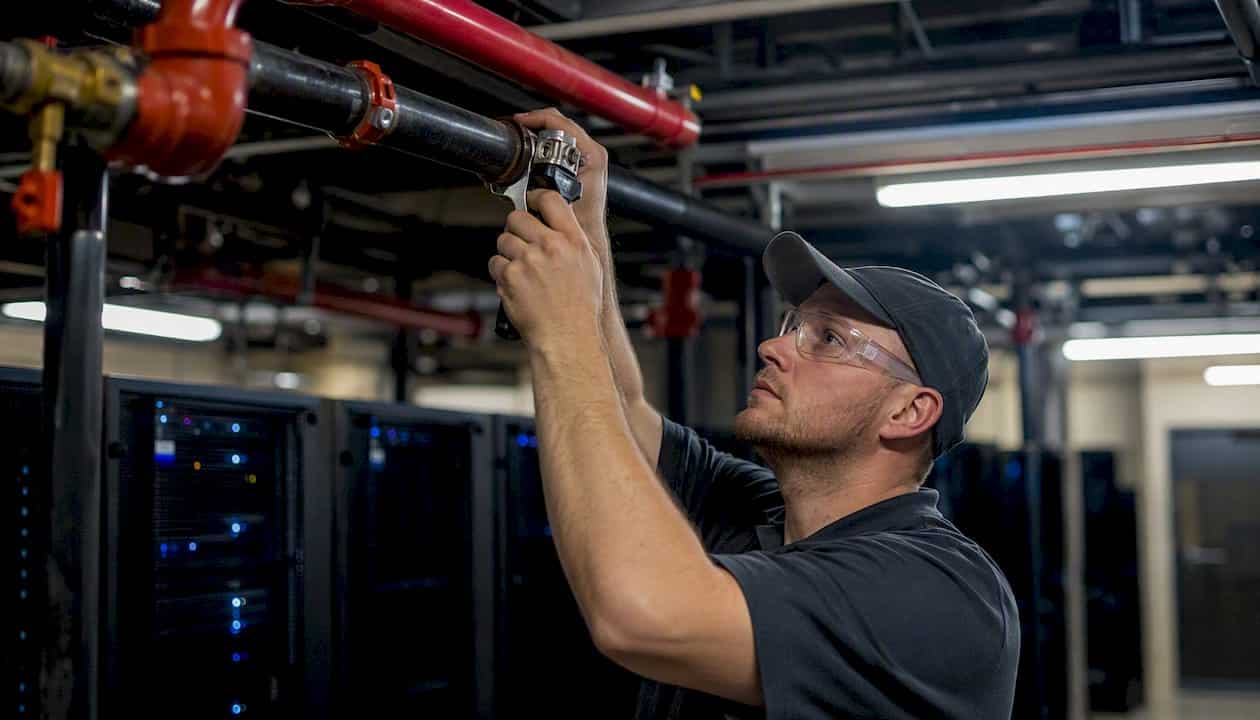
Room-level systems are where data-center-specific design begins. Pre-action sprinkler systems are the most common choice for large data halls: piping stays dry until both a detection signal and individual sprinkler head activation occur, which dramatically reduces the risk of accidental water discharge. Gaseous total-flooding systems (clean agents) are used in smaller, enclosed server rooms or high-value equipment rooms where water damage is unacceptable. Detection at both ceiling level and below raised floors is required by NFPA 75/76, and the detection system must interface with suppression controls and HVAC dampers.
Rack-level protection
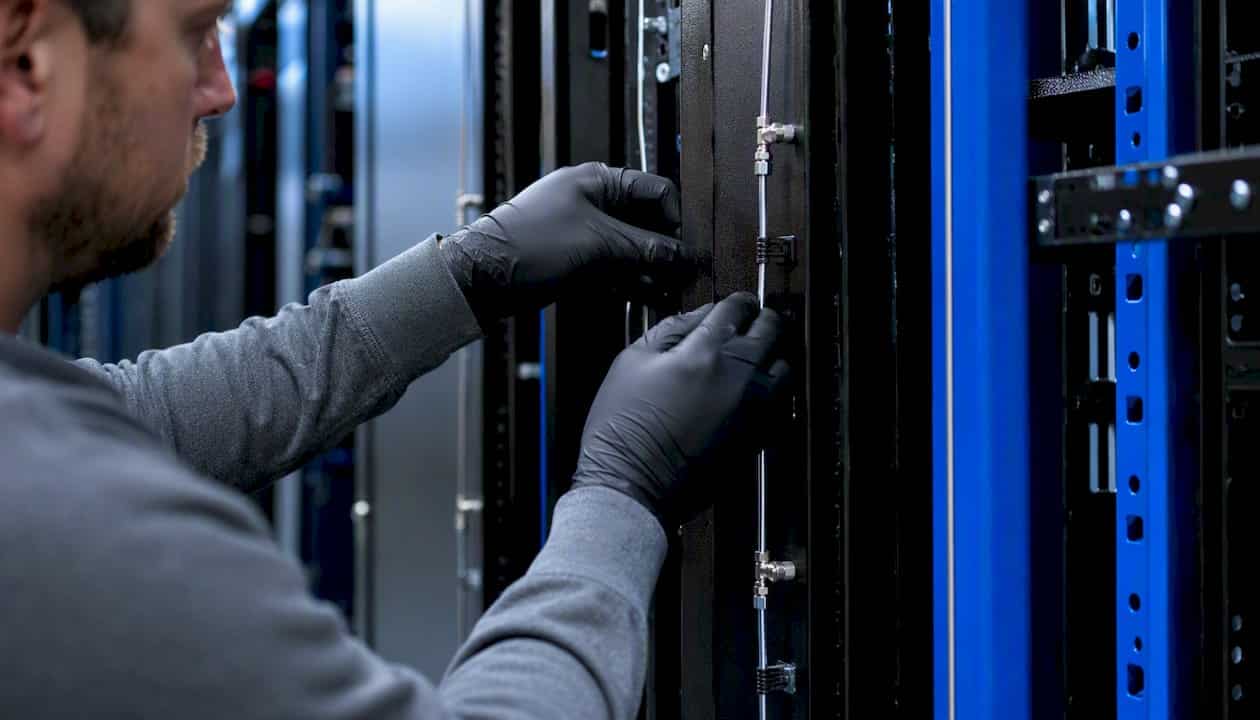
Rack-level protection is the most targeted layer. Pre-engineered in-rack suppression systems use small-diameter tubing routed through the rack to deliver a clean agent directly at the heat source, limiting activation to a single rack rather than flooding an entire room. This layer is most appropriate for high-value or high-density racks, single-tenant pods, or situations where a room-level flooding event would cause disproportionate downtime. Detection tubing in these systems also functions as a linear heat detector, giving an early-warning signal before a full suppression event.
| Protection level | Best for | Damage profile | CAPEX vs. OPEX | Maintenance burden | Detection sensitivity | Containment suitability |
|---|---|---|---|---|---|---|
| Building (wet-pipe sprinkler) | Life safety, structural protection | High water damage to equipment | Low CAPEX, low OPEX | Periodic inspections per NFPA requirements | Low (heat-activated heads) | Not suitable inside containment |
| Room (pre-action sprinkler) | Large data halls, equipment protection | Reduced water risk vs. wet-pipe | Moderate CAPEX, low OPEX | Annual NFPA 25 + valve tests | Moderate (requires detection signal) | Requires adjusted head placement |
| Room (clean agent total-flood) | Enclosed server rooms, high-value equipment | Minimal, no water | High CAPEX, moderate OPEX (recharge) | Annual agent weight checks, NFPA 2001 | High (detection-triggered) | Well-suited to enclosed rooms |
| Rack (pre-engineered in-rack) | High-value racks, single-tenant pods | Minimal, localized agent | High per-rack CAPEX | Periodic tubing inspection, agent checks | Very high (linear heat detection) | Designed for containment environments |
How do aspirating detectors and spot detectors compare for data centers?
Detection is where most data center fire events are won or lost. A suppression system that activates after a fire has spread through a cable tray is not protecting your equipment — it is cleaning up after a failure.
Aspirating smoke detection (ASD), often called VESDA (Very Early Smoke Detection Apparatus), actively draws air samples through a network of pipes to a central detector. It can identify combustion products at concentrations far below what a standard spot detector can sense. In a data hall with high airflow, where dilution constantly reduces smoke concentration at the ceiling, ASD gives you the early-warning window you need to investigate and escalate before triggering suppression. NFPA 75 (2024) recognizes ASD as appropriate for IT equipment areas, and the standard specifies detection requirements for both ceiling and underfloor zones.
Standard spot-type smoke detectors are appropriate for lower-risk areas, corridors, and spaces adjacent to the data hall. They are less expensive and simpler to maintain, but their response time in high-airflow environments is slower. In a hot-aisle/cold-aisle containment setup, a ceiling-mounted spot detector may never see meaningful smoke concentration until a fire is well-established.
Placement guidance:
- Ceiling detectors: required by NFPA 75/76, spaced per NFPA 72 with attention to airflow patterns from CRAC/CRAH units
- Underfloor detectors: required in raised-floor environments; ASD sampling pipes routed under the floor provide the best coverage
- In-containment: detectors or ASD sampling points inside hot-aisle enclosures catch fires that containment would otherwise mask from ceiling coverage
- Cable trays: linear heat detection or ASD sampling near high-density cable runs catches smoldering insulation early
- BESS rooms: dedicated detection per NFPA 855, separate from the main data hall system
Interlocking detection with HVAC is one of the highest-impact steps in any data center fire protection design. When the fire alarm activates, HVAC systems should reduce airflow or shut down, and smoke dampers should close to prevent smoke from migrating through ductwork to unaffected zones. The corrosion damage from smoke traveling through an active air-handling system often exceeds the direct fire damage.
Pro Tip: Set ASD sensitivity thresholds in stages: an alert level that triggers investigation, an action level that initiates HVAC interlock, and an alarm level that triggers suppression. This escalation sequence reduces false-alarm suppression events while preserving early-warning capability. Review and recalibrate thresholds after any major HVAC rebalancing or containment change.
What suppression system is right for a data center?
No single suppression technology is right for every zone in a data center. The practical answer for most facilities is a combination: pre-action sprinklers for the main data hall, clean agents for enclosed high-value rooms, and pre-engineered rack-level systems for the highest-density or highest-value racks.
Pre-action sprinkler systems
Pre-action systems keep piping dry under normal conditions. Water enters the piping only after a detection signal opens the pre-action valve, and individual sprinkler heads still require heat activation before discharging. That two-step sequence is why pre-action systems are the standard choice for large data halls: the risk of accidental water discharge is dramatically lower than with a wet-pipe system. Pre-action sprinkler installation requires careful valve programming and regular testing to confirm the detection-to-discharge sequence works as designed. The trade-off is higher installation complexity and more rigorous maintenance compared to wet-pipe.
Low-pressure water mist systems
Water mist systems use fine droplets at low pressure to suppress fire with significantly less water than a conventional sprinkler. The smaller water volume reduces equipment damage and cleanup time. Mist systems are gaining traction in data centers where water damage risk is a primary concern but clean agents are not practical at scale. They require specialized nozzles, dedicated pump sets, and careful hydraulic design — and they are not a drop-in replacement for a standard sprinkler layout.
Gaseous clean agents
Clean agents — primarily Novec 1230 (FK-5-1-12) and HFC-227ea (FM-200) — suppress fire by total-flooding an enclosed space with agent at a design concentration that interrupts combustion. No water, no residue, minimal equipment impact. That profile makes them the preferred choice for enclosed server rooms, tape libraries, and UPS rooms.
The trade-offs are real. Clean agents are expensive to install and to recharge after a discharge event. HFC-227ea carries a high global warming potential (GWP), which is driving regulatory pressure in some states and pushing many facilities toward Novec 1230 or inert gas alternatives. Both agents require the protected enclosure to be sealed to maintain design concentration for the required hold time — any unsealed penetration compromises the system. Occupied-space safety provisions under NFPA 2001 must be addressed, including pre-discharge alarms and abort switches.
Pro Tip: Combine pre-action sprinklers for hall-level protection with rack-level clean agent or pre-engineered suppression for your highest-value racks. This layered approach gives you cost-effective coverage across the hall while limiting equipment damage risk at the racks that matter most. See suppression system options for implementation considerations.
| Suppression type | Best for | CAPEX vs. OPEX | Damage/cleanup profile | Maintenance/regulatory burden | Response time | Containment suitability |
|---|---|---|---|---|---|---|
| Pre-action sprinkler | Large data halls | Moderate CAPEX, low OPEX | Water damage possible; lower risk than wet-pipe | Periodic inspections per NFPA requirements, valve tests | Moderate (detection + heat) | Requires adjusted head layout |
| Low-pressure water mist | Mid-size rooms, water-sensitive areas | High CAPEX, moderate OPEX | Less water than sprinkler; some equipment risk | Specialized nozzle/pump maintenance | Moderate to fast | Limited; nozzle placement critical |
| Clean agent (Novec 1230 / FM-200) | Enclosed server rooms, UPS rooms | High CAPEX, high OPEX (recharge) | Minimal; no water or residue | Annual agent weight/pressure checks; GWP regulations for FM-200 | Fast (detection-triggered) | Requires sealed enclosure |
| Pre-engineered in-rack | High-value racks, single-tenant pods | High per-rack CAPEX | Minimal, localized | Periodic tubing and agent checks | Very fast (linear heat) | Designed for containment |
How does hot/cold aisle containment change your fire protection design?
Containment is one of the most common sources of compliance problems in data center fire protection. Facilities add or modify containment after the original fire protection design is complete, and nobody updates the sprinkler layout or detector placement to match.
The core problem: containment enclosures obstruct ceiling-mounted sprinkler spray patterns. A standard sprinkler head designed to cover a 12-by-12-foot area on an open ceiling may cover almost nothing useful when a solid containment roof sits two feet below it. Containment materials must be noncombustible or explicitly approved by the AHJ, and the sprinkler layout must be redesigned to account for the obstruction — typically by adding sprinkler heads inside the containment or repositioning existing heads.
Common design mistakes and how to avoid them:
- Blocked sprinkler deflectors: Containment panels, cable trays, or equipment installed after the sprinkler layout was finalized can block deflector patterns. Conduct a post-installation obstruction survey before commissioning.
- Unsealed penetrations: Cable penetrations through fire-rated walls and floors must be sealed with listed firestop materials. Unsealed penetrations allow fire and smoke to bypass compartmentation. This is one of the most frequently cited deficiencies in AHJ inspections.
- Improperly located HVAC intakes/exhausts: HVAC return air intakes near potential ignition sources can pull smoke into the air-handling system before detection triggers a shutdown. Review intake locations against your fire risk assessment.
- Detector placement inside containment: Hot-aisle enclosures trap heat and smoke. If detectors are only at the ceiling outside containment, a fire inside the enclosure may not be detected until it has grown significantly. Add detection sampling points or spot detectors inside containment.
Containment retrofits are the single most common trigger for fire protection non-compliance in operating data centers. A facility that was fully compliant at commissioning can fall out of compliance within months if containment changes are not run through a formal change-control process that includes fire protection review.
Pro Tip: Treat every containment modification as a trigger for a fire protection design review. Before any new row of containment goes in, have your fire protection contractor confirm that sprinkler coverage, detector placement, and HVAC interlock logic still meet NFPA 75/76 requirements for the modified layout. This is also the moment to confirm that new construction fire protection requirements are being applied to the retrofit scope.
What does commissioning, testing, and monitoring actually require?
A fire protection system that has never been fully tested is not a fire protection system — it is a collection of components that might work. Commissioning is where you find out, and it needs to happen before the facility goes live, not after.
Commissioning checklist
Before accepting any fire protection system in a data center, witness or document the following:
- Pre-action valve logic test: Confirm the valve opens on the correct detection signal and closes on reset. Test both the primary and backup detection circuits.
- Control panel programming verification: Walk through every zone, every alarm point, and every supervisory signal with the contractor. Confirm that panel outputs match the design drawings.
- Detection sensitivity check: For ASD systems, verify that sensitivity thresholds are set per the design specification and that the system responds within the required time at each sensitivity level.
- Alarm-to-AHJ relay test: Confirm that alarm signals transmit correctly to the central monitoring station and that the AHJ receives the required notifications.
- HVAC interlock test: Trigger a test alarm and physically verify that HVAC units shut down or reduce airflow and that smoke dampers close as designed.
- Underfloor detection test: Introduce a test aerosol below the raised floor and confirm detection response time.
- Notification appliance coverage: Walk the facility during an alarm test and confirm that audible and visual devices are perceptible in all required areas.
Maintenance schedule highlights
| System | Monthly | Quarterly | Annual |
|---|---|---|---|
| Pre-action sprinkler | Visual inspection of valve supervisory signals | Partial flow test of pre-action valve | Full NFPA inspection, trip test, internal pipe inspection per schedule |
| Clean agent system | Visual check of cylinder pressure/weight gauges | Inspect nozzles and enclosure integrity | Agent weight/quantity verification, enclosure integrity test, NFPA 2001 inspection |
| ASD / aspirating detection | Check airflow indicators on sampling unit | Clean sampling pipe filters | Full sensitivity calibration, pipe integrity check |
| Spot smoke detectors | None required | Functional test of a sample | Full test of all devices per NFPA 72 |
| BESS room detection | Visual check of detector indicators | Functional test | Full NFPA 72 inspection plus NFPA 855 system review |
Monitoring and impairment procedures
24/7 central station monitoring is not optional for a data center. Every alarm, supervisory signal, and trouble condition should transmit to a UL-listed central station that can notify the fire department and your on-call team simultaneously. When any part of the fire protection system is taken out of service for maintenance or repair, a documented impairment procedure must be in place: notify the AHJ and insurance carrier, implement a fire watch for the impaired area, and restore the system as quickly as possible.
Credentials to require
- NICET-certified technicians for fire alarm and suppression system work. NICET (National Institute for Certification in Engineering Technologies) certification levels indicate demonstrated competency — require Level II minimum for technicians, Level III or IV for lead engineers on complex systems.
- UL or FM-listed equipment for all system components. Listed equipment has been independently tested to the applicable product standard.
- Documented NFPA experience specific to data centers — not just commercial buildings generally.
How does fire risk management connect to insurance and business continuity?
A documented fire risk assessment is not just a compliance checkbox. It is the document that justifies your protection choices to the AHJ, your insurer, and your leadership team — and it is the baseline against which every future change to the facility is measured.
NFPA 75 requires the risk assessment as the foundation for protection decisions. It should address:
- Occupancy and use of each space (IT equipment areas, battery rooms, mechanical spaces)
- Ignition sources and fuel loads (cable types, UPS systems, BESS installations)
- Detection and suppression coverage for each zone
- Consequences of fire in each zone (downtime, equipment loss, data loss, life safety)
- Engineered alternatives being proposed and the basis for AHJ acceptance
From an insurance standpoint, NFPA compliance is often a condition of coverage, not just a best practice. Insurers review your risk assessment, commissioning documentation, and inspection records when underwriting a data center. A facility with documented NFPA 75/76 compliance and a clean inspection history will typically face lower premiums and fewer coverage exclusions than one without. When BESS systems are involved, NFPA 855 compliance is increasingly a specific underwriting requirement, and non-compliance can trigger higher premiums or coverage denial.
Business-continuity planning for a fire event should address three phases:
- Pre-incident: Segmentation of critical systems into separate fire compartments, redundant power paths routed through separate fire zones, and documented recovery procedures for each fire scenario.
- Mitigation: Suppression system response, HVAC interlock activation, and evacuation procedures — all tested and documented before an incident occurs.
- Recovery: Equipment swap timelines, data recovery procedures, vendor SLAs for replacement equipment, and communication protocols for customers and regulators.
The nearly $700,000 average downtime cost cited in the UL white paper is a useful framing number for leadership conversations about protection investment. The actual cost for a large colocation facility can be substantially higher when contractual penalties and customer churn are included.
How do you choose a fire protection contractor for a data center?
The wrong contractor for a data center is not just a quality problem — it is a compliance and liability problem. A contractor who has never commissioned a pre-action system in a containment environment will not know what they do not know, and you will find out during an AHJ inspection or, worse, during an actual event.
Required credentials
- NICET-certified technicians (Level II minimum; Level III or IV for system design and commissioning lead)
- UL or FM-listed equipment on all specified components
- Documented NFPA 75/76 project experience — ask for specific project references, not general data center experience
- Adequate insurance limits for the scope of work, including errors and omissions coverage
- Demonstrated familiarity with your local AHJ and their current code adoption
Questions to ask during bid evaluation
- What pre-action systems have you commissioned in active data centers, and can you provide references from those facilities?
- How do you handle HVAC interlock testing, and who coordinates with the building controls contractor?
- What is your commissioning documentation package, and does it include witnessed test results for every acceptance test item?
- How do you manage suppression system impairments during maintenance, and what compensating measures do you provide?
- What is your spare-parts strategy for pre-action valves and clean agent cylinders, and what is your response SLA for system impairments?
Red flags
- No documented commissioning procedure or inability to describe their acceptance test protocol
- No experience with containment environments or HVAC interlock coordination
- Vague answers about impairment procedures (“we’ll put up a sign”)
- Equipment that is not UL or FM-listed
- Inability to name the current NFPA 75 edition adopted by your local AHJ
Contract terms to insist on
- Explicit scope for commissioning and acceptance testing, with witnessed tests and written results
- Defined outage windows for system work and required compensating measures during impairments
- Response SLAs for suppression system impairments (typically two to four hours for a data center)
- Warranty terms for all installed work, including labor and parts
- Requirement for as-built drawings and a complete O&M manual at project closeout
A fire system design and compliance partner with AHJ familiarity and documented data center experience is worth more than the lowest bid. The commissioning phase alone will reveal whether the contractor actually knows the system they installed.
What do practitioners miss after a data center fire system goes live?
Installation and commissioning get the attention. The operational phase is where compliance quietly erodes.
Risk engineers consistently identify post-deployment operations — maintenance gaps, containment changes, HVAC retuning, and battery retrofits — as the most frequent cause of compliance drift and real incidents. The system that passed commissioning two years ago may not meet NFPA 75/76 today if the facility has changed around it.
Three patterns show up repeatedly in post-deployment audits:
- Containment retrofits that blocked sprinklers. A new row of hot-aisle containment was added without a fire protection review. The ceiling sprinklers above it now discharge into the containment roof instead of the floor below. The system is technically operational but functionally compromised.
- Battery additions without NFPA 855 treatment. A UPS upgrade added lithium-ion batteries to a room that was originally designed for VRLA (valve-regulated lead-acid) batteries. The fire risk profile changed substantially, but the suppression system was not updated and no NFPA 855 assessment was performed.
- Impaired suppression during maintenance with no fire watch. A clean agent cylinder was removed for recharging, and the system was left in impairment for three days with no documented fire watch and no AHJ notification.
The most dangerous assumption in data center fire protection is that a system that passed commissioning will remain compliant through operational changes. Every rack layout change, every containment modification, and every BESS addition is a potential compliance event that needs a fire protection review before it happens, not after.
Pro Tip: Build a post-deployment verification program into your change-control process. Any change to rack layout, containment configuration, HVAC settings, or energy storage systems should trigger a fire protection review before implementation. Schedule a full NFPA 75/76 compliance audit annually, tied to your insurance renewal cycle. 24/7 monitoring gives you real-time visibility into system status, but it does not substitute for periodic physical inspection of detector placement, sprinkler coverage, and penetration seals.
A practitioner’s perspective on what AHJs actually inspect
The gap between a compliant design and a compliant installation is wider than most facility managers expect. AHJ inspectors are not reviewing your drawings — they are walking the floor, looking at what was actually built.
The items that generate the most field corrections in data center fire protection inspections are not exotic. Unsealed cable penetrations through fire-rated walls are the most common single deficiency. Sprinkler heads with missing or incorrect escutcheons, detectors installed in the wrong orientation, and pre-action valve rooms without proper signage are close behind. None of these are design failures — they are installation and coordination failures that a thorough commissioning process would catch.
Commissioning coordination with IT and operations is the other area where projects consistently run into trouble. The best time to run a full HVAC interlock test is not during peak business hours. Staging acceptance tests in phases — detection and alarm first, then suppression interlocks, then full system integration — lets you identify and fix issues without taking the entire facility offline at once. Parallel alarm testing, where the suppression system is placed in test mode while the alarm system is fully live, is a standard technique that most experienced contractors know but that first-time data center clients rarely think to request.
One practical note on AHJ submittals: submit early and submit complete. An incomplete submittal that comes back with 20 comments delays your project by weeks. A complete submittal with a documented fire risk assessment, system design drawings, equipment cut sheets showing UL/FM listings, and a commissioning plan gets reviewed faster and generates fewer comments. The AHJ is not your adversary — they are reviewing the same standards you are working from, and a well-documented submittal signals that you know what you are doing.
Preactionfire: local NFPA-aligned design and service for data centers
Data center fire protection done right requires a contractor who understands both the standards and the operational realities of a live facility. Pre Action Fire has served commercial and industrial clients in the Denver Metro Area since 2009, with NICET-certified technicians, UL/FM-listed equipment, and documented NFPA-aligned processes across fire alarm design, pre-action sprinkler installation, clean agent suppression, and ongoing inspection and monitoring services.
For data center clients specifically, Preactionfire provides design and installation of pre-action sprinkler systems, fire alarm system design and compliance with NFPA 72 and NFPA 75, commissioning with full witnessed test documentation, and 24/7 central station monitoring. Every project includes documented commissioning results and NFPA conformity statements — the paperwork your AHJ and insurer will ask for. Local AHJ familiarity means submittals go in complete and corrections come back fewer.
Request a consultation and ask specifically for commissioning documentation samples and NFPA 75 conformity statements. That request alone will tell you whether a contractor is ready for a data center project. Contact Preactionfire to schedule a fire safety inspection or design consultation for your facility.
Sources
These are the primary documents to read, share with your AHJ, and reference in your fire risk assessment:
- Swiss Re — Risk engineering services: data centres factsheet
- NFPA — NFPA 75 standard development
- UL white paper — NFPA 75 and fire protection and suppression in data centers
- TechTarget — Use NFPA data center standards to help evade fire risks
- Uptime Institute — Network Advisory: Fire risk management
For code interpretation questions, use the NFPA’s online standards development pages and consult your AHJ directly. The enforced edition and any local amendments are the AHJ’s determination, not NFPA’s.