
Budget $10 to $50 per unit for an annual inspection, $40 to $150 or more for a recharge depending on the extinguishing agent, and $30 to $200 for hydrostatic testing when a unit reaches that interval. Six-year internal maintenance runs another $40 to $150 per unit, often paired with a recharge. That’s the range most Denver-area property managers land in once a vendor’s trip fee and any corrective repairs get added to the invoice.
Every quote you receive is really three separate charges stacked together: a flat service call or trip fee, a per-unit inspection charge, and corrective work priced as a line item when something fails. Ask any vendor to break the bid down this way before you sign anything.
- Annual inspection: $10 to $50 per unit, per industry pricing data
- Recharge: $40 to $150+ depending on agent type
- 6-year internal maintenance: $40 to $150 per unit
- Hydrostatic testing: $30 to $200 depending on cylinder type and size
Pro Tip: Before you accept a quote, ask the vendor to cite the specific NFPA 10 interval driving each charge. If they can’t tell you why a unit needs hydrostatic testing this year, they’re guessing at your bill, not calculating it.
Key Takeaways
Fire extinguisher service cost depends on three stacked charges, service call, per-unit inspection, and corrective work, and understanding that structure is what lets you compare quotes accurately.
| Point | Details |
|---|---|
| Know the three price layers | Every quote combines a trip fee, per-unit inspection cost, and separately priced corrective work. |
| Budget by service type | Annual inspections run $10 to $50 per unit; recharges and hydrostatic testing vary widely by agent and cylinder size. |
| Watch for volume discounts | Fleets of 10 or more units typically see lower per-unit inspection rates than small accounts. |
| Compare repair versus replacement | When hydrostatic testing plus recharge nears the cost of a new unit, replacement is usually the better value. |
| Work with certified providers | Preactionfire’s NICET-certified technicians document to NFPA 10 standards for Denver metro commercial properties. |
Table of Contents
- How Much Does Fire Extinguisher Service Cost Per Visit?
- What Are the Typical Cost Ranges by Service Type?
- What Drives Fire Extinguisher Service Pricing Up or Down?
- How Much Should Small vs. Large Buildings Budget Annually?
- How Do You Compare Fire Extinguisher Service Quotes?
- What Local Experience Adds to Fire Extinguisher Servicing
- Where to Verify Fire Extinguisher Service Requirements
- Get a Clear, Itemized Fire Extinguisher Service Quote
- Frequently Asked Questions About Fire Extinguisher Service Cost
- Sources
How Much Does Fire Extinguisher Service Cost Per Visit?
The vendor’s flat service call typically runs $50 to $150 regardless of how many units you have, according to small-business cost guides that track visit-level pricing. On top of that, you pay a per-unit inspection fee of $10 to $50 depending on extinguisher type and local labor rates. Anything beyond a standard inspection, a failed gauge, a corroded valve, a hose that needs replacing, gets priced separately as corrective work.
This structure exists because technicians spend a fixed amount of time driving to your site and setting up regardless of unit count, then a variable amount of time per extinguisher. That’s why providers push for minimum order sizes. A single-unit call at a strip mall office might cost you $150 total once the trip fee and inspection are combined, while a 20-unit warehouse spreads that same trip fee across far more units and brings the effective per-unit cost down sharply.
A few things worth knowing before you request bids:
- Minimums exist because a technician driving 40 minutes for one $15 inspection loses money for the company.
- Bundling several properties under one contract, or scheduling multiple building visits on the same day, often gets the trip fee waived or reduced.
- Corrective work (parts, recharges triggered by a failed inspection) is never included in the base inspection price, no matter how the initial quote reads.
Always request an itemized quote that separates the service call, lists per-unit inspection cost, and shows a rate sheet for common corrective items. A one-line “annual service: $450” quote tells you nothing about whether you’re being overcharged for 10 units or fairly priced for 30.
What Are the Typical Cost Ranges by Service Type?
Pricing splits cleanly by service category, and knowing where your extinguishers fall on this list tells you what to expect before the technician even shows up.
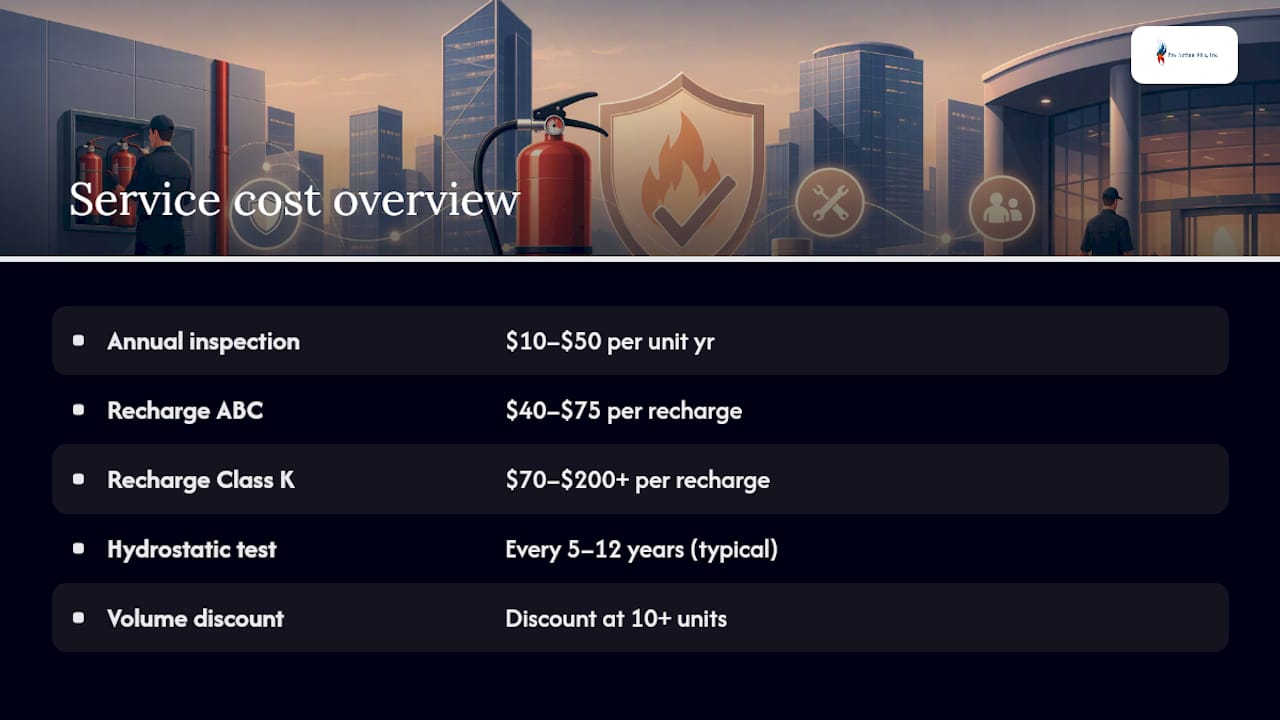
Annual inspection costs $10 to $50 per unit, with volume discounts kicking in for larger fleets. A building with 10 or more extinguishers commonly sees a lower per-unit rate than one with three, since providers offer tiered pricing to win larger accounts.
Recharge pricing varies significantly by agent:
- ABC dry chemical: $40 to $75
- CO2 extinguishers: $50 to $100
- Class K (commercial kitchens): $70 to $120
- Halotron and other clean agents: $100 to $200+
Six-year internal maintenance involves labor-intensive evaluation and servicing, incurring moderate per-unit costs. If wear is found internally, a recharge cost may be added.
Hydrostatic testing costs vary widely depending on extinguisher type and cylinder size, with smaller units generally costing less and larger or specialty cylinders costing more. NFPA 10 sets testing intervals anywhere from five to twelve years depending on the extinguisher type, so this isn’t an annual charge for most units, but it’s a real budget line when the interval hits.
Parts and minor repairs add up fast even though each item looks cheap:
- Gauge replacement: $15 to $30
- Hose replacement: $20 to $50
- Valve assembly: often the highest single-part cost, priced case by case
- Inspection tags: low cost individually, but a building with 40 units replacing tags annually notices it
What Drives Fire Extinguisher Service Pricing Up or Down?
Several variables push your total bill higher, and a few warning signs on a quote should make you ask harder questions before signing.
- Extinguisher type and agent. Clean agents and Class K units cost more to service than standard ABC dry chemical because the agent itself is more expensive and often requires specialized handling.
- Accessibility. Units mounted on mezzanines, in mechanical rooms, or behind stored inventory take longer to service, and technicians bill for that time.
- Building layout and travel time. A single-building account near a technician’s home base costs less to service than a portfolio spread across multiple zip codes.
- Local labor rates. Denver metro pricing reflects regional wage and overhead costs, which is why national “average” figures only get you so far.
- Service frequency and urgency. Same-day or emergency calls after a failed inspection or a discharged unit cost more than scheduled routine visits.
- Technician qualifications. Work performed by NICET-certified technicians who document to your authority having jurisdiction (AHJ) standards costs slightly more upfront but protects you during an insurance claim or fire marshal audit.
Watch for these red flags on any bid: no line-item breakdown between inspection and corrective work, vague language like “parts extra” with no rate sheet attached, zero reference to NFPA 10 anywhere in the proposal, and no proof of insurance or technician certification offered when asked. A vendor unwilling to show you a sample inspection tag or explain their documentation process is telling you something about how they’ll handle your compliance records later.
How Much Should Small vs. Large Buildings Budget Annually?
Real numbers help more than abstract ranges, so here’s how the math plays out across three common commercial scenarios.
- Small office (3 units). A $75 to $100 trip fee plus $15 to $30 per unit for inspection lands most small offices between $120 and $190 annually, assuming no corrective work. Every sixth year, add $40 to $150 per unit for internal maintenance.
- Restaurant with Class K and ABC units (6 units total). Higher recharge costs for the Class K units and more frequent inspection needs (kitchens see more wear on gauges and hoses) typically push annual totals to $300 to $500, before any hydrostatic testing years.
- Warehouse (15 units). Volume discounts usually bring the per-unit inspection rate down toward the $10 to $20 range, and many providers offer multi-year contract pricing at this scale. Annual totals commonly fall between $400 and $700, though a heavy maintenance year with several units hitting their six-year or hydrostatic interval can push that higher.
| Scenario | Unit Count | Typical Annual Cost Range |
|---|---|---|
| Small office | 3 | $120 to $190 |
| Restaurant (Class K + ABC) | 6 | $300 to $500 |
| Warehouse | 15 | $400 to $700 |
When a single older unit’s combined hydrostatic test and recharge cost approaches what a new extinguisher of the same class costs, replacement is usually the smarter move. This math shows up most often with small CO2 units and older dry chemical extinguishers that have already been through a few service cycles. Our fire equipment lifecycle guide walks through that decision point in more detail.
How Do You Compare Fire Extinguisher Service Quotes?
Before you sign with any provider, require these items in writing: an itemized trip fee, a per-unit inspection charge, a published parts and corrective-work price list, hydrostatic testing and recharge rates by extinguisher type, and a clear description of how records get documented and tagged for your AHJ and insurance carrier.
Service contracts offer predictable annual budgeting and often bundle in minor repairs at no extra charge, which helps if your building has an older fleet prone to gauge or hose issues. The trade-off is a multi-year commitment, and some contracts lock in pricing that doesn’t reflect your actual usage if your extinguisher count changes. One-off visits give you more flexibility but less price certainty year to year.
Before hiring anyone, verify their technicians hold current NICET certification, confirm they carry liability insurance, check that they’re licensed to work in your municipality, and ask for two or three references from similar commercial properties. A reputable provider should show you a sample inspection tag and explain exactly how they’ll format your service records before you ever sign a contract.
Pro Tip: Ask a prospective vendor how they document deficiencies found during inspection. If the answer is “we just fix it,” you have no paper trail if your insurer or fire marshal ever asks what was wrong and when it got corrected.
What Local Experience Adds to Fire Extinguisher Servicing
Preactionfire has served the Denver metro area since 2009, and that history matters more than it might seem when you’re comparing quotes in your broader commercial maintenance plan. A technician who’s worked the same buildings across multiple service cycles knows which extinguisher types in your facility tend to fail early, which corrective costs are predictable, and which ones signal it’s time to replace rather than repair.
NICET-certified technicians performing your inspections means the documentation behind every service visit holds up under an insurance audit or fire marshal review, not just a checkbox on a tag. That certification, paired with NFPA-compliant recordkeeping, is often the difference between a smooth annual review and a scramble to prove compliance after the fact.
Where to Verify Fire Extinguisher Service Requirements
Always confirm requirements with your local AHJ and keep dated service records on file.
Get a Clear, Itemized Fire Extinguisher Service Quote
Pre Action Fire gives Denver metro property managers something most quotes skip: a line-item breakdown showing your trip fee, per-unit inspection cost, and any corrective work separately, so you know exactly what you’re paying for before a technician sets foot on-site.
That transparency matters more once you’ve read through the price ranges above. A vendor who won’t itemize is asking you to trust a number instead of understanding it. Preactionfire’s NICET-certified technicians document every inspection to NFPA 10 standards, which means your records hold up whether it’s your insurance carrier or the local fire marshal asking questions. Whether you’re managing a single office building or a portfolio of warehouses across the Denver metro, the same documentation and pricing clarity applies. If your extinguishers are also part of a larger fire alarm or sprinkler system, it’s worth reviewing your building’s overall fire alarm compliance at the same time. Request an itemized inspection quote for your Westminster or Arvada property and get a straight answer on what your building actually needs this service cycle.
Frequently Asked Questions About Fire Extinguisher Service Cost
How much does fire extinguisher service cost per unit annually?
Most commercial buildings pay $10 to $50 per unit for a standard annual inspection, with the exact rate depending on extinguisher type, accessibility, and how many units are serviced in the same visit.
What’s included in a typical fire extinguisher inspection cost?
A standard inspection checks pressure gauge readings, physical condition, accessibility, and mounting, then confirms the unit meets NFPA 10 requirements. Recharges, part replacements, and hydrostatic testing are billed separately as corrective work.
Why do fire extinguisher recharge costs vary so much?
Recharge pricing depends on the extinguishing agent. ABC dry chemical typically costs $40 to $75, while Class K and clean-agent units can run $70 to $200 or more because the replacement agent itself costs more.
Is it cheaper to repair or replace an old fire extinguisher?
Once combined hydrostatic testing and recharge costs approach the price of a new unit of the same type, replacement usually makes more financial sense than continued repair, especially for smaller-capacity extinguishers.
How often does NFPA require fire extinguisher hydrostatic testing?
Testing intervals depend on extinguisher type and typically range from five to twelve years under NFPA 10, so most buildings only face this cost occasionally rather than annually.
Do fire extinguisher service providers offer volume discounts?
Many providers lower the per-unit inspection rate for buildings with 10 or more extinguishers, since spreading the trip fee across more units reduces the effective cost per extinguisher.
Sources
- Guide to fire extinguisher ITM | NFPA
- Portable fire extinguishers in your business | FDNY
- Fire extinguisher servicing prices: Your complete guide to costs, compliance, and smart savings | 119 Fire Control
- Cost of fire extinguisher testing for a small business | RoshaaCo