
Fire code penalties are civil fines, per-day continuing assessments, and potential orders to suspend operations or close a facility. When you receive a citation, the clock starts immediately. Verify the issuing authority, read the written notice for the correction deadline, and document the current condition of every cited item before touching anything.
Immediate steps after a citation:
- Confirm the notice is from the correct authority (fire marshal, AHJ, or local fire department) and note the violation code cited
- Photograph and log the condition of each cited item with timestamps
- Alert your property owner, risk manager, or legal contact the same day
- Contact a licensed fire protection contractor to assess the scope of required corrections
Pro Tip: Save the original notice, all photos, and every invoice from corrective work in a single folder. Jurisdictions that offer mitigated penalties typically require you to submit this documentation before your hearing date, not after.
Statutory maximums and local penalty matrices vary by state and municipality. Ohio’s fire code sets a ceiling of $1,000 per violation per day. Travis County, Texas publishes a points-to-dollar matrix that maps factor ratings to specific dollar bands. Your jurisdiction likely has something comparable.
Key Takeaways
Fire code penalties follow a structured calculation process, and documented timely correction is the most reliable way to reduce the final assessed amount.
| Point | Details |
|---|---|
| Penalty structure | Civil fines, per-day continuing penalties, and closure orders are the three main enforcement tools. |
| Calculation method | Factor scores (gravity, harm, history) sum into a rating that maps to a dollar band, as shown in the Travis County matrix. |
| Statutory maximums | Ohio caps civil penalties at $1,000 per violation and $1,000 per day; Massachusetts tickets run $100/$500/$1,000 for first/second/third offenses. |
| Mitigation lever | Correcting violations before the administrative hearing and filing certified documentation consistently reduces final penalty amounts. |
| Preactionfire | NICET-certified inspections and documented correction services in the Denver Metro Area help facilities resolve citations and build the compliance record that reduces future exposure. |
This article is general information, not a substitute for advice from a qualified lawyer. Consult a qualified legal professional about your own circumstances before acting on anything here.
Table of Contents
- How are fire code civil penalties calculated?
- What are typical penalty ranges and statutory maximums?
- Which violations most often trigger fire code fines?
- How does the enforcement process work from inspection to appeal?
- How to reduce your penalty exposure after a citation
- Worked example: calculating a penalty using the Travis County matrix
- What happens if you ignore a fire code penalty or keep violating?
- Your rights and obligations during a fire code appeal
- What contractors actually see in the field
- Preactionfire can help you get ahead of a citation
- Sources
How are fire code civil penalties calculated?
Most enforcement agencies use a structured formula rather than a flat fine. The goal is consistency: an inspector assigns factor scores, sums them into a rating, and the rating maps to a dollar amount. The Travis County penalty calculation matrix is a clear published example of this approach, showing how preliminary factor points combine into a total rating that then maps to a per-violation dollar band.
The factors that typically feed into the calculation:
| Factor | What it measures | Effect on penalty |
|---|---|---|
| Gravity of hazard | Severity of the life-safety risk | Higher gravity raises the base score |
| Likelihood of harm | Probability that the condition causes injury | Increases the rating multiplier |
| Good faith / corrective history | Prior violations, responsiveness to past orders | Prior history increases; quick correction decreases |
| Occupancy size | Number of occupants or square footage | Larger occupancy can increase exposure |
| Economic benefit of noncompliance | Cost savings from avoiding the fix | Added to the penalty to remove the financial incentive |
Once the inspector totals the factor points, the sum maps to a dollar band. Travis County’s matrix, for example, runs from $20 at the low end to $200 per violation for the highest-rated conditions. That may sound modest, but per-day continuing penalties multiply that figure for every day the violation persists uncorrected.
Mitigation note: Many jurisdictions reduce the assessed penalty when you correct the violation before the administrative hearing and submit certified documentation. Aggregated research across U.S. jurisdictions confirms that timely correction with invoices and photos is the single most reliable way to lower a final penalty amount.
What are typical penalty ranges and statutory maximums?
The range is wide, and the spread between a first-offense ticket and a repeat-offense civil penalty can be an order of magnitude.
First-offense ranges across U.S. jurisdictions typically run from $100 to $500 per violation for administrative tickets. Massachusetts, for instance, sets a $100 first-offense ticket, $500 for a second offense, and $1,000 for a third or subsequent offense under its ticketing scheme.
Civil penalty maximums at the state level are higher. Under Ohio Revised Code § 3737.51, fire officials may propose civil penalties up to $1,000 per violation and up to $1,000 per day for continuing violations, with consideration given to gravity, good faith, and prior history. New Jersey’s administrative code (N.J. Admin. Code § 5:70-2.12) similarly authorizes per-day penalties for ongoing violations, with amounts that escalate for repeat offenders.
Key points on ranges:
- Imminent hazard conditions (blocked exits, disabled sprinklers in an occupied building) often trigger emergency orders rather than standard fines, and those orders can include immediate closure
- Repeat violations within a defined look-back period typically double or triple the base penalty
- Per-day fines for uncorrected violations accumulate fast: a $500-per-day penalty over 30 days is $15,000
Caution: Published statutory maximums are ceilings, not typical amounts. Your actual exposure depends on occupancy type, the severity of the condition, and whether the jurisdiction treats the violation as a continuing offense. Always pull the specific code section for your state and municipality.
Which violations most often trigger fire code fines?
Inspectors prioritize conditions that directly impair life safety or system function. The violations below appear repeatedly in enforcement records and industry documentation of citations that lead to shutdowns:
- Blocked or locked egress paths: Exit doors chained, propped, or obstructed by storage are the fastest path to an emergency closure order
- Disabled or silenced fire alarms: A system in bypass, test mode, or with a dead panel battery is treated as a system failure, not a maintenance issue
- Painted or obstructed sprinkler heads: Paint, insulation, or storage within 18 inches of a head impairs activation; inspectors cite this under NFPA 25 requirements
- Missing or expired inspection records: No documentation of annual sprinkler tests, extinguisher service, or alarm inspections is itself a citable violation, separate from any equipment deficiency
- Improper storage of combustibles or flammables: Exceeding quantity limits or storing materials near ignition sources triggers both fire code and potentially hazmat citations
- Electrical hazards: Open junction boxes, overloaded panels, and extension cords used as permanent wiring appear in a high share of commercial inspection reports
- Expired or missing extinguisher tags: An extinguisher with a tag more than 12 months old fails inspection; missing tags mean the unit cannot be verified as serviceable
Each of these is serious on its own. When an inspector finds three or four together, the combined penalty exposure and the likelihood of a follow-up inspection both rise sharply. For a detailed look at recurring citation patterns in commercial buildings, the Denver facility inspection findings guide covers what local inspectors flag most often.
How does the enforcement process work from inspection to appeal?
The sequence is more predictable than most property managers expect. Understanding the timeline is what lets you act before fines accumulate.
- Inspection or observation: A fire marshal or AHJ inspector conducts a scheduled or complaint-driven inspection and documents violations.
- Written notice or ticket: You receive a written order listing each violation, the applicable code section, and a correction deadline. This is the document that starts the clock.
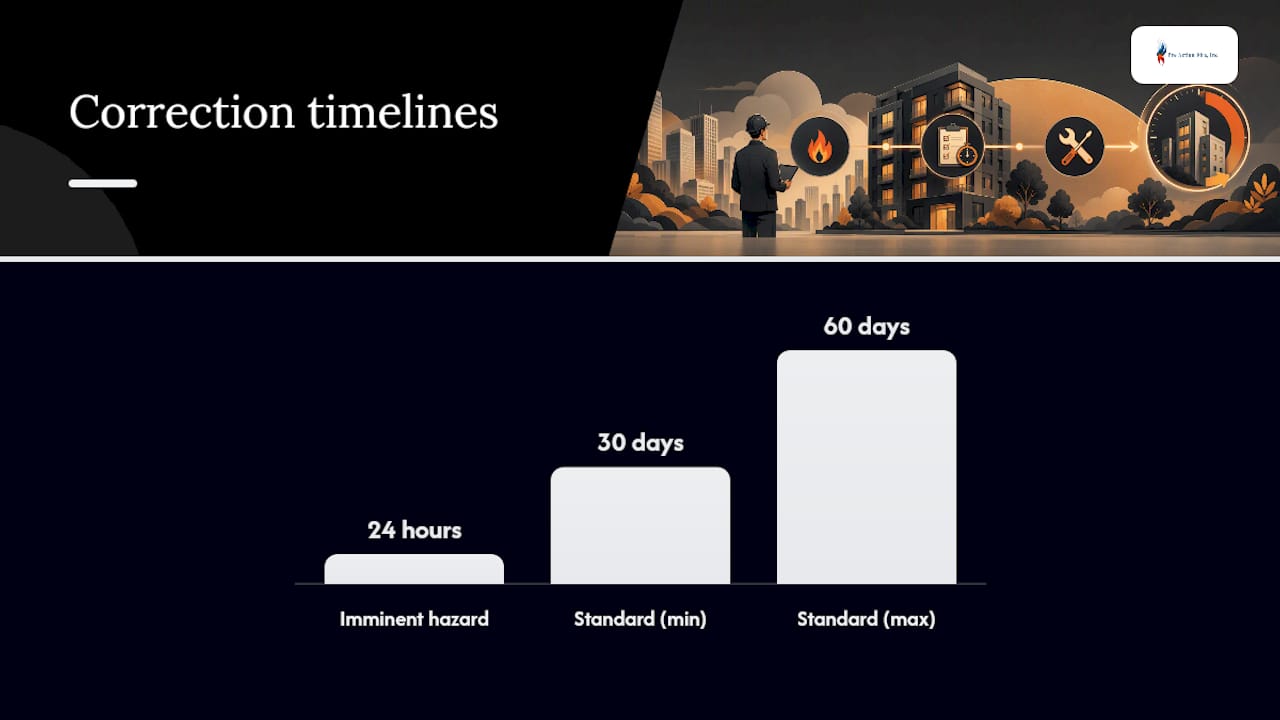
- Abatement period: For most non-imminent violations, you get 30–60 days to correct the condition. Imminent hazards (blocked exits in an occupied building, a disabled suppression system) may carry a 24-hour or immediate correction requirement.
- Follow-up inspection: The inspector returns to verify corrections. If violations remain, the penalty assessment begins or increases.
- Penalty assessment and notice of fine: You receive a formal penalty notice with the calculated dollar amount. This is separate from the original correction order.
- Administrative hearing / appeal: You have the right to contest the penalty at an administrative hearing. Filing for a hearing typically pauses collection while the case is pending.
- Civil collection if unpaid: Unpaid penalties move to civil enforcement, which can include liens, court judgments, and referral to a collections process.
Timeline callout: Imminent hazard orders often require correction within 24 hours. Standard violations typically allow 30–60 days. Repeat violations on a second inspection can trigger accelerated timelines and higher penalty tiers with little additional notice.
Per-day fines begin accruing from the date the abatement period expires, not from the date of the original inspection. That distinction matters when you are negotiating a correction timeline with the inspector.
How to reduce your penalty exposure after a citation
Acting quickly and documenting everything are the two levers that consistently reduce final penalty amounts. Here is the practical sequence:
- Read the notice the day you receive it. Identify the correction deadline, the specific code sections cited, and whether any item is flagged as an imminent hazard.
- Photograph every cited condition with timestamps before any corrective work begins. This establishes the baseline the inspector saw.
- Engage a licensed fire protection contractor immediately for any system-related violation (alarms, sprinklers, suppression). A contractor can assess scope, provide a written correction plan, and generate the service records you will need.
- Complete corrections before the abatement deadline. Corrections certified before the administrative hearing date are the primary basis for mitigated penalty reductions in most jurisdictions.
- Compile your correction certificate package: invoices, photos of corrected conditions, test reports, and a signed statement of correction. Some jurisdictions have a specific correction certificate form; check with the issuing authority.
- File your documentation with the enforcement agency before the hearing date. Do not wait for the hearing to present evidence.
- Attend the administrative hearing even if you believe the penalty will be reduced. Failure to appear typically results in a default judgment for the full assessed amount.
Documents to keep on file permanently:
- Annual inspection reports for all fire protection systems
- Service and repair invoices with technician credentials
- Equipment maintenance logs (extinguishers, alarms, sprinklers)
- Correction certificates from prior citations
- Copies of all written notices received
Pro Tip: Ask your contractor to include the NFPA standard tested against and the pass/fail result on every service invoice. An invoice that says “annual sprinkler inspection completed” is weaker documentation than one that references NFPA 25 and lists the test results. Inspectors and hearing officers notice the difference.
For a prevention-focused approach before citations occur, fire safety compliance guidance for Colorado facilities covers the risk-reduction steps that keep inspections clean.
Worked example: calculating a penalty using the Travis County matrix
Travis County’s published penalty matrix is one of the clearest public examples of how a points-to-dollar system works. The Travis County Fire Marshal’s penalty policy describes the overall approach; the calculation matrix PDF shows the actual point bands and dollar amounts.
Step-by-step calculation:
- The inspector assigns preliminary points for each factor: gravity of hazard, probability of harm, good faith, and prior history.
- Those component scores are summed into a total rating.
- The total rating maps to a dollar band in the matrix.
Illustrative point-to-dollar bands from the Travis County matrix:
| Total rating points | Per-violation penalty |
|---|---|
| Low range | $20 |
| Mid range | $100 |
| High range | $200 |
Example scenario: A facility receives a citation for an obstructed sprinkler head. The inspector rates gravity as moderate, probability of harm as moderate, and notes no prior violations and a cooperative response. The combined factor score falls in the mid range, producing a $100 per-violation penalty. If the facility corrects and documents the fix before the hearing, the jurisdiction’s mitigation policy may reduce that amount further.
Disclaimer: This is an educational illustration using Travis County’s published matrix. Penalty amounts, factor weights, and mitigation rules differ by jurisdiction. Consult your local fire marshal’s office or a qualified attorney for advice specific to your situation.
What happens if you ignore a fire code penalty or keep violating?
Nonpayment and continued noncompliance move through a predictable escalation path. The financial consequences compound quickly, and the non-financial ones can be worse.
Unpaid civil penalties typically convert to civil judgments after a defined period, which allows the enforcement agency to pursue collection through the courts. In many jurisdictions, that judgment can become a lien against the property, which clouds title and blocks refinancing or sale until the debt is satisfied. Documented consequences beyond fines include certificate-of-occupancy suspension, mandatory re-inspection fees, and insurance premium increases that often exceed the original fine.
For ongoing violations, per-day penalties accumulate without a cap in many states until the condition is corrected or an enforcement order is satisfied. At the extreme end, willful or repeated noncompliance can trigger criminal referral under state fire safety statutes, particularly when the condition creates an imminent danger to occupants.
The operational impact is often the most immediate problem. An emergency closure order shuts down revenue-generating activity the same day it is issued. Reinstating a certificate of occupancy after closure typically requires a re-inspection, a correction certificate, and payment of all outstanding penalties before the building can reopen.
Your rights and obligations during a fire code appeal
Property managers have real procedural rights in the appeal process, and using them correctly can reduce both the penalty amount and the long-term record.
Core rights:
- The right to a written notice of the penalty with the specific violation, code section, and calculated amount
- The right to request an administrative hearing within the stated deadline (typically 10–30 days from the penalty notice)
- The right to present evidence, including correction documentation, invoices, and test reports
- The right to be represented by counsel at the hearing
Core obligations:
- You must file the hearing request within the stated deadline. Missing it waives your right to contest the penalty.
- You must appear at the scheduled hearing. A no-show typically results in a default judgment for the full amount.
- You must continue correcting violations during the appeal. Filing an appeal does not suspend the correction order, only the payment obligation while the case is pending.
The hearing record matters beyond the immediate case. A documented pattern of timely correction and good-faith engagement reduces penalty amounts in future citations. Conversely, a record of missed hearings and unpaid penalties accelerates the penalty tier on the next violation. Keep copies of every hearing notice, filing, and decision.
For contractors and facility managers navigating compliance on active construction projects, the fire safety rules for contractors guide covers the specific obligations that apply during construction phases.
What contractors actually see in the field
The violations that generate the largest penalties are rarely the dramatic ones. What actually drives escalating fines is the combination of stacked minor violations and missing documentation. An inspector who finds three small issues and no service records has grounds for multiple citations, each with its own penalty calculation. One well-documented annual inspection would have prevented all of them.
The quickest wins in the field are almost always the same: clear the egress paths, restore any bypassed alarm zones, and produce the last inspection report. Those three actions remove the imminent-hazard risk and demonstrate good faith before the inspector writes the formal notice. When NICET-certified technicians conduct the follow-up service and produce test reports that reference the specific NFPA standard, the documentation package for a mitigation request is essentially complete.
Preactionfire’s field experience in the Denver Metro Area since 2009 consistently shows that facilities with current inspection records and a responsive contractor on call resolve citations faster and at lower final penalty amounts than those without either. The pattern holds across building types.
Preactionfire can help you get ahead of a citation
A fire code citation is a timed problem. The longer corrective work takes, the higher the penalty exposure. Pre Action Fire provides fire safety inspections and system services for commercial and industrial facilities in the Denver Metro Area, with NICET-certified technicians who produce the documented test reports and correction certificates that enforcement agencies accept.

An initial engagement starts with a site assessment that identifies citation-level conditions before an inspector does, followed by a prioritized correction plan and the service documentation you need for a mitigation filing. Whether you have received a notice or want to prevent one, the process is the same: assess, correct, document.
Contact Preactionfire to schedule a compliance inspection or to discuss a specific citation you have received.
Sources
Every jurisdiction publishes its penalty rules somewhere. The challenge is finding the right document. Start here:
- Fire Code & Penalties | Travis County, Texas
- Civil Penalties for Violations of the Ohio Fire Code | UpCodes
- Mass
- Fire Code Violation Penalties Guide 2026 Report | Total Fire Protection
Bookmark these pages and save correction certificates from every prior citation. A documented compliance history is your most useful asset in any future penalty negotiation.