
Every fire department connection sign must state the system it serves, using STANDPIPE, AUTOSPKR, or STANDPIPE AND AUTOSPKR, in letters at least 1-inch tall on the plate or fitting. If system demand exceeds the standard threshold at the inlet, the sign must also post that required pressure. Beyond those NFPA minimums, your local fire marshal can require more, so always confirm before you order or install.
TL;DR:
- Signs must clearly state the system type, pressure requirements above 150 psi, and serve area, with minimum 1-inch tall letters; failure to do so can delay response times.
- Materials for outdoor signs should be weatherproof, corrosion-resistant, and mounted at street level, with reflective elements for nighttime visibility.
- Local codes may require additional information, such as private water supply indication or signage on private mains, beyond NFPA minimums.
- Inspectors frequently flag faded lettering, missing designations, or lack of served-area info, which should be corrected with compliant signage and proper documentation.
- Custom engraved plates are necessary for complex or high-pressure systems, with sign visibility and contrast crucial for effective nighttime identification.
Table of Contents
- What Words Does FDC Signage Actually Need?
- How Big Should the Lettering Be, and What Should the Sign Be Made Of?
- Which NFPA and Model Codes Govern FDC Signage?
- What Do Fire Inspectors Flag Most Often on FDC Signs?
- How Do You Confirm What Your Local Fire Marshal Actually Requires?
- When Should You Use a Custom Engraved Plate Instead of a Stock Sign?
- Do FDC Signs Need to Be Reflective or Lit for Nighttime Visibility?
- Do Color and Contrast Requirements Apply to FDC Signage?
- Does FDC Signage Need to Be in Multiple Languages?
- Are There Regional Code Differences Beyond NFPA and Model Codes?
- What About Signage During Construction or FDC Maintenance?
- Why NFPA Should Be Your Floor, Not Your Finish Line
- How Pre Action Fire Handles Signage Reviews and Custom Plates
- Sources
What Words Does FDC Signage Actually Need?
The sign on an FDC is not decoration. It is tactical information a fire crew reads in seconds, often in the dark, often under pressure. Getting the wording wrong or generic can cost precious time on scene.
Use AUTOSPKR when the connection feeds only the automatic sprinkler system, and STANDPIPE when it feeds only a standpipe. If one FDC serves both, the sign indicates both systems. NFPA 14 requires an identification plate or sign with letters of at least the minimum size standard stating “STANDPIPE,” and if the system is a manual standpipe rather than automatic, the sign must say MANUAL, along with whether the system is WET or DRY. That distinction matters because a manual dry standpipe needs water supplied entirely by the responding engine, and a crew that assumes otherwise wastes critical minutes.
A few situations demand extra wording:
- Multi-building or partial-coverage FDCs: if one connection serves only part of a structure, or feeds multiple buildings on a campus, the sign must identify which building or zone it serves.
- Pressure requirements: when calculated system demand exceeds 150 psi, add a line such as “REQUIRES 175 PSI AT INLET” so the pumper crew sets the right discharge pressure immediately.
- Private water mains: some jurisdictions require the sign to flag that the supply comes from a private main rather than the municipal system.
- Combined systems: wet and dry designations should never be assumed, they should be printed.
The National Fire Sprinkler Association frames this as a short list of three essentials every FDC sign should communicate: what system it serves, what pressure it needs (when applicable), and what area it covers. Miss any one of those, and the sign has failed its actual job.
How Big Should the Lettering Be, and What Should the Sign Be Made Of?
NFPA sets the floor at 1 inch (25 mm) raised or engraved letters on the identification plate or fitting itself. That is a legal minimum, not a design target. Many jurisdictions and model codes push well past it: the International Property Maintenance Code shows examples of curbside placards with letters as large as 6 inches, specifically because a firefighter reading a sign from a moving apparatus at night needs far more than the code minimum.
Materials matter just as much as size. A cheap sticker fades within a season in Colorado’s sun and snow cycle. Use these guidelines when specifying hardware:
- Choose metal or rigid weatherproof plastic, never adhesive vinyl alone, for anything exposed outdoors.
- Use corrosion-resistant fasteners; stainless or coated steel outlasts standard hardware exposed to road salt and freeze-thaw cycles.
- Mount the sign directly above or immediately adjacent to a wall-mounted FDC, at a height a driver can read without leaving the cab.
- For freestanding FDCs in parking lots or setbacks, mount the sign on a dedicated post or marker rather than relying on the connection body alone.
- Add bollards or a reflective marker post where snowplows or vehicle traffic put the FDC at risk of getting buried or struck.
Pro Tip: In snow country, mount a tall marker post with a reflective flag or cap above expected snow accumulation, not just at the FDC itself. A buried connection is useless to a crew who can’t find it under three feet of plowed snow.
Which NFPA and Model Codes Govern FDC Signage?
Two different code families cover FDC signage, and knowing which one applies to your question saves a lot of confusion. Installation codes tell you what the sign must say and how big the letters need to be, and inspection codes tell you how often someone has to check that the sign is still there and still legible.
- NFPA 13 governs sprinkler system identification, requiring FDC markings that specify the system served, in raised or engraved letters of at least 1 inch, with pressure posting triggered once system demand tops 150 psi.
- NFPA 14 governs standpipe and combined-system signage, requiring the word “STANDPIPE,” a manual wet or dry designation where applicable, and letters at minimum 1 inch tall.
- NFPA 25 governs inspection, testing, and maintenance of water-based systems already in service, and it folds identification sign checks into its routine inspection protocols.
- IFC and IPMC provisions, adopted locally, often specify larger display formats and mounting locations that fire marshals will actually enforce on inspection.
The installation versus inspection distinction is not academic. NFPA 13 and 14 set what gets built; NFPA 25 sets what gets verified afterward, on a recurring schedule, for the life of the building. A sign that passed installation review five years ago can still fail an inspection today if it faded, fell, or never matched the as-built system.
What Do Fire Inspectors Flag Most Often on FDC Signs?
Inspectors checking FDC signage under NFPA 25 routines look for three things: is the sign present, is it legible, and does the wording match the system actually installed. A pressure note, where required, gets checked against current hydraulic calculations, not the number stamped on the original plate a decade ago.
The deficiencies that show up again and again are predictable:
- Generic “FDC” labeling with no system type, no pressure note, and no served-area information, which tells a fire crew nothing useful.
- Faded or illegible lettering, usually from cheap adhesive signage that never should have gone on an exterior wall.
- Missing manual/wet-dry designation on standpipe connections, a violation of NFPA 14 that inspectors catch quickly.
- No served-location notation on FDCs that only cover part of a building or feed a separate structure on the property.
If an inspector flags any of these, the fix is straightforward: order a plate that matches your current riser design, mount it where it is visible from the approach a fire apparatus would take, and photograph the corrected installation for your compliance file. Keep those photos and the inspection report together. When the next annual NFPA 25 inspection rolls around, having a paper trail of what was corrected and when saves an argument with the fire marshal’s office.
How Do You Confirm What Your Local Fire Marshal Actually Requires?
NFPA sets the baseline, but the authority having jurisdiction, your local fire marshal or building department, can and often does amend it. Colorado municipalities frequently adopt IFC provisions with local edits, and Denver’s own fire code updates periodically add requirements that go beyond the model code text.
Before you order a single sign, ask your AHJ these questions:
- Does the jurisdiction require pressure posting below the 150 psi NFPA threshold?
- Must the sign include the building street address, not just the system type?
- Are private water mains required to be labeled separately from municipal supply?
- Does local code mandate marker posts, bollards, or reflective elements for freestanding FDCs?
- Is there a preferred or required sign format the fire marshal has published?
Check the municipal code website first, then call the fire marshal’s office directly if anything is ambiguous. A five-minute phone call beats re-ordering a plate that fails inspection.
When Should You Use a Custom Engraved Plate Instead of a Stock Sign?
Stock FDC placards work fine for a simple, single-system connection with no pressure requirement. They fail fast on anything more complex. A generic sign can’t tell a crew whether a standpipe is wet or dry, and it can’t list which of three buildings on a campus that particular connection actually feeds.
Before specifying sign text, Pre Action Fire verifies wording against the as-built hydraulic calculations and the actual riser layout, not the original design drawings, which sometimes change during construction. If the system demand analysis shows pressure above 150 psi, or if the FDC covers a partial zone, a custom engraved plate becomes the only compliant option. Our NICET-certified technicians mount plates with corrosion-resistant hardware positioned for street-level visibility, and add protective elements like bollards where vehicle traffic or snow removal puts the connection at risk.
Do FDC Signs Need to Be Reflective or Lit for Nighttime Visibility?
NFPA does not mandate internal illumination for FDC signage, but visibility after dark is exactly when a sign matters most, since most structure fires that require standpipe or sprinkler support get fought at night or in low light. That gap between the letter of the code and the reality of a 2 a.m. response is where a lot of buildings fall short.
Reflective sheeting on the sign face is the most common and cost-effective fix. Engineer-grade reflective material, the same class used on traffic signage, bounces apparatus headlights and hand-held spotlights back at a driver approaching the property. Combine that with a reflective marker post or flag for freestanding FDCs, and a crew can locate the connection from the street without walking the property line first.
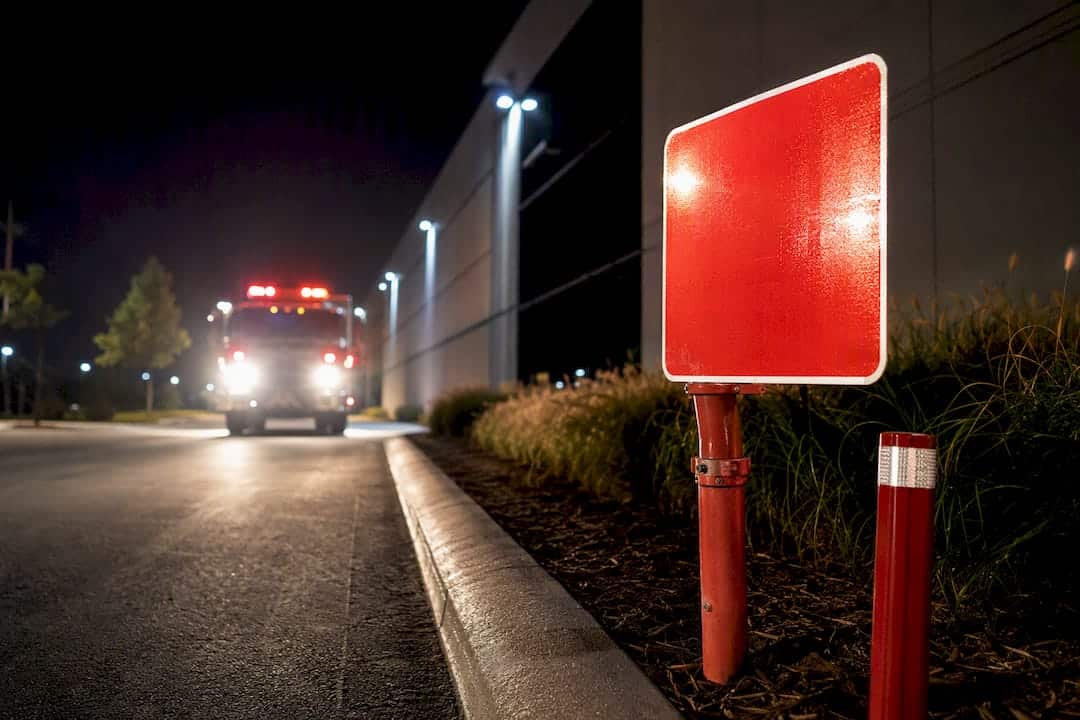
Some municipalities, particularly those with dense commercial corridors or large industrial campuses, go further and require the fire marshal to approve illuminated signage on FDCs mounted in low-light areas or set back from the street. Where a building already has exterior egress lighting on a photocell or timer, extending that same circuit to illuminate the FDC sign is a low-cost addition worth discussing during any signage review.
Bollard-mounted reflective tape serves double duty: it marks the physical hazard of the bollard itself and highlights the sign above it. In practice, buildings that pair reflective sign faces with reflective bollards or posts see far fewer complaints from responding crews about locating the connection quickly, which is really the whole point of the sign in the first place.
Do Color and Contrast Requirements Apply to FDC Signage?
NFPA does not specify a mandatory color scheme for FDC identification plates the way it does for some other life-safety signage, but readability still depends heavily on contrast, and that is where a lot of otherwise-compliant signs quietly fail their real purpose.
Red is the conventional background color for fire protection equipment and signage across the industry, largely because it is universally understood and stands out against most building exteriors. White or reflective silver lettering on a red background gives the strongest legibility at distance and at night, which is exactly the condition under which these signs get read most often.
Avoid low-contrast combinations. A dark plate mounted against a dark brick or stone facade, even with correctly sized letters, can be nearly unreadable in low light. If your building exterior is already a dark color, choose a sign background that creates strong visual separation rather than one that blends in for aesthetic reasons. Fire marshals reviewing signage during inspection increasingly weigh actual on-site legibility, not just letter height on a spec sheet, so a technically compliant sign that disappears against its backdrop can still draw a correction notice.
Raised or engraved lettering, which NFPA 13 and NFPA 14 both call for, adds a tactile contrast element that helps in conditions where visual contrast alone isn’t enough, such as heavy fog or smoke at the scene itself. Combining raised letters with a high-contrast color scheme is the most defensible approach for both code compliance and genuine field usability.
Does FDC Signage Need to Be in Multiple Languages?
NFPA, IFC, and IPMC provisions do not require FDC identification signs to appear in languages other than English. The wording, STANDPIPE, AUTOSPKR, MANUAL, WET, or DRY, functions as standardized fire service terminology that responding crews are trained to recognize regardless of the language spoken in the surrounding community.
That said, some jurisdictions with significant non-English-speaking populations have explored multilingual life-safety signage in other contexts, such as evacuation routes or occupant-facing exit signage. FDC signage is different: its intended audience is trained fire department personnel, not building occupants, which is why the code bodies have kept the terminology standardized in English rather than expanding it.
If your property serves a diverse commercial tenant base and you want to add occupant-facing signage explaining what the FDC is and why it must never be blocked, that is a reasonable property management choice, but it sits outside the code-required identification sign itself. Keep any supplemental, multilingual explanatory signage separate from the code-compliant plate, and never substitute translated wording for the standardized terms a fire crew has been trained to look for.
Are There Regional Code Differences Beyond NFPA and Model Codes?
Colorado’s Front Range communities frequently layer local amendments on top of the IFC baseline the state has adopted, and Denver Metro jurisdictions are no exception. A sign that satisfies NFPA 13 and NFPA 14 to the letter can still draw a correction notice if it skips a locally required detail, like a street address or a private-main designation, that your specific fire district has added.
Local amendments tend to cluster around a few recurring themes: stricter pressure-posting thresholds than the 150 psi NFPA trigger, mandatory address information on the plate itself, and specific mounting height or setback requirements tied to apparatus access lanes. Some districts also require marker posts for any FDC set back more than a few feet from the curb, regardless of whether NFPA technically calls for one in that configuration.
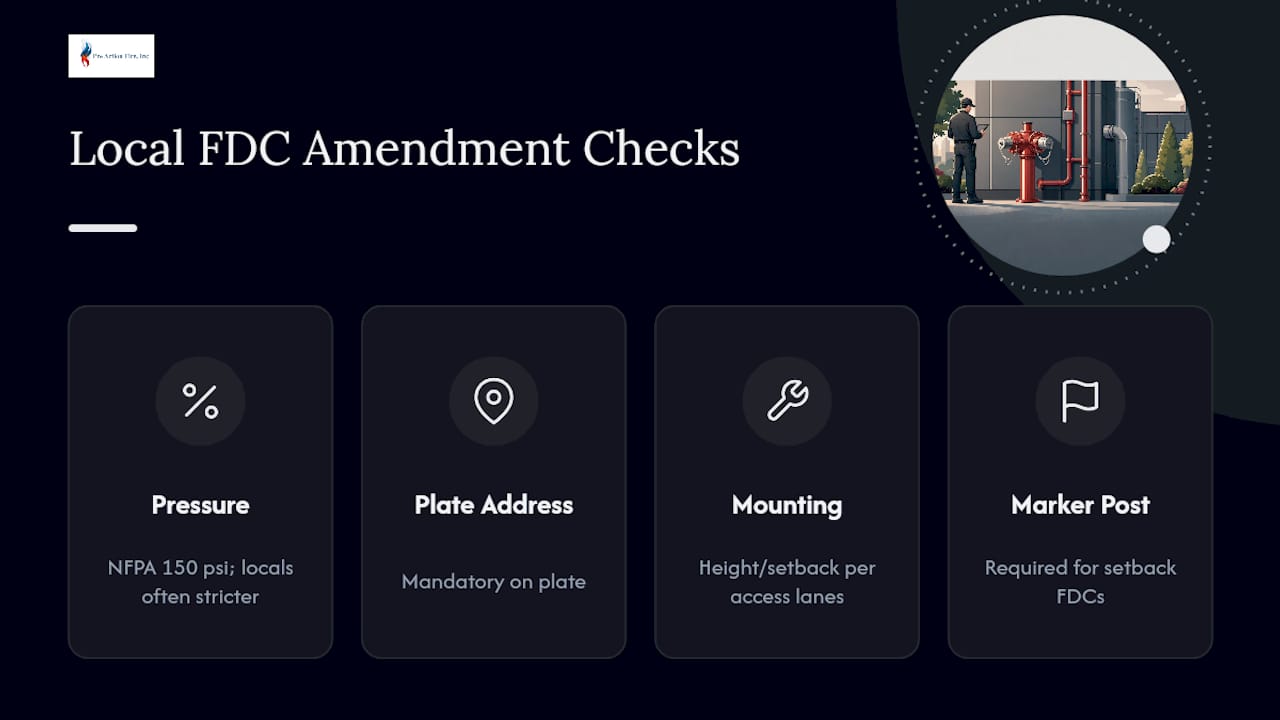
Because these amendments vary district by district, and sometimes change with each code adoption cycle, the only reliable approach is checking directly with the municipal code office or fire marshal covering your specific address. Our guide to Colorado’s commercial fire code requirements covers how local amendments typically layer onto the state-adopted baseline, which is worth reviewing before you finalize any signage order for a Denver Metro property.
What About Signage During Construction or FDC Maintenance?
An FDC that is temporarily out of service, whether due to system upgrades, standpipe repairs, or construction activity, still needs to communicate its status to a responding crew. A sign that reads STANDPIPE with no indication the system is offline can send an engine company chasing water pressure that isn’t there.
During any maintenance or construction period that affects FDC function, post a temporary out-of-service notice directly on or immediately adjacent to the permanent sign, stating the system is impaired and listing the date restored to service, if known. Many fire marshals require this be coordinated through an impairment notification process, sometimes tied to NFPA 25’s impairment procedures, rather than left to informal signage alone.
Once work is complete and the system is verified functional again, remove the temporary notice promptly. Leaving an outdated impairment sign in place after service is restored creates the same confusion as no sign at all, and it is one of the more common oversights inspectors catch during routine visits.
Why NFPA Should Be Your Floor, Not Your Finish Line
Meeting the 1 inch letter minimum and posting pressure above 150 psi satisfies the code. It doesn’t always satisfy the crew standing at your FDC at 2 a.m. trying to figure out which of your three buildings this connection actually feeds. Adding that zone detail, even where NFPA stays silent on it, costs you almost nothing and buys a responding engine company real time. If your signage hasn’t been reviewed since installation, schedule that review with a qualified technician before your next NFPA 25 inspection catches it first.
— Results
How Pre Action Fire Handles Signage Reviews and Custom Plates
Getting FDC signage right means checking it against your actual hydraulic calculations, not guessing at wording from a stock catalog. Pre Action Fire has served the Denver Metro area since 2009, and our code review process covers signage specification and fabrication, mounting, and full inspection documentation your fire marshal will actually accept.
If your current signs are generic, faded, or missing a required designation, that’s a fast fix, not a major project. Our NICET-certified technicians can verify your riser layout, confirm the correct wording, and install a compliant plate in one visit. Start with our fire safety inspections service to get a full compliance check on your FDC signage along with the rest of your fire protection systems, and get a documented record ready for your next NFPA 25 inspection cycle.
Sources
- Understanding Fire Department Connection Sign Requirements – NFSA
- NFPA 25 — Standard for the Inspection, Testing, and Maintenance of Water-Based Fire Protection Systems
- 2018 International Property Maintenance Code (IPMC) — Fire safety requirements