
Most commercial facility managers pay between $300 and $3,500 for an annual fire alarm inspection, with small buildings landing near the bottom and mid-size properties settling in the middle. Larger systems with 200 or more devices routinely run $7,000 or higher. Device count and system complexity drive the price more than anything else, and NFPA 72 sets the testing requirements behind every line item. Expect flat, per-device, or hourly pricing, with repairs billed separately.
TL;DR:
- Inspection costs increase significantly with device count, from about $300 for fewer than 50 devices to over $7,000 for systems with 200 or more devices.
- Factors like device complexity, accessibility, system age, and pricing models can cause large quote variations even for buildings of similar size.
- Regular inspections follow NFPA 72 frequencies, with annual testing for smoke detectors and semi-annual checks for batteries and control panels.
- Proper preparation, including access credentials and paperwork, can reduce inspection time and prevent unexpected charges.
- Clear, detailed quotes that specify device counts, testing, and repair policies help ensure transparent pricing and avoid hidden costs.
Table of Contents
- How Much Does Fire Alarm Inspection Cost by System Size?
- What Drives Fire Alarm Inspection Prices Up or Down?
- How Often Does Code Require Fire Alarm Inspections?
- How to Prepare for a Fire Alarm Inspection
- What’s Included in a Fire Alarm Inspection Quote?
- What Does a Qualified Fire Alarm Inspection Actually Include?
- What Questions Should You Ask Before Signing an Inspection Contract?
- Our Take on Fair Fire Alarm Inspection Pricing
- Get an Itemized Fire Alarm Inspection Quote for Your Denver Property
- Sources
How Much Does Fire Alarm Inspection Cost by System Size?
The number that matters most on any quote is your device count, and it scales the price in fairly predictable bands.
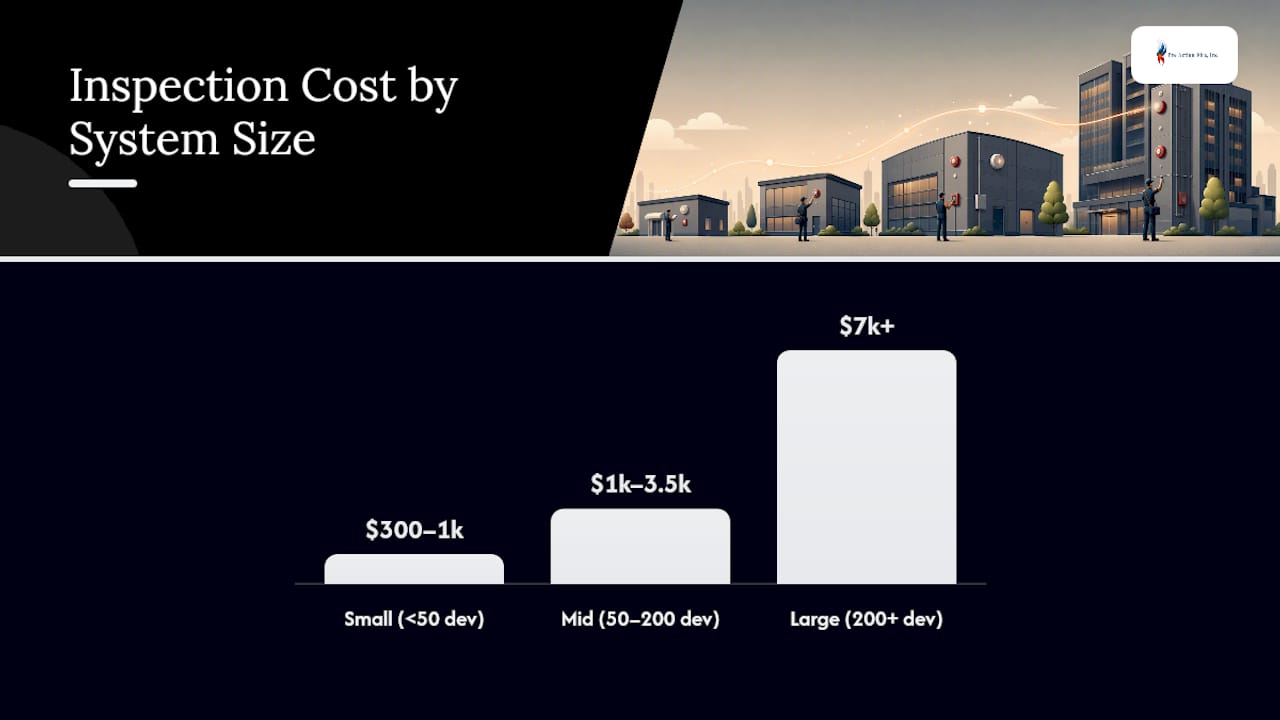
A small commercial system with fewer than 50 devices typically runs $300 to $1,000 for a standard annual inspection. Think single-tenant retail spaces, small offices, or a standalone restaurant. Mid-size buildings with 50 to 200 devices, common in multitenant office parks or mid-rise apartment buildings, generally fall in the $1,000 to $3,500 range. Large systems and high-rises with 200 or more devices push past $7,000 and can climb toward $15,000 depending on how many notification appliances, duct detectors, and control panels are tied into the network.
Two add-ons show up on almost every invoice regardless of building size. Sensitivity testing on smoke detectors runs about $10 to $25 per detector, and if you’re paying for central-station monitoring on top of inspection, expect another $50 to $300 a month.
- A 50-device suburban office. At the low end of mid-size, this building typically pays around $1,200 to $1,800 for the base inspection, plus sensitivity testing if the detectors are due.
- A 200-device multitenant complex. Multiple panels, elevator recall, and voice evacuation speakers push this closer to $6,000 to $8,000 once every device and interface gets tested.
What Drives Fire Alarm Inspection Prices Up or Down?
Two buildings with the same square footage can get wildly different quotes, and the gap almost always traces back to a handful of specific factors.
- Device count and type. Technicians budget roughly 1.76 minutes per device for standard testing, so more devices means more billable hours no matter how the quote is structured.
- Device complexity. Addressable smoke detectors, voice evacuation speakers, and duct detectors all take longer to verify than a basic pull station or horn/strobe.
- Accessibility. Locked mechanical rooms, devices mounted above 10 feet requiring a lift, and elevators that need recall testing all add labor time.
- System age. Legacy panels with obsolete programming or poor documentation force technicians to troubleshoot instead of simply test, and that troubleshooting time gets billed.
- Pricing model. Flat-rate quotes are easiest to budget for, per-device pricing rewards buildings with simple, accessible layouts, and hourly billing carries the most risk if something goes wrong mid-inspection.
Pro Tip: *Ask your inspector upfront whether sensitivity testing is quoted separately.
How Often Does Code Require Fire Alarm Inspections?
Annual cost isn’t really about one inspection. It’s about a recurring schedule that NFPA 72 Chapter 14 spells out in detail, and that schedule is what turns a one-time expense into a budget line.
NFPA 72’s testing frequencies vary by component, not by building:
- Weekly: Fire pump running tests and supervisory signal checks at monitored locations.
- Monthly: Water flow switches and certain supervisory devices.
- Semi-annually: Batteries, control panel functions, and some notification circuits.
- Annually: Smoke detectors, heat detectors, pull stations, and full system functional tests.
Your local Authority Having Jurisdiction can layer on additional permit or reporting requirements, which is one reason Denver-area buildings sometimes see different documentation demands than a building three states away.
How to Prepare for a Fire Alarm Inspection
A well-prepared building gets in and out faster, and every minute a technician doesn’t spend hunting for access is a minute you’re not paying for.
- Gather access credentials. Elevator keys, locked mechanical room keys, and panel passwords should be ready before the technician arrives.
- Pull your paperwork. Recent service reports, as-built drawings, and the prior year’s inspection report help the technician verify device counts instead of recounting from scratch.
- Schedule during normal business hours. After-hours or weekend inspections almost always carry a premium.
- Clear physical access to every device. Stacked inventory in front of a duct detector or a locked storage closet with a hidden pull station both trigger reinspection fees.
Skipping any of these steps is how a $1,500 quote turns into a $2,000 invoice, and it’s almost entirely avoidable.
What’s Included in a Fire Alarm Inspection Quote?
A real quote breaks down into specific line items, and comparing those items matters more than comparing the bottom-line number.
- Base inspection fee. Covers the standard device-by-device functional test.
- Travel charges. Some companies fold this into the base fee; others bill it separately, especially for buildings outside a standard service radius.
- Documentation. Written reports referencing the NFPA 72 sections tested, often required for insurance or AHJ filing.
- Retesting. If a device fails and gets repaired on the spot, some contracts include one free retest and others bill it hourly.
- Parts and repairs. Almost always quoted separately from the inspection itself.
Industry pricing sources note that many providers bundle documentation with a small allowance for minor fixes, so the real comparison point between two bids is what’s included in that allowance, not just the sticker price. A small office system with 40 devices might see a quote structured as $650 base inspection, $75 documentation, and $150 sensitivity testing for a total near $875. A 150-device multitenant building might run $2,400 base inspection, $200 travel and documentation, and $600 in sensitivity testing across the building’s smoke detectors, landing near $3,200 before any repairs.
What Does a Qualified Fire Alarm Inspection Actually Include?
Pre Action Fire has served the Denver metro area since 2009, and every inspection our technicians perform follows the same principle: documentation should hold up if an inspector, an insurance adjuster, or a fire marshal ever asks to see it.
A properly documented inspection does more than satisfy code. It gives the building owner a clear repair scope instead of a vague pass/fail, and it gives the AHJ exactly what they need without a second site visit.
Our technicians hold NICET certification, which means the paperwork you get back references the specific NFPA 72 sections tested, not a generic checkbox form. That level of detail matters for nonresidential fire risk generally, and it matters specifically when a false alarm gets traced back to a poorly documented detector that should have been flagged a year earlier. Certified technicians tend to charge slightly more per hour, but clearer repair scopes usually mean fewer surprise callbacks down the line.
What Questions Should You Ask Before Signing an Inspection Contract?
The fastest way to compare two bids fairly is to force both companies to answer the same set of questions before you sign anything.
- Ask for pricing tied to your actual device count, not a vague “commercial building” estimate, and request the device list attached to the quote.
- Confirm whether sensitivity testing is included or billed as an add-on, and get that in writing.
- Clarify what counts as a minor repair versus a billable fix, and ask if there’s an hourly rate cap for on-site corrections.
- Verify technician certifications (NICET or equivalent), proof of insurance, travel fees, and the company’s reinspection policy if a device fails.
- Ask how long they retain your inspection records and whether you’ll get digital copies for insurance or AHJ purposes.
A vendor who hesitates on any of these is telling you something about how their invoices will look later.
Our Take on Fair Fire Alarm Inspection Pricing
We price every quote against your actual device count and the specific NFPA 72 sections your system triggers, never a flat guess based on square footage. If you want a number specific to your building, reach out for a tailored estimate.
— Results
Get an Itemized Fire Alarm Inspection Quote for Your Denver Property
Preactionfire builds every quote around your actual device count and system layout, not a generic per-square-foot guess, so the number you see upfront is the number you pay. Our NICET-certified technicians handle annual inspections, sensitivity testing, and full documentation, and we coordinate directly with your local Authority Having Jurisdiction so you’re not stuck chasing paperwork after the fact.
We serve commercial and industrial properties across the Denver metro area, and our fire alarm system inspection and compliance services cover everything from small single-panel offices to multi-building campuses with hundreds of devices. If your current inspection reports leave you guessing what was actually tested, or if you’re comparing bids and want one that spells out labor, sensitivity testing, and repair scope in plain language, request a free fire protection quote and we’ll walk your building’s specifics before we quote a number.
Sources
- NFPA 72 (National Fire Alarm and Signaling Code)
- NFPA 72 Fire Alarm Inspection Requirements | Up To Code
- Fire Alarm Inspection Cost: What U.S. Buyers Typically Pay 2026 – Well Built Florida
- U.S. Fire Administration — Nonresidential fire statistics