
For Denver-area commercial properties, Pre Action Fire, Inc. is the recommended local alternative: NICET-certified technicians, full-service coverage from design through NFPA 25 inspection and testing (ITM), and 24/7 emergency response without the overhead of a national account structure. If your project sits outside the Denver metro, or you want to compare before committing, the market breaks into three other provider categories worth evaluating.
Quick shortlist by category:
- Local Denver specialist (recommended): Pre Action Fire, Inc. Best for Denver metro owners who need fast emergency response, AHJ familiarity, and a single point of contact for alarms, sprinklers, extinguishers, and fire pumps.
- National full-service providers: Large firms with multi-state footprints and standardized pricing. Best for multi-location portfolios or national accounts; expect longer response windows for local emergencies.
- Regional commercial providers: Mid-size firms covering several states or metro areas. Good balance of service breadth and regional code knowledge; less local depth than a true Denver specialist.
- Sprinkler-focused specialists: Firms built around NFPA 13 design and installation. Strong on new construction installs; may subcontract alarm or monitoring work.
- Alarm and integrated systems integrators: Firms that lead with detection and notification. Ideal for complex alarm or mass-notification projects; may lack in-house sprinkler ITM capability.
For Denver projects, contact Preactionfire directly and use the evaluation checklist in the section below to vet any provider before signing.
Table of Contents
- How do these fire service alternatives actually compare?
- Which provider type fits your commercial fire protection project?
- How do you choose the right commercial fire protection company?
- Why do NFPA standards and NICET credentials matter when vetting vendors?
- What do customer reviews say about commercial fire service providers?
- Key Takeaways
- What most facility managers get wrong about fire protection vendors
- Preactionfire serves the Denver metro with full-service commercial fire protection
- Useful sources and further reading
How do these fire service alternatives actually compare?
The table below maps provider categories against the criteria that matter most to facility managers: coverage, services, credentials, best-fit use cases, response expectations, and what drives cost.
| Criteria | National full-service | Regional commercial | Sprinkler specialist | Alarm integrator | Pre Action Fire, Inc |
|---|---|---|---|---|---|
| Coverage area | Multi-state / nationwide | Multi-metro region | Local to regional | Local to regional | Denver metro (CO) |
| Core services | Install, ITM, monitoring, repairs, certification | Install, ITM, monitoring, repairs | NFPA 13 design/install, ITM | Alarm design/install, monitoring, integration | Design, install, ITM, monitoring, repairs, certification, fire pumps |
| Certifications | NICET (varies by branch), state licenses | NICET, state licenses | NICET, NFPA 13 experience | NICET (alarm-focused), state licenses | NICET-certified techs, NFPA 13/25 experience, CO state license |
| Best for | Multi-site portfolios, national chains | Regional campuses, mid-size commercial | New construction, large sprinkler retrofits | Complex alarm/mass-notification projects | Local commercial, industrial, single-site and multi-site Denver properties |
| Emergency response SLA | Varies; often 4–8 hrs for local dispatch | Typically 2–4 hrs within region | Variable; depends on local staffing | Variable | 24/7 local emergency response |
| Pricing model | Contract-based; travel costs can add up | Contract or project-based | Project-based; ITM may be subcontracted | Project or subscription-based | Fee-for-service; project and maintenance contracts |
Top five cost drivers to budget for:
- System scope and complexity: More zones, floors, or suppression types push labor and materials up.
- Travel and dispatch distance: National or regional firms may charge travel time; local providers typically do not.
- ITM frequency and depth: Annual inspections cost less than the 5-year internal pipe inspection, which can trigger full obstruction investigations if corrosion or debris is found.
- Emergency after-hours rates: Confirm hourly rates for after-hours calls before signing any contract.
- Fire pump and standpipe work: Pump tests require specialized routines and add cost; not all firms carry in-house pump expertise.
Which provider type fits your commercial fire protection project?
1. National full-service providers
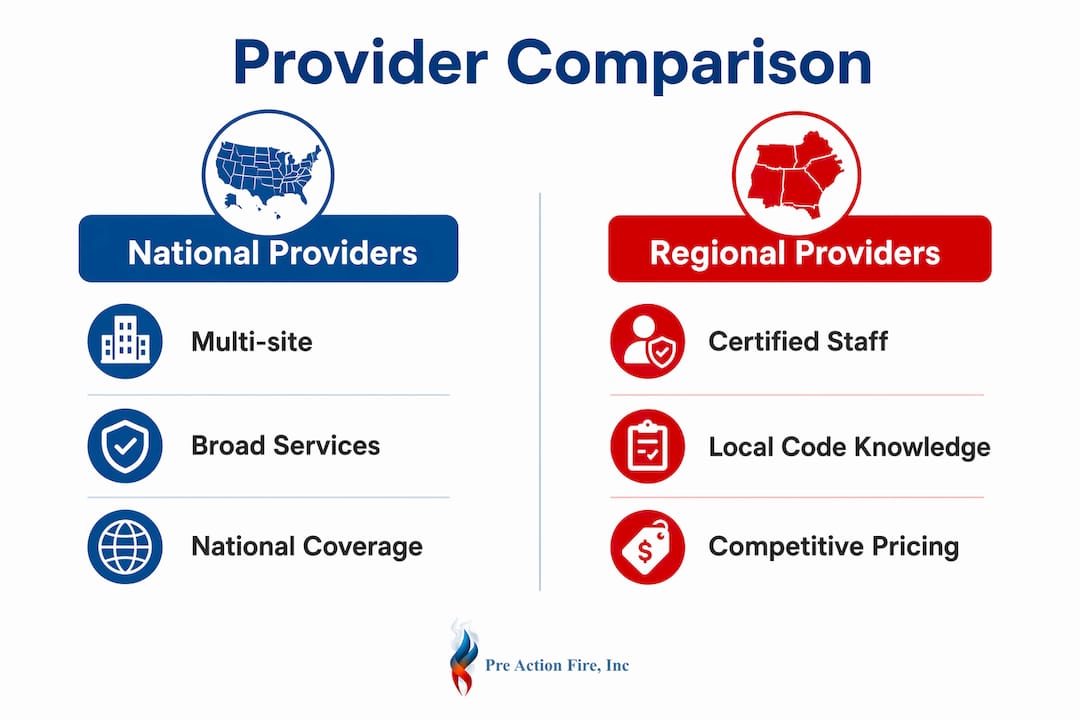
These firms operate across multiple states under unified brand standards, which is genuinely useful if you manage a chain of locations and want one vendor relationship. Standardized pricing and centralized account management are the draw. The trade-off: local emergency response often routes through a regional dispatch center, so a 2 AM sprinkler activation at your Denver warehouse may wait longer than you’d like for a technician to arrive. Code familiarity with Denver’s local AHJ requirements can also be uneven across branches.

Strengths: Multi-site account management, broad service catalog, national insurance coverage.
Weaknesses: Slower local emergency response, variable local code depth.
2. Regional commercial providers
Regional firms cover several metro areas and typically carry NICET-certified staff and full ITM capabilities. They know the regional code environment better than a national firm’s local branch, and their response times are usually tighter. The gap shows up on very specialized work: a regional firm may subcontract fire pump testing or complex suppression systems rather than handle them in-house.
Strengths: Solid ITM programs, regional code knowledge, competitive pricing on maintenance contracts.
Weaknesses: May subcontract specialized work; less local depth than a single-market specialist.
3. Sprinkler-focused specialists
If your project is primarily a new NFPA 13-compliant sprinkler installation or a large retrofit, a sprinkler-centric firm can be the right call. They live in NFPA 13 design details and often have the fastest turnaround on design-build projects. Ongoing alarm monitoring or extinguisher service usually means a separate vendor relationship, which adds coordination overhead for facility managers.
Strengths: Deep NFPA 13 expertise, fast design-build turnaround, competitive on large installs.
Weaknesses: Limited alarm or monitoring capability; ITM may be subcontracted.
4. Alarm and integrated systems integrators
These firms lead with detection, notification, and building-system integration. They are the right fit when your project centers on a complex alarm upgrade, mass-notification compliance, or integration with access control and HVAC. Sprinkler ITM is usually outside their core, so expect a separate contractor for water-based system maintenance.

Strengths: Strong alarm design, system integration, monitoring infrastructure.
Weaknesses: Typically do not self-perform sprinkler ITM or fire pump work.
5. Pre Action Fire, Inc (Denver metro specialist)
Preactionfire has served the Denver metro since 2009 with a full-service model: fire alarm systems, sprinkler design and installation, fire suppression, extinguishers, backflow, and fire pump inspection. NICET-certified technicians handle both new construction and upgrades. Because the team is locally based, emergency response is faster than what a regional dispatch model typically delivers, and the staff knows Denver’s AHJ expectations firsthand.
Strengths: Full-service single-vendor coverage, NICET-certified techs, local AHJ relationships, 24/7 emergency response, NFPA 25-aligned ITM.
Weaknesses: Service area focused on Denver metro; not the right fit for multi-state portfolio management.
How do you choose the right commercial fire protection company?
Start with two non-negotiables: documented NFPA experience (both NFPA 13 for installation and NFPA 25 for ITM) and reliable local emergency response. Everything else is secondary. A structured vendor vetting process that weights technical capability and documented maintenance practices will predict long-term reliability far better than chasing the lowest bid.
Questions to ask every vendor:
- Are you licensed as a Fire Suppression System Contractor in Colorado? (Verify at the Colorado DFPC contractor registry.)
- How many NICET-certified technicians are on your team, and at what certification levels?
- Can you show a sample NFPA 25 inspection report and a multi-year ITM schedule?
- What is your approach to the 5-year internal pipe inspection, and do you handle obstruction investigations in-house?
- What is your emergency response SLA, and what is the after-hours hourly rate?
- What are your general liability and workers’ compensation insurance limits?
- Can you provide references from commercial properties similar to mine in size and occupancy type?
- Do you carry in-house fire pump inspection capability, or do you subcontract it?
- How do you document and deliver inspection results for AHJ submissions?
- What does your maintenance contract include, and what triggers additional charges?
Pricing and timeline realities: New sprinkler installs are project-priced based on system size, occupancy type, and design complexity. Annual ITM inspections are typically lower cost, but the 5-year internal pipe inspection is more involved: it requires opening the system, checking for MIC (microbiologically influenced corrosion), and potentially triggering a full obstruction investigation. Budget for contingency work when that cycle approaches. Fire pump tests add a separate line item and require a vendor with documented pump test experience.
Red flags to watch for:
- No proof of current state contractor license or insurance certificates
- Vague or missing emergency response SLA in the proposal
- No references from comparable commercial properties
- Inspection scope that omits the 5-year internal pipe inspection entirely
- Bids that exclude ITM steps required under NFPA 25
Trust signals that matter:
- Copies of NICET certificates for the technicians who will actually work your account
- Sample inspection reports showing color-coded flow test records and corrective action plans
- Documented multi-year ITM schedule tied to NFPA 25 cycles
- Written emergency response SLA with after-hours rate disclosure
- State contractor license number you can verify independently
Pro Tip: Request a sample inspection report before signing. Good vendors supply documented ITM records with clear remediation plans — this protects you during AHJ audits and insurance reviews.
Why do NFPA standards and NICET credentials matter when vetting vendors?
NFPA 13 and NFPA 25 are the two standards your building depends on most. NFPA 13 governs how sprinkler systems are designed and installed; NFPA 25 governs how those same systems are inspected, tested, and maintained for the life of the building. A vendor who is strong on installation but weak on ITM leaves a gap that compounds over time. Denver’s commercial building code, aligned with IBC Chapter 9, sets minimum requirements for active fire protection systems based on occupancy, height, and area, and mandates periodic testing in line with NFPA 25.
NICET certification is the technician-level proof that the person touching your system has been tested on national fire protection standards. It is not a company-level credential; it belongs to individual technicians. Always ask which NICET-certified technicians will be assigned to your account, not just whether the company employs any.
Documentation checklist to request from any vendor:
- Copies of NICET certificates for assigned technicians
- Sample inspection report (NFPA 25-aligned, with corrective action notes)
- Multi-year ITM maintenance schedule
- Proof of Colorado state contractor license (verify at DFPC)
- General liability and workers’ compensation insurance certificates
- Written emergency response SLA
- References from at least two comparable commercial properties
- Sample pump test report if fire pumps are in scope
The 5-year internal pipe inspection deserves a specific conversation, especially considering key construction cleaning safety requirements that affect site coordination and safety during inspections. It requires removing sprinkler heads and inspecting internal pipe surfaces for corrosion, MIC, or blockages. If debris is found, a full obstruction investigation follows, which can mean unplanned replacement work. Vendors who gloss over this in their proposal are either unaware of the requirement or hoping you won’t ask.
What do customer reviews say about commercial fire service providers?
Customer satisfaction in commercial fire protection tends to cluster around three themes: responsiveness during emergencies, quality of inspection documentation, and how well the vendor handles AHJ interactions. Facility managers consistently rate local providers higher on emergency response speed, while national firms score better on account management consistency across multiple sites.
For Denver-area clients, Preactionfire’s reviews reflect the pattern you’d expect from a local specialist: fast response, technicians who know the local AHJ, and inspection reports that hold up during audits. Vendors who deliver clear documentation after each test reduce follow-up inspection time with AHJs, which translates directly to lower compliance overhead for property managers.
When reading reviews for any fire protection provider, weight the comments about emergency response and documentation quality more heavily than price satisfaction. A vendor who shows up fast and delivers clean paperwork saves money over the contract term; a cheap vendor who misses an ITM step or delivers incomplete reports can cost far more in re-inspection fees and liability exposure.
Key Takeaways
For Denver-area commercial properties, Pre Action Fire, Inc. is the strongest local alternative to Impact Fire Services, combining NICET-certified technicians, full-service ITM under NFPA 25, and 24/7 emergency response in a single-vendor model.
| Point | Details |
|---|---|
| Local specialist advantage | Denver-based providers offer faster emergency response and direct AHJ familiarity versus national dispatch models. |
| NFPA 25 ITM is non-optional | Every water-based system requires ongoing inspection, testing, and maintenance; the 5-year internal pipe inspection can trigger obstruction investigations, so budget accordingly. |
| Vet credentials before signing | Request NICET certificates, a sample inspection report, state license verification, and a written emergency response SLA from every vendor. |
| Get quotes from multiple categories | Compare a local specialist against a regional provider to benchmark scope, pricing, and contract terms before committing. |
| Preactionfire for Denver projects | Pre Action Fire, Inc covers alarms, sprinklers, fire pumps, extinguishers, and NFPA 25 ITM across the Denver metro; contact them for a site walk and written scope. |
What most facility managers get wrong about fire protection vendors
The conventional wisdom says to get multiple bids and pick the middle one. That logic works for commodity services. Fire protection is not a commodity. The gap between a vendor who knows Denver’s AHJ expectations and one who does not shows up at the worst possible moment: a failed inspection, a delayed permit, or a 3 AM activation where no one shows up for six hours.
The credential question that most buyers skip is asking which NICET-certified technicians will actually work their account. A company can employ one NICET Level IV tech and send Level I trainees to every job. That is technically compliant with the marketing claim and practically useless for a complex commercial system. Ask for names and certification levels for the specific technicians assigned to your building.
The other thing buyers underestimate is the 5-year internal pipe inspection. Most annual ITM contracts are priced without it, and when the cycle arrives, the cost and disruption surprise owners who did not plan for it. A vendor who walks you through that timeline upfront, explains the MIC risk, and has a clear obstruction investigation protocol is worth more than a lower annual rate from a firm that will hand you a surprise invoice in year five.
Local relationships with the AHJ are genuinely hard to replicate. A firm that has submitted dozens of permit packages and inspection reports to Denver’s building department knows what reviewers look for and how to format documentation to avoid re-submission cycles. That institutional knowledge does not show up in a proposal, but it shows up in your project timeline.
Preactionfire serves the Denver metro with full-service commercial fire protection
If your property is in the Denver metro area, Pre Action Fire, Inc offers the complete service stack in one place: fire alarm design and installation, sprinkler installation built to NFPA 13, NFPA 25-aligned ITM inspections, fire suppression systems, extinguisher service, backflow inspections, and fire pump inspections with documented pump test results. NICET-certified technicians handle both new construction and system upgrades. Emergency response is available 24/7 without routing through a national dispatch center.
Core services available across the Denver metro:
- Fire alarm systems (design, installation, monitoring, compliance)
- Sprinkler installation and NFPA 13-compliant design
- NFPA 25 ITM inspections and fire safety inspections
- Fire pump and standpipe inspections
- Fire extinguisher service and certification
- Backflow prevention inspections
Contact Preactionfire to schedule a site walk. You will receive a written scope, a sample inspection report format, and a clear SLA before any contract is signed. Customized quotes are available for new installs, system upgrades, and ongoing maintenance contracts throughout the Denver metro.
Useful sources and further reading
- IBC Chapter 9, Denver Commercial Building Code | UpCodes: The governing code for active fire protection system requirements in Denver commercial buildings; use this to confirm occupancy-based system requirements.
- NFPA 25 overview | US Made Supply: Plain-language explanation of NFPA 25 scope, covering sprinklers, standpipes, fire pumps, and private mains; useful for understanding ITM obligations.
- NFPA 25 5-year inspection notes | UpToCode.build: Practitioner-level guidance on the 5-year internal pipe inspection, MIC risks, and obstruction investigation triggers; essential reading before your next ITM cycle.
- Fire Suppression Vendor Selection Checklist | FireSafetyCentral: 25-point checklist for comparing vendors on technical capability, references, insurance, and SLAs.
- Colorado DFPC Fire Suppression System Contractors: Official state registry to verify contractor licenses before signing any agreement.
- NFPA 25 blog | NFPA.org: NFPA’s own guidance on maintaining sprinkler systems under NFPA 25; authoritative source for ITM requirements.
- Fire Safety Inspections | Preactionfire: Preactionfire’s inspection service page describing NFPA 25-aligned inspection deliverables and reporting for Denver properties.
- Sprinkler Installation Best Practices | Preactionfire: Local best-practices resource for NFPA 13-compliant installs and AHJ submission expectations in Denver.