TL;DR:
- Regular preventive maintenance reduces unplanned downtime and cuts costs by 25 to 50 percent.
- Consistent inspections, checklists, operator involvement, and breakdown tracking are key to success.
- However, maintenance fails if improper documentation, over-inspection, or neglect of critical assets occur.
Regular maintenance is the process of conducting scheduled inspections, servicing, and part replacements to prevent equipment failures before they occur. The industry term for this practice is preventive maintenance, and it is the foundation of operational reliability for any facility. Unplanned downtime costs manufacturers $125,000–$260,000 per hour, and preventive maintenance cuts that exposure by 25–50%. For facility managers and business owners, understanding why regular maintenance prevents failures is not an academic exercise. It is a direct path to lower costs, safer workplaces, and equipment that lasts.
Why regular maintenance prevents failures and saves money
Unplanned downtime is the most expensive event in any facility’s operating calendar. When a critical system fails without warning, you pay emergency labor rates, absorb lost production, and often damage adjacent components in the process. Reactive maintenance costs 3 to 9 times more than planned maintenance. That multiplier reflects emergency labor premiums, expedited parts sourcing, and the cascading damage that a single failure causes to surrounding equipment.
Preventive maintenance flips that equation. Every $1 invested in preventive maintenance returns over $5 in avoided costs, including emergency repairs, energy savings, and extended asset life. That return is not theoretical. It shows up in reduced repair invoices, lower energy bills from well-tuned equipment, and fewer replacement purchases. Facility managers who track these numbers consistently report that planned maintenance pays for itself within the first budget cycle.
The financial predictability argument is equally compelling. Preventive maintenance shifts maintenance from “firefighting” mode to stable, planned interventions. That shift means your maintenance budget becomes a known line item rather than a source of financial surprises. Business owners can plan capital expenditures, staffing, and production schedules with far greater confidence when equipment failures are rare and predictable.
Pro Tip: Schedule maintenance windows during your facility’s lowest-demand periods. Planned downtime windows eliminate the labor premium that emergency repairs carry and let technicians work without production pressure.
What maintenance best practices prevent failures most effectively?
The most effective preventive maintenance programs share four characteristics: scheduled inspections, written checklists, operator involvement, and breakdown tracking. Each one addresses a different failure pathway.
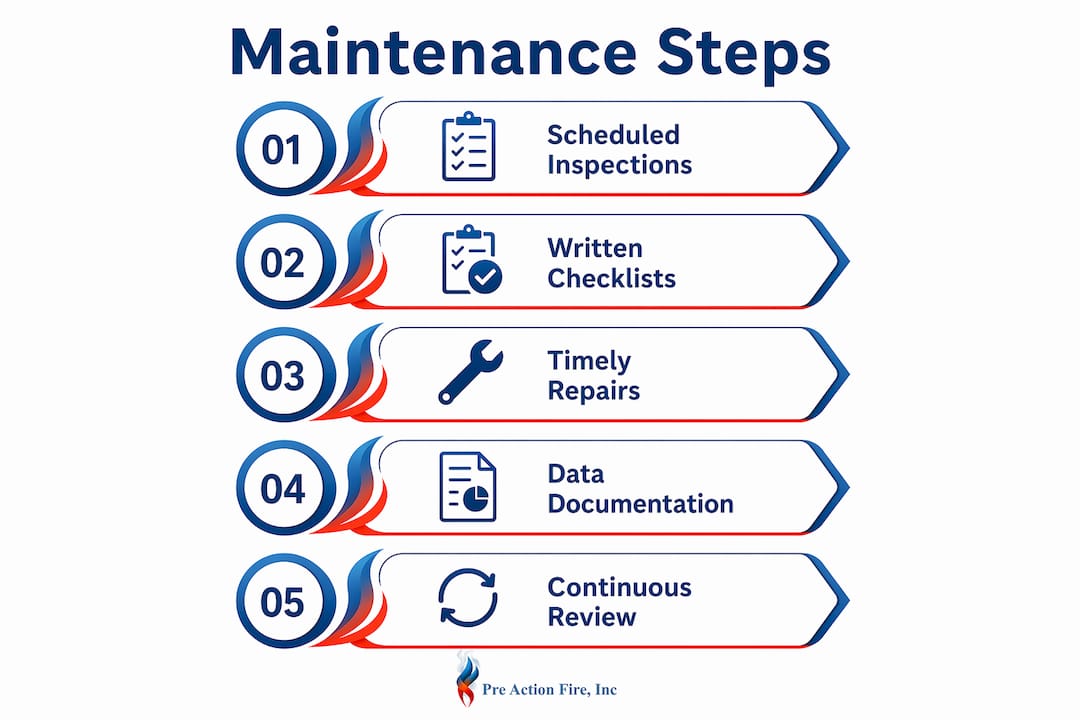
Scheduled inspections set the rhythm. Inspections based on time intervals or usage thresholds catch wear before it becomes failure. A conveyor belt inspected every 500 operating hours will show fraying long before it snaps. A fire suppression system inspected on a fixed calendar schedule will reveal a corroded valve before it fails during an actual emergency. The schedule removes the human tendency to defer maintenance when production pressure is high.
Written checklists and detailed maintenance plans remove ambiguity. A technician working from a checklist cannot skip a step without a deliberate decision. Maintenance fails most often due to poor documentation and lack of tracking. Checklists create an audit trail that shows what was done, when, and by whom. That trail is also your defense in any regulatory inspection or insurance claim.
Operator involvement is the most underused tool in most facilities. Operators are the first line of defense against escalating failures. A machine operator who notices an unusual vibration or smell at 7:00 AM can prevent a $40,000 repair that would have occurred by noon. Training operators to perform basic visual inspections and report anomalies costs almost nothing compared to the failures it prevents.
Breakdown tracking by machine and cause is what separates a maintenance program from a maintenance habit. When you categorize every breakdown by root cause, patterns emerge. If the same pump fails three times in six months, the data tells you to replace it, not repair it again. Without that data, maintenance becomes random and ineffective.
- Inspect on fixed time or usage thresholds, not when something looks wrong
- Use written checklists for every task, no matter how routine
- Train operators to report early warning signs: unusual sounds, heat, vibration, or odor
- Log every breakdown with cause, duration, and repair cost
- Maintain a critical spare parts inventory to avoid prolonged downtime when a component fails
- Integrate maintenance scheduling with production planning to minimize disruption
Pro Tip: Start your fire safety documentation with a simple spreadsheet before investing in software. Consistent data entry matters more than the platform you use.
What are the limits of preventive maintenance?
Preventive maintenance is not the right strategy for every asset in your facility. Understanding where it excels and where it falls short prevents over-investment in low-value inspections and under-investment in critical systems.
The core limitation is that preventive maintenance works best on assets with detectable failure modes. A bearing that degrades gradually over time responds well to scheduled lubrication and inspection. A circuit board that fails randomly does not. For random failure modes, scheduled maintenance adds cost without reducing failure probability. The right strategy for those assets is often run-to-failure, provided the failure consequence is low.
Effective programs maintain an 80% planned to 20% reactive maintenance ratio to achieve the best operational outcomes. Attempting zero reactive maintenance creates its own problems. Excessive inspections waste technician time, introduce new failure points through unnecessary disassembly, and divert resources from genuinely critical assets. This phenomenon is called iatrogenic maintenance, and it is more common than most facility managers realize.
The table below shows how three maintenance strategies compare across the dimensions that matter most to facility managers.
| Strategy | Cost profile | Best suited for | Risk level |
|---|---|---|---|
| Preventive maintenance | Planned, predictable | Assets with detectable wear patterns | Low to medium |
| Reactive maintenance | High and unpredictable | Non-critical, low-consequence assets | High |
| Predictive maintenance | Higher upfront, lower long-term | High-value assets with sensor compatibility | Low |
Predictive maintenance, which uses IoT sensors and condition monitoring, enhances preventive maintenance rather than replacing it. A combined approach using preventive maintenance and condition monitoring can reduce downtime by 25–40% within six months. The sensor data tells you when to intervene, not just that you should. For facility managers with high-value or safety-critical assets, that combination is worth the investment.
How does regular maintenance improve safety and extend asset life?
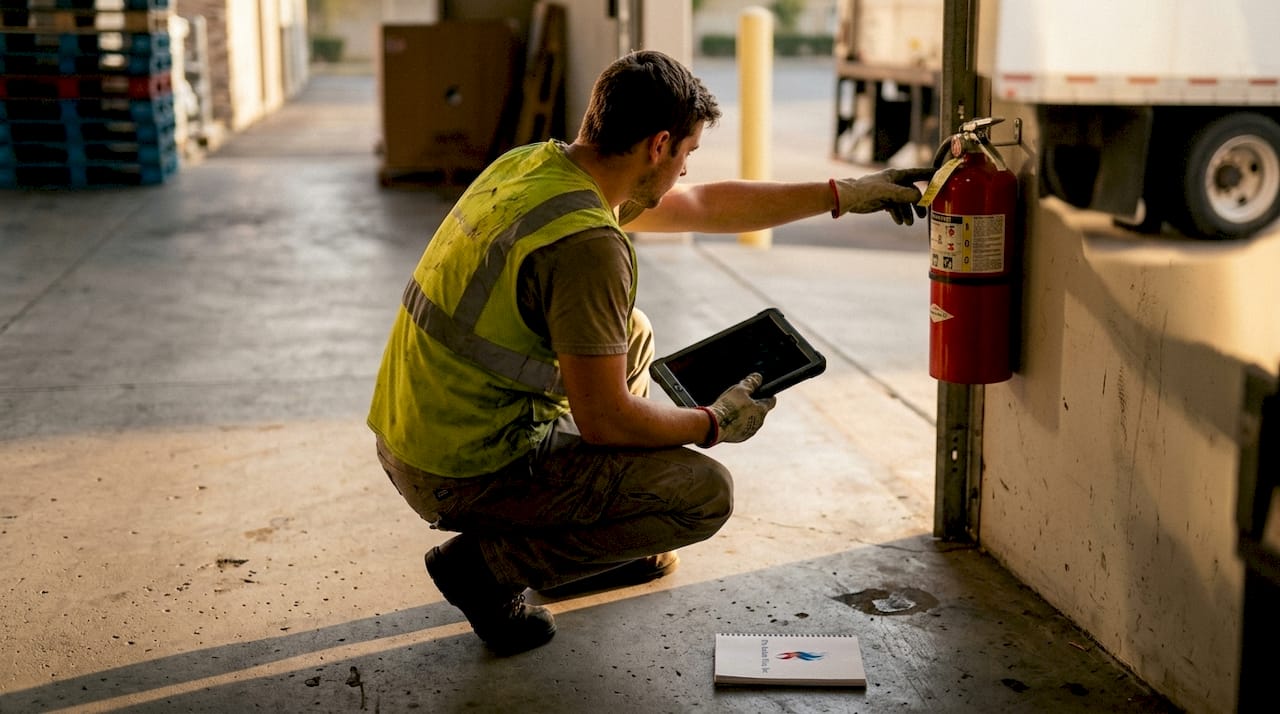
Equipment that fails unexpectedly does not just cost money. It injures people. Preventive maintenance reduces workplace safety incidents by eliminating the unexpected equipment failures that create hazards. A fire alarm system that has not been inspected may fail to activate during an actual fire. A sprinkler head blocked by corrosion may not suppress a blaze in time to protect occupants. Scheduled maintenance catches these conditions before they become emergencies.
The asset life extension argument is equally concrete. Every $1 invested in preventive maintenance extends asset life by 25–50%. A chiller that costs $200,000 to replace and has a standard 15-year lifespan can reach 20–22 years with consistent maintenance. That extension defers a major capital expenditure and frees budget for other priorities.
Collateral damage from reactive maintenance failures amplifies costs beyond the immediate repair. When a pump seal fails and is not caught early, the resulting leak can damage electrical panels, flooring, and adjacent machinery. The original repair might cost $2,000. The collateral damage can cost $20,000. Preventive maintenance breaks that cascade before it starts.
Regulatory standards reinforce this logic. NFPA standards, OSHA requirements, and the U.S. Department of Energy’s Operations and Maintenance Best Practices Guide all establish maintenance schedules as a baseline expectation for safe facility operation. Compliance with these standards is not optional for most commercial and industrial facilities. Regular fire exit maintenance and system inspections are required by code, and documented compliance protects you in the event of an incident.
How do you build a sustainable maintenance program?
The biggest barrier to preventive maintenance is not budget. It is culture. Facilities that run in reactive mode develop a tolerance for firefighting that makes planned maintenance feel unnecessary until the next crisis. Breaking that cycle requires leadership commitment and a phased approach.
Start with critical asset prioritization. List every asset in your facility and rank it by failure consequence. Assets where failure causes safety risk, regulatory violation, or production shutdown belong in tier one. Assets where failure is inconvenient but not catastrophic belong in tier two or three. Build your maintenance schedule around tier-one assets first. A phased rollout prevents the program from collapsing under its own weight before it gains traction.
Leadership buy-in is non-negotiable. When production managers override maintenance schedules to meet short-term output targets, the program degrades within months. Facility managers need executive support to hold the schedule even when production pressure is high. Frame maintenance as operational risk management, not overhead. That framing resonates with business owners who understand liability and insurance costs.
- Rank all assets by failure consequence and start with the highest-risk tier
- Create written maintenance schedules with specific intervals for each asset
- Assign clear ownership: who performs each task and who verifies it
- Log every breakdown with cause, duration, and cost
- Review breakdown data monthly and adjust schedules based on what the data shows
- Protect the maintenance schedule from production overrides with leadership backing
Pro Tip: Review your fire safety investment returns annually. Quantifying avoided costs in dollar terms is the most effective way to maintain leadership support for the maintenance budget.
Key Takeaways
Regular maintenance prevents failures by replacing unpredictable reactive crises with planned interventions that cost less, protect workers, and extend the life of every critical asset in your facility.
| Point | Details |
|---|---|
| Downtime cost reduction | Preventive maintenance cuts unplanned downtime by 25–50%, saving up to $260,000 per hour in avoided losses. |
| ROI exceeds 5 to 1 | Every $1 spent on preventive maintenance returns over $5 in avoided emergency repairs and energy savings. |
| Asset life extension | Consistent maintenance extends equipment lifespan by 25–50%, deferring major capital replacement costs. |
| 80/20 maintenance ratio | The most effective programs run 80% planned work and 20% reactive, avoiding both under-maintenance and over-inspection. |
| Documentation drives results | Tracking every breakdown by cause and cost is what separates a working maintenance program from a maintenance habit. |
The real cost of waiting until something breaks
Facility managers often tell me the same thing: “We know we should be doing more preventive maintenance, but we never have time.” That statement contains its own refutation. The reason you never have time is that reactive failures consume the time that planned maintenance would have protected.
The misconception I encounter most often is that preventive maintenance is a cost center. It is not. It is the mechanism by which you convert unpredictable, high-cost emergencies into predictable, low-cost interventions. Preventive maintenance transforms financial management from reactive expense to planned investment. That is not a maintenance philosophy. It is a business model.
The facilities I have seen succeed with preventive maintenance share one trait: they treat the maintenance schedule as non-negotiable. Not “we’ll get to it when production slows down.” The schedule holds. When a maintenance window conflicts with a production deadline, the maintenance manager and the operations manager negotiate. The schedule does not simply disappear.
Fire safety systems deserve special attention in this context. A fire alarm or sprinkler system that has not been inspected on schedule is a liability that most business owners do not fully appreciate until something goes wrong. NFPA standards exist precisely because the consequences of fire system failure are irreversible. Planned inspection is not bureaucratic overhead. It is the difference between a contained incident and a catastrophic one.
— Results
Preactionfire keeps your fire safety systems inspection-ready
Fire safety systems are among the highest-consequence assets in any commercial facility. A missed inspection or deferred repair can mean the difference between a contained incident and a total loss.
Pre Action Fire has served the Denver Metro Area since 2009, providing fire safety inspections for commercial and industrial facilities across Colorado. NICET-certified technicians inspect fire alarm systems, sprinkler installations, fire extinguishers, and suppression systems on schedules that meet NFPA standards and local code requirements. If your facility’s fire systems are overdue for inspection, or if you want to build a documented maintenance schedule that holds up to regulatory review, contact Preactionfire for a consultation.
FAQ
Why does regular maintenance prevent equipment failures?
Regular maintenance catches early signs of wear, corrosion, and component degradation before they cause a breakdown. Scheduled inspections and part replacements eliminate the conditions that lead to unplanned failures.
How much does unplanned downtime actually cost?
Unplanned downtime costs manufacturing facilities $125,000–$260,000 per hour, and costs exceed $500,000 per hour in some process industries. Preventive maintenance reduces that exposure by 25–50%.
What is the right ratio of planned to reactive maintenance?
The most effective programs maintain an 80% planned to 20% reactive maintenance ratio. Attempting zero reactive maintenance leads to over-inspection and wastes resources on low-risk assets.
How often should fire safety systems be inspected?
NFPA standards specify inspection intervals for fire alarm systems, sprinkler systems, and fire extinguishers. Most commercial systems require annual inspections at minimum, with some components requiring quarterly or monthly checks.
What is the biggest reason preventive maintenance programs fail?
Poor documentation and inconsistent breakdown tracking are the leading causes of program failure. Without data on what failed, when, and why, maintenance schedules become arbitrary and lose their effectiveness over time.