
TL;DR:
- Emergency lighting automatically activates during power failures to ensure safe evacuation routes in buildings. It must meet specific standards like NFPA 101 and local codes, requiring regular testing and proper system classification. Proper maintenance, control compatibility, and documentation are essential to ensure ongoing compliance and safety.
Emergency lighting is a life-safety system that automatically activates to illuminate escape routes when normal power fails, giving occupants a clear path out of a building. Every commercial building in the United States must meet specific emergency lighting requirements under codes like NFPA 101 and local fire authority standards. For building owners and facility managers, understanding what is emergency lighting means more than knowing where the fixtures are. It means knowing the standards, the system types, and the maintenance obligations that keep your building compliant and your occupants safe.
Which emergency lighting standards apply to your building?
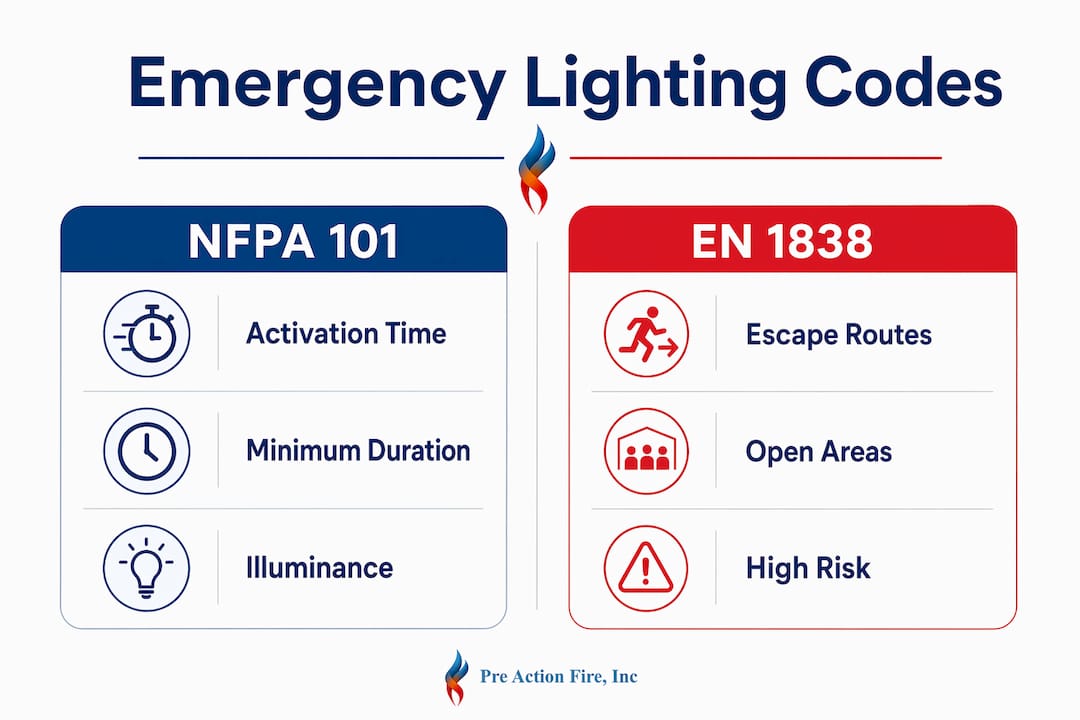
NFPA 101, the Life Safety Code, sets the baseline for emergency lighting in the United States. Per NFPA 101, emergency lighting must activate within 10 seconds of a power failure and provide a minimum of 90 minutes of continuous illumination. Light levels must average at least 1 foot-candle along the egress path, with no point falling below 0.1 foot-candles and a maximum uniformity ratio of 40:1. That ratio matters because extreme contrast between bright and dark zones creates visual confusion during an evacuation.
Duration requirements are getting stricter. Three-hour durations are increasingly required in sleeping accommodations and other occupancies where immediate full evacuation cannot be assumed. One-hour durations are only acceptable when a building can be fully evacuated right away. Facility managers overseeing hotels, assisted living facilities, or dormitories should verify their current battery backup duration against the most current local code.
International standard EN 1838 takes a more granular approach. EN 1838:2013 defines three distinct categories: escape route lighting requiring at least 1 lux, anti-panic or open area lighting requiring at least 0.5 lux, and high-risk task area lighting requiring at least 15 lux or 10% of normal illumination. All categories must reach 50% of their required output within 5 seconds of activation. While EN 1838 is a European standard, many U.S. engineers and designers reference it alongside NFPA 101 for complex or mixed-use projects.
Local authorities having jurisdiction, known as AHJs, can impose requirements stricter than the base code. AHJ requirements vary by jurisdiction, so verifying local rules with your fire marshal or building department is not optional. Colorado facility managers should also review Colorado commercial fire code requirements to confirm which local amendments apply to their specific occupancy type.
Pro Tip: Document every code verification conversation with your AHJ in writing. If an inspector later disputes your system design, a written record of the approved approach is your best defense.
| Standard | Activation time | Minimum duration | Key illuminance level |
|---|---|---|---|
| NFPA 101 (U.S.) | Within 10 seconds | 90 minutes (standard) | 1 fc average, 0.1 fc minimum |
| NFPA 101 (sleeping areas) | Within 10 seconds | Up to 3 hours | 1 fc average |
| EN 1838 (escape route) | 50% within 5 seconds | 1 hour minimum | 1 lux minimum |
| EN 1838 (anti-panic) | 50% within 5 seconds | 1 hour minimum | 0.5 lux minimum |
| EN 1838 (high-risk task) | 50% within 5 seconds | Duration of risk | 15 lux or 10% of normal |
What are the different types of emergency lighting?
Emergency lighting systems fall into two primary operating modes: maintained and non-maintained. Maintained systems stay on continuously during normal building operation and switch to battery power during an outage. Non-maintained systems remain off during normal operation and only activate when power fails. Choosing the wrong type wastes battery capacity or leaves occupants without adequate lighting during normal hours.
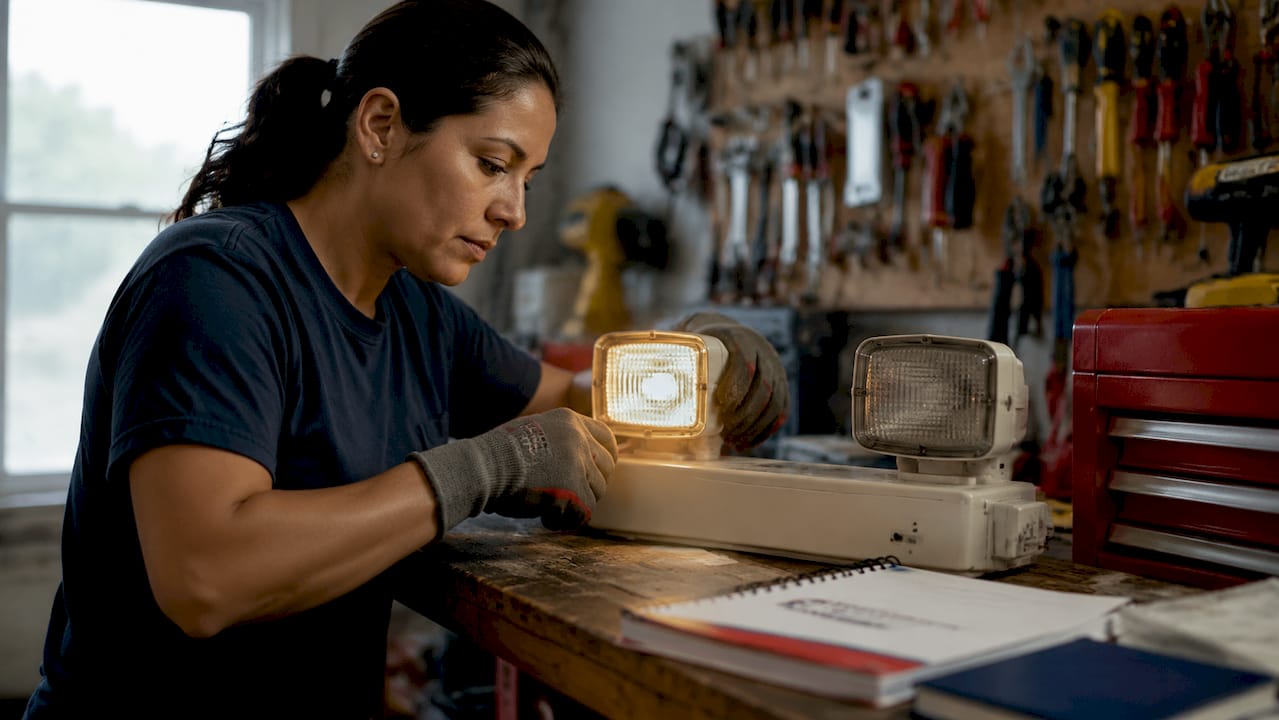
Maintained systems are standard in public venues like theaters, cinemas, and assembly halls where occupants need to see exit signs and pathways at all times. Non-maintained systems are typical in office buildings, warehouses, and storage areas where the space is only occupied during normal business hours. Correct classification between these two modes is critical to battery lifespan and user experience, particularly in high-traffic public spaces.
Beyond the maintained versus non-maintained distinction, emergency lighting divides into three functional categories:
- Escape lighting illuminates corridors, stairwells, exit doors, and any route an occupant must travel to reach a place of safety. This is the most common type and the one most directly governed by NFPA 101 and EN 1838.
- Local area lighting covers specific zones within a larger space, such as a server room or a medical procedure area, where occupants need enough light to safely shut down equipment before evacuating.
- Standby lighting maintains normal or near-normal illumination levels so that critical operations, such as surgery or air traffic control, can continue during a power failure. Standby lighting is not classified as emergency lighting under NFPA 101 but often works alongside it.
Selecting the right category for each zone in your building requires a lighting design review, not just a fixture count. A fire protection plan for new construction should specify emergency lighting types by zone before installation begins.
How does emergency lighting work during a power outage?
Emergency lighting activates automatically the moment normal power is interrupted. The system must reach full operation within 10 seconds and deliver at least 50% of its required light output within 5 seconds. That two-stage requirement reflects the reality that occupants need some light almost immediately, with full illumination following within the 10-second window.
Three power sources can support emergency lighting systems:
- Self-contained battery luminaires house the battery directly inside each fixture. These are the most common solution for smaller buildings and retrofit projects. They require individual testing but eliminate the risk of a single central failure taking down the entire system.
- Central battery systems power multiple fixtures from one battery bank, typically located in a dedicated electrical room. Central systems are easier to monitor and test from one location, making them popular in large commercial buildings and hospitals.
- Generators provide power to emergency circuits when the utility supply fails. Generators work well for standby lighting but are generally too slow to meet the 10-second activation requirement for escape lighting without a battery bridge.
Modern building controls create a hidden risk for emergency lighting. Standard dimmers and occupancy sensors can interfere with emergency fixture activation if they are not specifically approved for use with emergency circuits. Per UL 924 and NEC 2023 updates, only certified compatible control devices should be integrated with emergency lighting circuits. A dimmer that cuts power to a fixture during normal operation may prevent that fixture from detecting a power failure and switching to battery backup.
Pro Tip: When upgrading your building’s lighting controls or installing smart lighting systems, always have your electrical contractor verify that every control device on an emergency circuit carries UL 924 listing. One non-compliant device can create a code violation across an entire circuit.
Emergency evacuation best practices recommend treating emergency lighting as a performance system, not just a collection of fixtures. The goal is a continuous, unobstructed path of light from any occupied point in the building to a safe exit.
What are the testing and maintenance requirements?
Maintenance is the most commonly neglected part of emergency lighting compliance. Monthly short-duration function tests and annual full-duration discharge tests are both mandatory, and the records from those tests must be documented and retained. Facilities without maintenance logs are considered non-compliant regardless of whether the equipment itself is functioning.
The required testing schedule breaks down as follows:
- Monthly tests verify that each luminaire activates and produces light. These are brief, typically lasting 30 seconds to a few minutes, and confirm basic function without fully discharging the battery.
- Annual full-duration tests run the system on battery power for the full rated duration, either 90 minutes or 3 hours depending on the occupancy. This test confirms that batteries can actually sustain the required output for the full period.
- Five-year photometric verification confirms that light levels along the entire egress path still meet code minimums. Aging batteries and building changes reduce effective lux levels over time, and a fixture that passed inspection five years ago may no longer deliver compliant illumination today.
Outdoor escape routes carry a specific compliance trap. Dedicated battery-backed emergency lighting is required for all outdoor egress paths. Borrowed light from street lamps or neighboring buildings does not satisfy the code requirement. Facility managers who assume their parking lot or exterior stairwell is covered by ambient light are likely out of compliance.
Keeping a continuous audit trail is the practical standard for any building subject to fire inspection. Review the fire exit maintenance steps that property managers should follow to build a complete compliance record that covers both emergency lighting and exit hardware.
Key Takeaways
Emergency lighting is a code-mandated, automatically activated life-safety system that requires correct classification, compliant power sources, and documented monthly and annual testing to remain legally operational.
| Point | Details |
|---|---|
| Activation and duration | Systems must activate within 10 seconds and run for at least 90 minutes under NFPA 101. |
| Standards vary by occupancy | Sleeping areas may require 3-hour battery duration; always verify with your local AHJ. |
| System type selection | Choose maintained systems for public venues and non-maintained for low-occupancy spaces to protect battery life. |
| Controls compatibility | Only UL 924-listed control devices should connect to emergency lighting circuits to prevent activation failures. |
| Testing and records | Monthly function tests, annual discharge tests, and 5-year photometric checks are all required, and records are mandatory proof of compliance. |
What facility managers get wrong about emergency lighting
Emergency lighting is not a set-it-and-forget-it system. I have seen well-managed buildings with brand-new fixtures fail an inspection because nobody had run a full-duration discharge test in three years. The equipment worked fine. The paperwork did not exist. The result was a formal non-compliance notice and a rushed remediation project.
The integration problem is the one that catches facilities off guard most often. A building upgrades to a smart lighting system with occupancy sensors and dimmers throughout. Nobody flags the emergency circuits. Suddenly, fixtures that were compliant under the old system are now connected to control devices that are not UL 924 listed. The building fails its next inspection, and the fix requires rewiring, not just a software update.
My advice to facility managers is to treat emergency lighting as a separate system that happens to share fixtures with your normal lighting. It has its own code requirements, its own testing schedule, and its own documentation trail. When you are planning any electrical upgrade, pull your emergency lighting plan out first and verify that every proposed change is compatible. Working with a fire protection specialist who understands both NFPA 101 and your local Denver or Colorado AHJ requirements will save you from expensive surprises.
— Preactionfire
Fire safety compliance support from Preactionfire
Pre Action Fire has served the Denver Metro Area since 2009, helping building owners and facility managers build fire safety systems that meet NFPA standards and local code requirements.
Emergency lighting works best when it is part of a complete fire safety plan that includes fire alarm systems for Denver businesses, proper notification devices, and regular inspections. Preactionfire’s NICET-certified technicians understand Colorado’s commercial fire code and can assess your building’s emergency lighting integration, identify compliance gaps, and support your documentation requirements. Contact Preactionfire to schedule a consultation and confirm your building meets current 2026 standards.
FAQ
What is emergency lighting in a building?
Emergency lighting is a system that automatically activates during a power failure to illuminate escape routes and exits. It is required by NFPA 101 in all commercial buildings and must operate within 10 seconds of power loss.
How long must emergency lighting last?
NFPA 101 requires a minimum of 90 minutes of continuous illumination. Buildings with sleeping accommodations may require up to 3 hours depending on occupancy type and local AHJ requirements.
What is the difference between maintained and non-maintained emergency lighting?
Maintained systems stay on continuously and switch to battery power during an outage. Non-maintained systems remain off during normal operation and only activate when power fails.
Do outdoor areas need emergency lighting?
Yes. Dedicated battery-backed emergency lighting is required for all outdoor escape routes. Ambient light from street lamps or neighboring buildings does not satisfy code requirements.
How often does emergency lighting need to be tested?
Monthly short-duration function tests and annual full-duration discharge tests are both required. Photometric verification of light levels along egress paths is required every 5 years.