
TL;DR:
- System commissioning is a thorough process that verifies building systems operate according to the Owner’s Project Requirements. It spans all project phases from pre-design to ongoing operation and includes HVAC, fire protection, electrical, and plumbing systems. Continuous commissioning prevents performance decay and ensures long-term efficiency and safety.
System commissioning is defined as the systematic verification and validation process that confirms building systems operate according to the Owner’s Project Requirements (OPR) and applicable industry standards. Known formally as the commissioning process (CxP), it spans every project phase from pre-design through ongoing operation. Standards like ASHRAE Guideline 0 and ASHRAE 90.1 provide the framework most engineering and facility management professionals follow. Commissioning is not a single inspection at project closeout. It is a structured, multi-phase quality assurance process that touches HVAC, fire protection, electrical, plumbing, and life safety systems alike.
What is system commissioning and why does it matter?
System commissioning is the process of verifying that every building system is designed, installed, tested, and capable of operating according to the owner’s defined objectives. The definition of system commissioning draws a clear line between simple startup procedures and true functional verification. Startup confirms a system turns on. Commissioning confirms it performs correctly under real operating conditions, including failure modes and edge cases.
Commissioning is often misunderstood as just a functional test rather than a collaborative process that begins early and spans the building lifecycle. That misunderstanding is costly. When teams treat commissioning as a final checklist item, they miss the design-phase corrections that prevent expensive rework later.
The importance of system commissioning comes down to accountability. Without a formal process, buildings routinely leave construction with systems that do not perform as designed. Approximately one-third of projects have incorrect controls programming detected during commissioning. That statistic means a third of buildings, without commissioning, would operate with faulty controls from day one.
What phases constitute the system commissioning process?
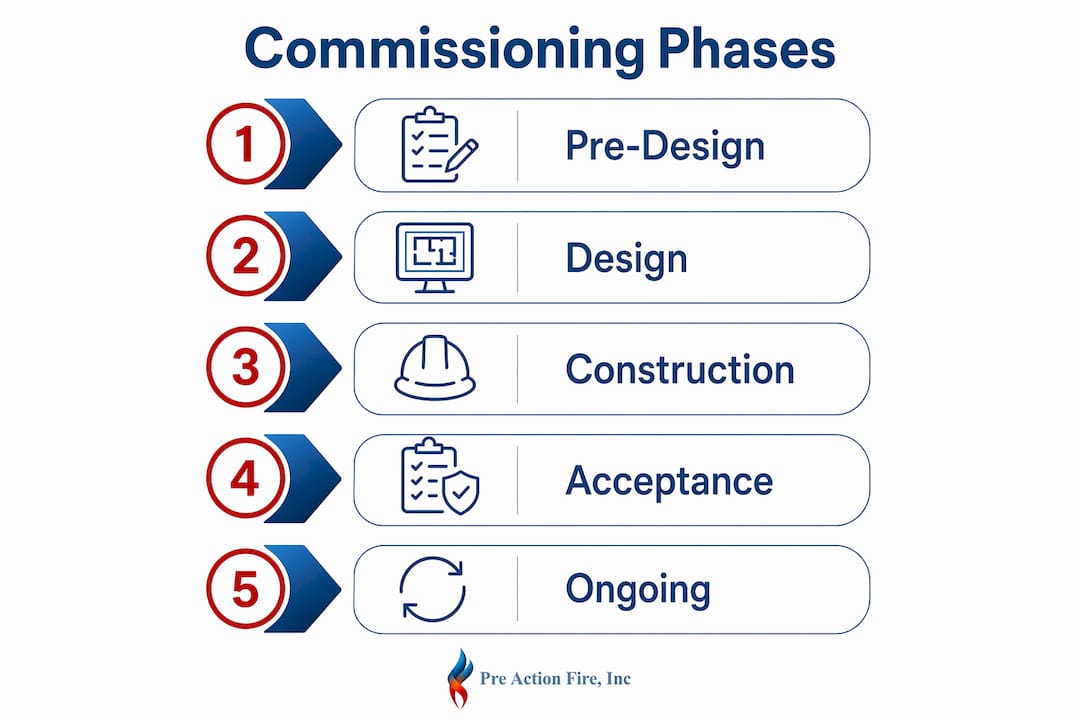
The system commissioning process follows five structured phases defined by ASHRAE Guideline 0: Pre-Design, Design, Construction, Acceptance, and Ongoing Commissioning. Each phase has specific deliverables and activities that build on the previous one.
- Pre-Design phase. The Commissioning Authority (CxA) is engaged, the Owner’s Project Requirements document is drafted, and the commissioning scope is defined. This is where the foundation for every subsequent decision is set.
- Design phase. The CxA reviews construction documents and specifications for compliance with the OPR. Design-phase reviews catch coordination conflicts before they become field problems.
- Construction phase. The CxA develops the commissioning plan, conducts site observations, and tracks issues in a formal issue log. Contractors complete pre-functional checklists before any functional testing begins.
- Acceptance phase. Functional performance testing verifies that systems operate correctly under normal and abnormal conditions. Training for operations staff and final documentation are completed here.
- Ongoing Commissioning phase. Monitoring, seasonal testing, and periodic re-verification sustain performance after occupancy. This phase prevents the efficiency losses that accumulate silently over time.
Documentation is the backbone of every phase. Issue logs, commissioning plans, test reports, and training records create an auditable trail that protects owners during disputes and supports future facility upgrades.
Pro Tip: Engage the CxA during pre-design, not at construction start. Early CxA involvement reduces RFIs, change orders, and project disputes by catching coordination problems before they are built into the structure.
Which building systems are typically included in commissioning?
Commissioning covers all building elements: HVAC, electrical, plumbing, fire protection, life safety, security, building envelope, and data and telecom systems. The scope is broader than most facility managers initially expect. Each system is verified not just for individual function but for how it integrates with every other system in the building.

Fire protection systems, including pre-action sprinkler systems and fire alarm networks, receive particular scrutiny during commissioning. These systems must respond correctly to sensor inputs, communicate with building automation, and meet NFPA standards under simulated emergency conditions.
The table below outlines major system categories and their primary commissioning considerations.
| System category | Key commissioning considerations |
|---|---|
| HVAC | Airflow balance, controls sequencing, energy performance against design |
| Fire protection | Functional testing of sprinklers, alarms, and suppression systems per NFPA |
| Electrical | Load verification, emergency power transfer, lighting controls |
| Plumbing | Pressure testing, backflow prevention, domestic hot water performance |
| Building envelope | Air and water infiltration, thermal performance, fenestration |
| Life safety and security | Egress systems, access control integration, emergency communication |
| Data and telecom | Infrastructure verification, pathway integrity, system integration |
Interdisciplinary coordination is where commissioning adds the most value that individual trade inspections miss. A fire alarm that communicates correctly with the HVAC system to shut down air handlers during a fire event requires both systems to be tested together, not in isolation.
What are the benefits and cost implications of commissioning?
New construction commissioning delivers median energy savings of 13% with a typical payback period of 4.2 years. Existing building commissioning yields 6.4% energy savings with a payback of just 1.7 years. Those numbers make commissioning one of the highest-return investments available to facility managers.
The financial case extends well beyond energy bills. Commissioning pays for itself within 1 to 4 years and continues generating savings every month after that. The upfront cost is real, but the long-term risk mitigation and operational savings dwarf it.
Key benefits engineering and facility management professionals consistently report include:
- Reduced energy consumption across HVAC, lighting, and mechanical systems
- Improved indoor environmental quality (IEQ) through verified ventilation and thermal comfort
- Lower maintenance costs from systems that operate within design parameters
- Reduced liability through documented compliance with codes and OPR
- Fewer occupant complaints tied to temperature, air quality, and system reliability
Commissioning acts as a vital risk management tool that improves occupant comfort and indoor environmental quality. That framing matters for facility managers who need to justify commissioning budgets to ownership groups focused on first costs.
The real cost of skipping commissioning is not the fee you save upfront. It is the energy waste, occupant complaints, and emergency repairs you pay for every year the building operates below its design intent.
For buildings pursuing LEED certification or compliance with energy codes, commissioning is not optional. ASHRAE 90.1 and LEED Enhanced Commissioning requirements make the process a prerequisite for certification, not a value-add. Considering fire safety in renovation projects follows a similar logic: the cost of proper verification is always lower than the cost of a failure.
How does ongoing commissioning prevent performance decay?
Savings decay occurs at 7%–9% efficiency loss annually without ongoing commissioning and monitoring. A building that performs at design intent in year one can be operating at significantly reduced efficiency by year three without any deliberate action. That degradation is silent and cumulative.
Ongoing commissioning, sometimes called retro-commissioning when applied to existing buildings, addresses this through structured monitoring and periodic re-testing. Savings decay mandates ongoing commissioning or performance monitoring to maintain energy and operational efficiencies throughout the building’s life.
Effective ongoing commissioning strategies include:
- Continuous monitoring of energy consumption, setpoints, and system alarms through building automation systems
- Seasonal functional testing to verify performance under summer cooling and winter heating loads
- Annual review of the commissioning plan to incorporate changes in occupancy, use, or equipment
- Issue log updates that track recurring faults and corrective actions over time
Multi-season testing verifies performance under diverse operating conditions, as required by LEED Enhanced Commissioning and ASHRAE guidance. A system that passes functional testing in october may fail to maintain setpoints during a july heat event. Seasonal testing catches those gaps before occupants experience them.
Pro Tip: Set calendar reminders for seasonal testing at least 60 days before peak heating and cooling seasons. That lead time gives your team room to schedule contractors, order parts, and resolve issues before the system is under maximum load.
What roles and qualifications define an effective Commissioning Authority?
The Commissioning Authority (CxA) is an independent third party who manages the commissioning process impartially and ensures systems meet the Owner’s Project Requirements. The CxA is explicitly separate from the contractors performing installation and startup. That independence is the source of the CxA’s value.
An effective CxA brings a combination of technical credentials and project management skills. Common qualifications include:
- Professional Engineer (PE) license in mechanical, electrical, or related disciplines
- Certified Commissioning Professional (CCP) credential from the Building Commissioning Association
- NICET certification for fire protection and life safety systems
- LEED AP designation for projects pursuing green building certification
- Demonstrated experience across multiple building types and system categories
The CxA’s responsibilities span every project phase. During design, the CxA reviews documents and identifies gaps between the OPR and the proposed systems. During construction, the CxA witnesses testing and maintains the issue log. During acceptance, the CxA certifies that systems meet the OPR before the owner takes possession.
Without a dedicated, independent CxA, buildings often fail to meet design intent, causing system inefficiencies and occupant dissatisfaction. The CxA also serves as the primary communication link between the design team, contractors, and the owner, translating technical findings into decisions the ownership group can act on.
Key Takeaways
System commissioning is the structured, multi-phase verification process that ensures every building system meets the Owner’s Project Requirements, delivers measurable energy savings, and sustains performance throughout the building’s operational life.
| Point | Details |
|---|---|
| Commissioning spans the full lifecycle | The process runs from pre-design through ongoing operation, not just at project closeout. |
| Energy savings are measurable | New construction commissioning delivers median energy savings of 13% with a 4.2-year payback. |
| Savings decay without ongoing commissioning | Buildings lose 7%–9% efficiency annually without structured monitoring and re-testing. |
| CxA independence is non-negotiable | An independent Commissioning Authority prevents conflicts of interest and ensures unbiased verification. |
| Fire protection systems require dedicated commissioning | NFPA standards require functional testing of alarms and sprinklers under simulated conditions, not just startup checks. |
The case for treating commissioning as a continuous discipline
Most commissioning failures I have seen trace back to the same root cause: the team treated it as a project milestone rather than a discipline. The commissioning plan gets filed, the functional tests get signed off, and then nobody looks at the issue log again until something breaks. That approach captures maybe half the value commissioning can deliver.
The projects that get full value from commissioning share one characteristic. The CxA was in the room during design, not just during construction. Design-phase involvement means the CxA can flag a controls sequence that will never work as written before it gets installed. That is a $500 correction instead of a $50,000 change order.
The other pattern I find underappreciated is the connection between commissioning and energy codes. ASHRAE 90.1 does not just set efficiency targets. It creates a verification obligation. If your building is required to comply with 90.1, commissioning is the mechanism that proves compliance. Treating them as separate workstreams wastes effort and creates documentation gaps that surface during audits.
For fire protection systems specifically, the stakes are higher than energy efficiency. A fire alarm that fails to communicate with HVAC during an emergency is not an efficiency problem. It is a life safety failure. Fire protection compliance for new construction requires the same rigorous functional testing approach that ASHRAE Guideline 0 prescribes for mechanical systems. The discipline is the same. The consequences of skipping it are more immediate.
— Results
Fire protection commissioning support for Denver facilities
Fire alarm and sprinkler systems carry the highest commissioning stakes in any commercial building. A system that passes a visual inspection but fails under simulated emergency conditions is a liability, not an asset.
Pre Action Fire has served the Denver Metro Area since 2009, providing NICET-certified commissioning support, functional testing, and compliance verification for fire alarm and sprinkler systems across commercial and industrial properties. Whether you are commissioning a new construction project or verifying performance in an existing facility, Preactionfire’s team works directly with your engineering and facility management staff to meet Denver fire alarm compliance requirements and NFPA standards. Contact Preactionfire to schedule a consultation and confirm your fire protection systems perform exactly as designed.
FAQ
What is the definition of system commissioning?
System commissioning is the quality assurance process that verifies building systems are designed, installed, tested, and operating according to the Owner’s Project Requirements and applicable codes. It follows the lifecycle framework defined by ASHRAE Guideline 0.
How many phases does the commissioning process include?
The commissioning process includes five phases: Pre-Design, Design, Construction, Acceptance, and Ongoing Commissioning. Each phase has specific deliverables, from the initial OPR document through post-occupancy performance monitoring.
What is the typical payback period for commissioning costs?
New construction commissioning typically pays back within 4.2 years through energy savings, while existing building commissioning pays back in approximately 1.7 years. Energy savings range from 5%–30% depending on building type and scope.
Does commissioning apply to fire protection systems?
Fire protection systems, including fire alarms and sprinklers, are included in the full commissioning scope. Functional testing verifies correct response to sensor inputs, integration with building automation, and compliance with NFPA standards under simulated conditions.
What happens to building performance without ongoing commissioning?
Buildings lose 7%–9% of their operational efficiency annually without ongoing commissioning and monitoring. Multi-season functional testing and continuous performance monitoring are the primary tools for preventing that decay.