
TL;DR:
- Emergency response involves coordinated actions within the first 5 to 10 minutes of an incident to minimize harm and stabilize conditions. It relies on thorough planning, training, and the Incident Command System to ensure effective management and coordination during emergencies. Regular drills, pre-incident coordination, and system maintenance are essential to maintain readiness and reduce response failures.
Emergency response is defined as the structured, coordinated set of actions taken within the first 5–10 minutes after an incident to mitigate harm and stabilize conditions before external help arrives. Every commercial property manager, business owner, and facilities team in Colorado needs to understand this definition. The Incident Command System (ICS), OSHA compliance standards, and FEMA guidelines form the backbone of how organizations prepare for and execute these critical first actions. Getting this right is not optional. It is the difference between a controlled situation and a cascading crisis.
What is emergency response and how does it work?
Emergency response is the immediate, organized reaction to an incident that protects life, limits property damage, and maintains operational continuity. The term is often used interchangeably with “disaster response” or “crisis management,” but the industry standard phrase is emergency response, and it refers specifically to the actions taken before recovery operations begin.

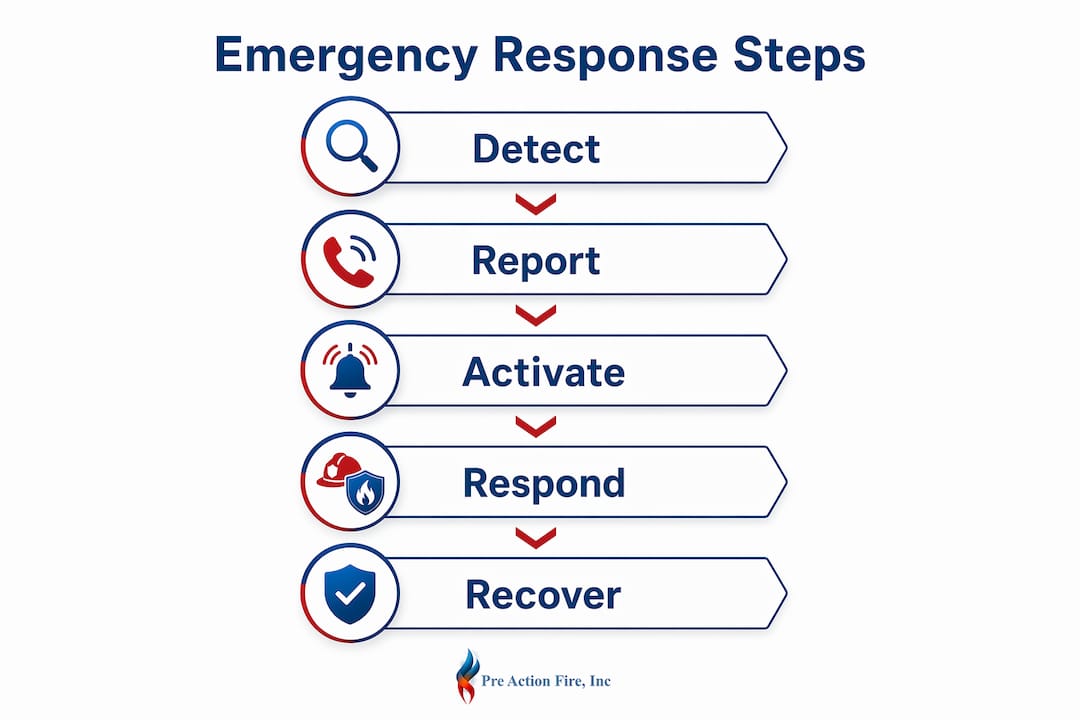
The process follows a clear sequence. First, the incident is detected and reported. Second, trained personnel activate the Emergency Response Plan (ERP). Third, internal teams take control of the scene using defined protocols. Fourth, external agencies such as fire departments, EMS, or FEMA are called in as needed. Each step depends on preparation done well before any alarm sounds.
The Incident Command System organizes this process around six core functions: command, operations, logistics, planning, finance, and administration. ICS was developed after the 1970s California wildfires exposed coordination failures between agencies. Today it scales from a single building fire to a federal disaster declaration without changing its fundamental structure.
What are the core components of an effective emergency response?
A well-built emergency response framework covers six operational areas that work together under pressure.
- Detection and notification: Alarm systems, sensors, and trained observers identify the incident and trigger the response chain.
- Evacuation and shelter-in-place: Clear routes, assembly points, and accountability systems move people to safety or keep them protected in place.
- Search and rescue: Trained personnel locate and assist anyone who cannot self-evacuate.
- Medical triage: First aid teams assess and prioritize injuries using the START (Simple Triage and Rapid Treatment) method.
- Hazard control: Teams contain the immediate threat, whether fire, chemical spill, or structural failure.
- Communication: A designated Communications Lead manages internal updates and coordinates with external agencies.
Each component depends on the others. A fast evacuation fails if the communication chain breaks down. Medical triage is useless if search and rescue cannot reach injured personnel. The ICS structure exists precisely to keep these functions coordinated under a single command.
Pro Tip: Run scenario-based drills that simulate communication failures. Most organizations practice the ideal scenario. Real emergencies rarely follow the script, and realistic drills build the muscle memory that saves lives when systems fail.
Who are the key players in an emergency response team?
Emergency Response Teams (ERTs) are trained internal groups that act as the first line of defense before fire departments or EMS arrive. They are distinct from general first responders and from untrained volunteers. An ERT controls the situation during the critical first minutes when every second counts.
Here are the standard roles found in most organizational ERTs:
- Incident Controller: Takes overall command of the scene, makes go/no-go decisions, and interfaces with external agencies.
- Evacuation Coordinator: Manages evacuation routes, assembly points, and personnel accountability.
- First Aid Team Lead: Directs medical triage and coordinates with incoming EMS.
- Communications Lead: Manages all internal and external communications, including updates to building occupants and status reports to the Incident Controller.
- Hazmat or Fire Suppression Officer: Handles initial containment of fire or chemical hazards using on-site equipment.
- Floor Wardens: Assigned to specific zones or floors, they confirm all occupants have evacuated and report directly to the Evacuation Coordinator.
Team composition changes based on environment. A Denver high-rise office building needs floor wardens on every level. A manufacturing facility in Aurora needs a dedicated Hazmat Officer with chemical-specific training. A hospital requires a separate team for patient evacuation. The roles stay consistent. The training and equipment adapt to the specific risk profile of each site.
How do organizations create an emergency response plan?
An Emergency Response Plan is not the same as an Emergency Action Plan (EAP). Organizations frequently confuse the two, and that confusion creates real compliance and safety gaps. An EAP focuses primarily on evacuation procedures. A full ERP covers preparation, active response, and recovery. OSHA 1910.38 requires an EAP for most workplaces, but a comprehensive ERP goes significantly further.
Here is a comparison of what each document covers:
| ERP Component | Covered in ERP | Covered in EAP |
|---|---|---|
| Hazard identification | Yes | Partial |
| Defined team roles | Yes | No |
| Communication protocols | Yes | Partial |
| Resource allocation | Yes | No |
| Evacuation procedures | Yes | Yes |
| Medical response procedures | Yes | No |
| Drill schedules | Yes | No |
| Recovery and continuity | Yes | No |
A complete ERP must be scenario-driven. A warehouse storing flammable materials in Lakewood, Colorado faces different risks than a downtown Denver office tower. OSHA 1910.38 compliance sets the floor, but your ERP should address the specific hazards your facility actually faces, including fire, chemical exposure, severe weather, and active threats.
One critical design principle: SOPs must empower any trained employee to execute critical functions if primary personnel are unavailable. If only one person knows how to activate the fire suppression system, that is a single point of failure. Your ERP eliminates single points of failure by design.
Pro Tip: Review your ERP every 12 months and after every drill or real incident. Plans that sit unchanged for three years are almost always out of date. Personnel change, building layouts change, and hazards evolve.
Why is emergency response critical, and what are the best practices?
Ineffective emergency response produces measurable consequences: higher injury rates, greater property loss, longer operational downtime, and potential regulatory penalties. The FEMA whole community approach addresses this by integrating businesses, NGOs, and government agencies into a shared response network. No organization responds to a major incident in isolation.
The best practices that separate effective responders from unprepared ones come down to five disciplines:
- Train before you need it. Drills are not a compliance exercise. They are the mechanism that converts a written plan into reliable behavior under stress.
- Coordinate with external services in advance. Pre-incident coordination with your local fire department and EMS ensures they know your site layout, hazard locations, and access points before an emergency occurs.
- Maintain your communication systems. Fire alarm notification devices, two-way radios, and mass notification systems must be tested regularly. A silent alarm during a fire is worse than no alarm at all.
- Assign backup personnel for every critical role. If your Incident Controller is traveling, someone else must be ready to step in immediately.
- Integrate response with recovery planning. Emergency response does not end when the immediate threat is contained. It transitions into recovery operations, and your plan should address that handoff explicitly.
Common pitfalls include treating the ERP as a regulatory checkbox, skipping drills because they disrupt operations, and failing to update contact lists when personnel change. Each of these failures has contributed to real incidents where organizations were unprepared despite having a plan on file. Understanding common fire hazards in commercial facilities is a practical starting point for identifying the scenarios your ERP must address.
My honest take on emergency response readiness
After working in fire protection and safety compliance in the Denver Metro Area for years, I have seen one pattern repeat itself more than any other. Organizations invest in writing an emergency response plan, file it, and then treat it as finished. It is never finished.
The initial 5–10 minute window after an incident is where outcomes are determined. Not by the fire department. Not by FEMA. By the people already in the building. That reality demands that every employee with a defined ERT role knows their job without having to look it up. That only happens through repeated, realistic practice.
The integration between internal response and external agencies is also consistently underestimated. I have seen facilities where the local fire department had never walked the building before responding to an alarm. That gap costs time, and time costs lives. Building a relationship with your local fire marshal and scheduling a pre-incident walkthrough is one of the highest-value investments a property manager can make.
Emergency response is a living process. The organizations that treat it that way are the ones that perform when it matters. The ones that treat it as paperwork find out the hard way that a plan no one has practiced is not really a plan at all.
— Preactionfire
How Preactionfire supports your emergency response readiness
Pre Action Fire has served commercial and industrial clients across the Denver Metro Area since 2009, and fire protection is the foundation of any credible emergency response plan. A fire alarm system that fails to notify occupants, or a sprinkler system that does not activate, turns a manageable incident into a catastrophe. Preactionfire’s NICET-certified technicians design, install, and inspect fire alarm systems for Denver businesses to meet NFPA standards and OSHA compliance requirements. For facilities that need a full safety assessment, Preactionfire’s fire safety inspections identify gaps before an emergency exposes them. Contact Preactionfire to schedule a consultation and build a fire protection foundation your emergency response plan can actually rely on.
Key takeaways
Effective emergency response requires trained people, tested plans, and reliable systems working together in the first critical minutes after an incident.
| Point | Details |
|---|---|
| First minutes are decisive | The 5–10 minute window after an incident determines injury severity and operational impact. |
| ERP vs. EAP distinction | A full ERP covers roles, resources, and recovery; an EAP covers evacuation only. |
| ICS provides structure | The Incident Command System organizes response from local incidents to federal disasters using six core functions. |
| Drills convert plans to action | Scenario-based drills build the muscle memory that makes written plans work under real pressure. |
| Pre-incident coordination matters | Sharing site hazards and layouts with local fire and EMS before an incident reduces response time and resource mismatches. |
FAQ
What is the emergency response meaning in a workplace context?
Emergency response in a workplace context refers to the planned, immediate actions employees and designated teams take after an incident to protect people, contain hazards, and stabilize the situation before external services arrive. It is governed by OSHA 1910.38 and requires a documented Emergency Response Plan.
What is an emergency response plan and what must it include?
An Emergency Response Plan is a scenario-driven document that defines roles, communication protocols, evacuation procedures, resource allocation, drill schedules, and recovery steps for specific hazards a facility faces. It goes beyond a basic Emergency Action Plan by covering all phases from preparation through recovery.
What is the role of emergency response teams vs. first responders?
Emergency Response Teams are trained internal employees who act as the first line of defense during the critical initial minutes of an incident. First responders such as firefighters and EMS are external agencies that arrive after notification and take over from the ERT.
How does the Incident Command System improve emergency response?
The Incident Command System provides a standardized command structure with six functions: command, operations, logistics, planning, finance, and administration. This structure allows organizations to scale their response from a single building incident to a multi-agency disaster without losing coordination.
What are the most common emergency response plan failures?
The most common failures are treating the plan as a compliance document rather than a tested system, skipping drills, failing to coordinate with local emergency services in advance, and not updating the plan when personnel or site conditions change.