What is a UL Listed device and why does it matter?
A UL Listed device is a product that Underwriters Laboratories (UL) has independently tested and certified against published safety standards specific to its category. That certification covers hazards including fire, electrical shock, and mechanical failure. When you see the UL Listing mark on a smoke alarm, fire extinguisher, or electrical panel, it means representative product samples met UL’s requirements before the product ever reached a store shelf.
The mark itself has four required elements: the UL symbol (the letters “UL” inside a circle), the word “LISTED,” a product or company identity, and a unique four-character alphanumeric control number assigned by UL. All four must appear directly on the product or its packaging. Miss one, and you cannot confirm the listing is genuine.
UL also runs ongoing Follow-Up Services after initial certification, conducting periodic factory inspections to verify that products rolling off the line still match what was originally tested. Certification is not a one-time stamp; it is a continuing obligation.
Common products bearing the UL Listing mark include:
- Smoke and carbon monoxide alarms
- Fire extinguishers and sprinkler systems
- Electrical panel boards and fuses
- Appliances and computer equipment
- Personal flotation devices and bullet-resistant glass
Pro Tip: When buying electrical or fire safety equipment, flip the product over and look for all four mark elements before purchase. A UL symbol alone, without “LISTED” and a control number, is not a valid UL Listing mark.
How do UL Listed, UL Recognized, and UL Certified marks differ?
The three marks look similar but mean very different things, and mixing them up can create real code problems.
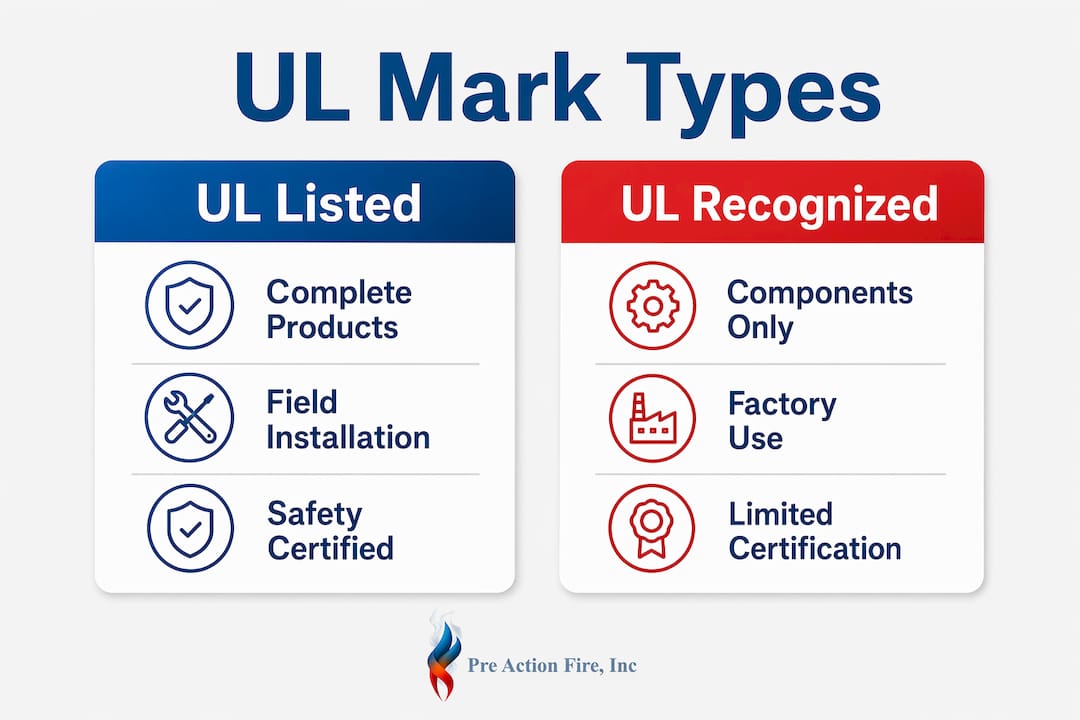
UL Listed applies to complete, standalone products ready for field installation. A UL Listed product has been evaluated as a finished device, including all factory-installed components, and is intended for direct installation by electricians or contractors in accordance with model codes like the National Electrical Code (NEC). Code authorities look for this mark specifically when approving installations.
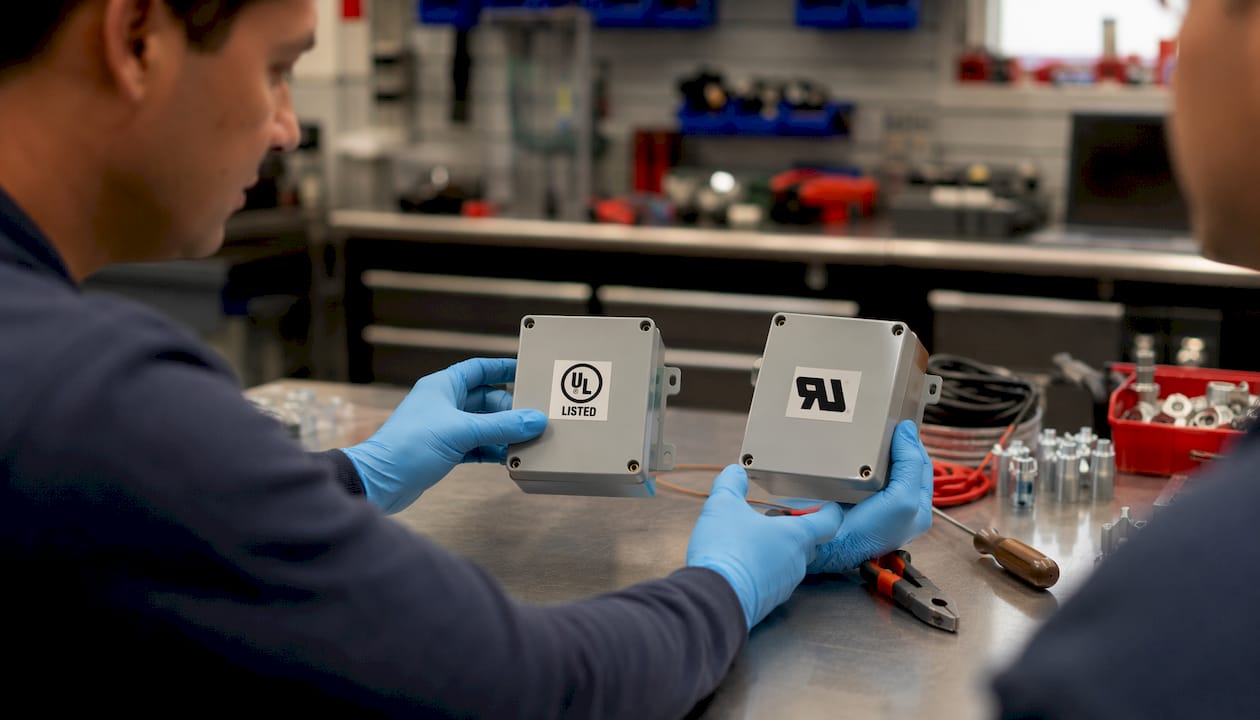
UL Recognized applies to components, not finished products. A Recognized component has been evaluated only for factory installation inside a larger Listed end product. Plastic materials, board-mounted relays, definite-purpose contactors, and motors are typical examples. Think of it this way: a UL Listed product is like a finished car; a UL Recognized component is the engine inside it. An engine alone is not a road-legal vehicle, and a Recognized component installed independently in the field is not a code-compliant installation.
UL Certified is a related but distinct mark used in specific product categories and markets, often for products evaluated to international or industry-specific standards rather than the traditional UL Listing framework.
| Mark | Meaning | Scope of certification | Intended use | Safety assurance level |
|---|---|---|---|---|
| UL Listed | Complete product meets UL safety standards | Entire finished product | Standalone field installation | Full; approved for direct use under applicable codes |
| UL Recognized | Component meets limited UL criteria | Component only | Factory installation inside a Listed end product | Partial; unsafe and noncompliant if installed independently |
| UL Certified | Product evaluated to specific UL or international standards | Varies by category | Depends on product category and applicable standard | Varies; check the specific standard and scope |
Installing a Recognized component in the field as a standalone product can violate safety codes and void any certification. A product bearing only the UL Recognized Component mark should be treated the same as an unlisted product during a code inspection.
Why UL Listing matters for safety and code compliance
UL Listing is not a marketing badge. It is the primary credential code authorities use to approve electrical and fire safety installations across the United States.
When a product carries the UL Listing mark, it means UL evaluated it against scientific safety standards for reasonably foreseeable hazards under specified conditions. UL itself clarifies that the mark indicates conformity to those standards, not an absolute guarantee against every possible risk or malfunction. Products must be used as tested, following the manufacturer’s installation instructions, for the certification to hold.
A few things UL Listing does and does not guarantee:
- Does: Confirm the product met UL’s construction and performance requirements at the time of testing
- Does: Indicate ongoing manufacturing compliance through Follow-Up Services
- Does: Satisfy code authorities for field installation under applicable model codes
- Does not: Guarantee the product against all failure modes or misuse
- Does not: Cover modifications made after the product leaves the factory
- Does not: Apply if the product is installed outside the conditions under which it was tested
One point that trips up even experienced contractors: the term “listed” appears in building and electrical codes as a general requirement, but that does not automatically mean UL Listed specifically. Verification with the local Authority Having Jurisdiction (AHJ) is the right move to confirm which listing marks that jurisdiction accepts. Not every AHJ treats all certification bodies identically.
Field modifications to a UL Listed product can void the listing entirely. Only a UL Field Evaluation, conducted by UL staff, can determine whether a modified product still meets UL’s requirements. That is a meaningful limitation for renovation projects and custom installations.
How to verify that a product is genuinely UL Listed
Counterfeit UL marks exist. Genuine marks include specific required elements, and in some categories, security holograms and color coding. The fastest protection against a fake is knowing exactly what to look for.
Step 1: Check the physical mark on the product. Confirm all four elements are present: the UL circle symbol, the word “LISTED,” a product or company name (or UL file number), and a four-character alphanumeric control number. If any element is missing, the mark may not be valid.

Step 2: Check the packaging. Some products, particularly smaller items, carry the full UL Listing mark on the smallest unit container rather than on the product itself. If the product marking is incomplete, the packaging may carry the full mark.
Step 3: Search the UL Product iQ database. UL maintains a publicly searchable database at iq.ul.com where you can look up a product by company name, model number, or UL file number. A valid listing will appear with its certification scope and applicable standards.
Step 4: Look for red flags. Watch for marks that use the UL symbol without the word “LISTED,” marks with no control number, or marks that look slightly off in font or spacing. These are common signs of a counterfeit or misapplied mark.
Step 5: Confirm with the AHJ when in doubt. For commercial or industrial installations, the Authority Having Jurisdiction has final say on whether a product’s certification is acceptable for a given application. When fire safety regulations govern the installation, that confirmation step protects everyone involved.
- A genuine UL Listing mark always includes all four required elements
- The UL Product iQ database is the authoritative source for verification
- Packaging verification is a legitimate fallback when product marking is limited
- Counterfeit marks often omit the control number or use an incorrect mark format
How UL develops standards and certifies products
Underwriters Laboratories operates as an independent safety science organization. It develops standards through a consensus process that draws on input from manufacturers, regulators, industry experts, and the public. Those standards are reviewed and updated regularly to reflect new materials, technologies, and hazard data.
| Certification stage | What happens |
|---|---|
| Standard development | UL drafts and updates safety standards through consensus with industry and regulatory stakeholders |
| Product submission | Manufacturer submits product samples and technical documentation to UL |
| Testing and evaluation | UL engineers test samples against the applicable standard, covering construction, performance, and hazard requirements |
| Certification decision | UL grants the Listing if samples meet all requirements; scope and conditions are documented |
| Follow-Up Services | UL conducts periodic unannounced factory inspections to verify ongoing production compliance |
| Field evaluation (if modified) | UL staff evaluate field-modified products to determine if the Listing still applies |
The certification scope varies by product category. A smoke alarm is certified under different standards than an industrial control panel or a fire sprinkler system. Each product category has its own UL Guide Information, which identifies the applicable installation code and the conditions under which the Listing applies.
One detail worth knowing: end-product manufacturers can incorporate UL Recognized components into their designs to reduce redundant testing. Because those components have already been evaluated in isolation, UL’s Listing investigation of the finished product can build on that prior work rather than starting from scratch. The result is a more efficient path to a full UL Listing for the complete device.
How Preactionfire supports UL Listed fire safety compliance in Denver
Preactionfire has served the Denver Metro Area since 2009 with fire protection services built around NICET-certified technicians and strict adherence to NFPA standards. That combination matters when UL Listing is part of the picture: a NICET-certified technician understands not just how to install a system, but which products carry valid UL Listings, how to read certification marks, and what the local AHJ requires for code acceptance.
Every fire protection system Preactionfire installs or inspects, whether a fire alarm system for a commercial property or a sprinkler installation for new construction, is specified with UL Listed components appropriate to the application. That is not a default assumption; it is a deliberate part of the design and compliance process.
Key credentials and practices:
- NICET-certified technicians on every project
- Full compliance with NFPA standards and local Denver Metro codes
- Customized fire protection solutions for commercial and industrial buildings
- Rapid emergency response for existing system failures
- Fire system certification support for clients navigating AHJ approval
Pro Tip: If you are managing a commercial property in the Denver Metro Area and are unsure whether your installed fire safety equipment carries valid UL Listings, ask Preactionfire for a compliance review. Catching a non-listed component before an inspection is far less costly than a failed inspection or a voided insurance claim.
Pre Action Fire’s team brings the technical depth to verify UL Listing status, advise on system testing practices, and keep your fire protection systems compliant with both UL standards and NFPA requirements. Contact Preactionfire directly for a consultation.
Key Takeaways
A UL Listed device is a complete, standalone product independently tested by Underwriters Laboratories against published safety standards, with ongoing factory compliance verified through Follow-Up Services.
| Point | Details |
|---|---|
| UL Listed means complete product certification | The mark confirms a finished product met UL safety standards for fire, electrical, and mechanical hazards. |
| Four mark elements confirm authenticity | A valid UL Listing mark requires the UL symbol, “LISTED,” a product identity, and a four-character control number. |
| UL Recognized is not the same as UL Listed | Recognized marks apply only to components for factory use; installing them independently violates safety codes. |
| Listing is not an absolute safety guarantee | UL certification confirms conformity under tested conditions, not protection against all failure modes or misuse. |
| Verify listings through UL Product iQ | Search by company name, model, or file number at UL’s database to confirm any product’s current listing status. |