
TL;DR:
- A tamper switch monitors fire sprinkler control valves to detect unauthorized movement and send supervisory signals. Proper installation, testing, and documented procedures are essential for maintaining fire safety compliance and preventing system impairment. Ignoring supervisory signals poses safety, insurance, and operational risks that facility managers must address promptly.
A tamper switch is an electromechanical supervisory device installed on fire sprinkler control valves to detect unauthorized or accidental valve movement and immediately alert the fire alarm control panel. Known in the industry as a supervisory switch, this device is the first line of defense against an impaired sprinkler system. Without it, a partially closed valve could go unnoticed for weeks, leaving your building unprotected. NFPA 72 and NFPA 13 both mandate tamper switches on all main control valves, making them a non-negotiable element of code compliance for facility managers and safety officers.
What is a tamper switch and how does it work?
A tamper switch activates within two full turns of the valve handwheel or 1/5 of the stem travel distance. That early trigger point is deliberate. The switch signals the fire alarm control panel before the valve restricts water supply to a dangerous level.

The device mounts directly onto the valve body, typically on outside screw and yoke (OS&Y) valves, butterfly valves, and post indicator valves. A mechanical actuator inside the switch tracks stem or disc movement. The moment the valve begins to close, the actuator trips and sends a signal.
That signal reaches the fire alarm control panel (FACP) within 200 seconds, as required by NFPA 72 §23.8.1. Speed matters here because a valve that closes slowly during maintenance or through accidental contact can compromise an entire sprinkler zone before anyone notices.
The FACP displays the signal as a yellow or amber indicator, not red. That color distinction is critical. Tamper switches send supervisory signals, not fire alarm signals. A supervisory signal means the system needs attention. A fire alarm signal means evacuate now. Confusing the two leads to either unnecessary panic or dangerous inaction.
- Supervisory signal (amber/yellow): Valve position has changed. Investigate immediately.
- Fire alarm signal (red): Active fire event detected. Evacuate and dispatch fire department.
- Trouble signal: Wiring fault or broken connection detected. Maintenance required.
Pro Tip: Label your FACP zones clearly so any staff member, not just your fire safety officer, can distinguish a supervisory signal from a fire alarm at a glance.
What are the installation and maintenance requirements for tamper switches?
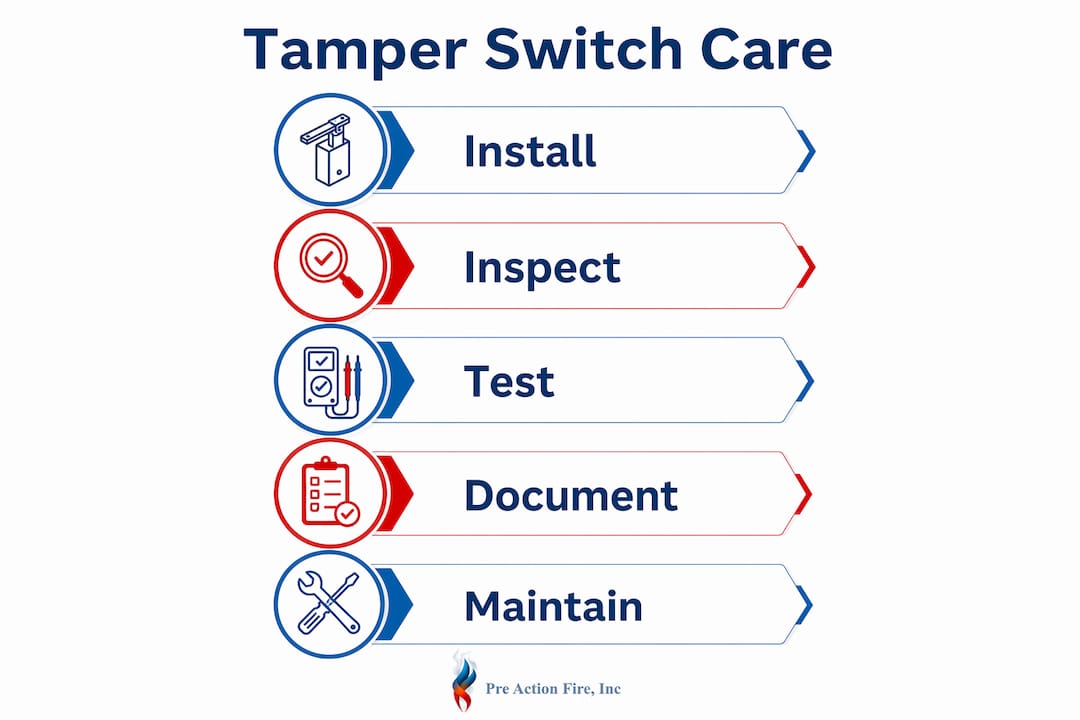
NFPA 13 mandates that all main control valves be supervised with tamper switches installed directly on the valve stem and integrated into the building’s fire alarm system. Valves must also be accessible, clearly labeled, and connected to supervisory monitoring. That requirement applies to new construction and to any system upgrade that touches the valve assembly.
Proper installation follows a specific sequence:
- Select the correct switch model for the valve type. OS&Y valves use a different actuator style than butterfly valves. Mismatched hardware causes false supervisory signals.
- Mount the switch on the valve stem so the actuator contacts the stem directly. Loose mounting is the most common installation error.
- Wire the switch to the FACP using supervised wiring. The circuit must be capable of generating a trouble signal if the wire is cut or grounded.
- Test activation timing after installation. The switch must signal the panel within two full turns of the handwheel.
- Document the installation with photos, wiring diagrams, and the valve’s location on your building’s fire protection plan.
Weatherproof tamper switches reduce false supervisory signals caused by condensation and temperature swings. Even indoor mechanical rooms experience humidity fluctuations that corrode standard switch contacts over time. Corrosion-resistant, weather-rated switches cost marginally more upfront and save significantly on service calls.
Maintenance schedules under NFPA 72 are straightforward. Semiannual visual inspections confirm the switch is physically intact and properly mounted. Annual functional testing verifies the switch signals the FACP correctly when the valve moves. Waterflow switches require quarterly testing, which is more frequent than tamper switches, but that difference does not make tamper switch testing optional.
Pro Tip: Build tamper switch functional tests into your annual fire protection inspection contract. Bundling them with sprinkler system inspections reduces scheduling gaps and keeps your documentation current for insurance audits.
Recordkeeping is not optional under NFPA 72. Every inspection and test result must be documented with the date, technician name, and outcome. Gaps in records are treated as failures during Authority Having Jurisdiction (AHJ) inspections. Reviewing fire safety documentation practices before your next inspection cycle is time well spent.
What common issues arise with tamper switches?
The most persistent problem with tamper switches is misinterpretation. Facility managers often mistake supervisory signals for fire alarms and either overreact or, more dangerously, dismiss them as nuisance alerts. Neither response is correct. A supervisory signal is a maintenance emergency, not a fire emergency.
A tamper switch supervisory signal means your sprinkler system’s water supply is at risk. Ignoring it does not make the risk go away. It removes your last warning before a fire finds an impaired system.
The consequences of ignoring supervisory signals extend beyond safety. Insurance carriers treat unaddressed supervisory signals as evidence of negligence. A fire loss in a building with documented ignored tamper alerts can result in denied claims or reduced payouts. That financial exposure is avoidable with a written internal response protocol.
Common operational issues include:
- False supervisory signals from condensation: Moisture inside the switch housing causes intermittent contact. Weatherproof-rated switches eliminate this.
- Wiring faults generating trouble signals: Cut or grounded wiring between the switch and FACP triggers a trouble signal, not a supervisory signal. The two are distinct and require different responses.
- Accidental activation during maintenance: Technicians partially closing a valve during routine work trigger the switch. A formal lockout/tagout procedure with FACP notification prevents unnecessary alarm responses.
- Switch mounting drift: Vibration in mechanical rooms loosens switch mounting over time. Semiannual visual checks catch this before it causes missed activations.
The greatest failure related to tamper switches is not device malfunction. It is the absence of a formal internal response plan when a supervisory signal appears. Every facility should have a written procedure that assigns a responsible person, sets a response time, and requires documentation of every supervisory event.
For guidance on connecting tamper switch monitoring to a broader fire safety program, fire monitoring service advantages for facility managers covers the operational framework in detail.
How do tamper switches compare with flow switches?
Tamper switches and flow switches are both supervisory devices, but they monitor entirely different conditions. Understanding the distinction prevents misdiagnosis during system troubleshooting.
Flow switches detect water movement through the sprinkler piping, indicating that sprinkler heads have activated or that a pipe has burst. A flow switch signal means water is flowing now. A tamper switch signal means a valve has moved. The two devices answer different questions about system status.
| Feature | Tamper switch | Flow switch |
|---|---|---|
| What it monitors | Valve position | Water movement in pipe |
| Signal type | Supervisory (amber) | Alarm or supervisory (varies) |
| Triggers fire department? | No | Often yes, depending on system |
| Testing frequency | Annually | Quarterly |
| Primary purpose | Prevent valve impairment | Detect active water flow |
The practical implication for facility managers is that both devices must function correctly for the sprinkler system to provide reliable protection. A closed valve with a working flow switch still fails. The flow switch cannot detect water movement if the valve is shut. Tamper switches protect the conditions that allow flow switches to do their job. For more on how water flow alarms fit into the broader system, that resource covers the operational relationship clearly.
For facilities managing supervised sprinkler systems under Colorado compliance requirements, both device types must be installed, tested, and documented per current NFPA standards.
Key Takeaways
A tamper switch is the supervisory device that protects your sprinkler system’s water supply by detecting valve movement before impairment occurs, and ignoring its signals creates both safety and insurance liability.
| Point | Details |
|---|---|
| Tamper switch definition | An electromechanical device that monitors valve position and sends supervisory signals to the FACP. |
| Signal color matters | Amber/yellow on the FACP means supervisory, not fire alarm. Treat it as a maintenance emergency. |
| NFPA compliance | NFPA 72 requires annual functional testing and semiannual visual inspections of tamper switches. |
| Wiring faults are separate | Trouble signals from cut or grounded wiring differ from supervisory signals and need immediate maintenance. |
| Response plan is mandatory | The biggest tamper switch failure is no formal internal response procedure when a supervisory signal appears. |
The security guard your sprinkler system cannot work without
After years of working with facility managers across commercial and industrial properties, the pattern I see most often is not broken equipment. It is broken awareness. A tamper switch fires a supervisory signal, and the person at the panel either does not know what it means or assumes someone else will handle it. Neither assumption is safe.
Think of the tamper switch as the security guard for your sprinkler water supply. It does not put out fires. It makes sure the system that puts out fires is ready to work. When that guard raises an alert, the right response is immediate investigation, not a note on a to-do list.
The facilities that handle tamper switch compliance well share one habit: they treat every supervisory signal as a documented event, even when the cause turns out to be a technician who partially closed a valve during routine work. That documentation habit protects you during AHJ inspections, insurance reviews, and post-incident investigations. It also builds the institutional knowledge that prevents repeat issues.
Integrating tamper switch checks into your regular safety audits, rather than treating them as a separate fire protection task, is the single most effective change most facilities can make. The construction signage and safety compliance framework used in high-risk construction environments applies the same principle: every supervisory device gets a documented check, every time.
— Results
Preactionfire supports your tamper switch compliance
Tamper switch compliance is not a one-time installation task. It requires annual testing, documented inspections, and a monitoring setup that catches supervisory signals in real time.
Pre Action Fire has served the Denver Metro Area since 2009, with NICET-certified technicians who specialize in fire alarm systems and sprinkler supervision. Their team handles tamper switch installation, functional testing, and full fire alarm system compliance for commercial and industrial properties across Colorado. If your last tamper switch inspection is overdue or your FACP documentation has gaps, contact Preactionfire to schedule a review before your next AHJ inspection.
FAQ
What is the tamper switch definition in fire protection?
A tamper switch is an electromechanical supervisory device that monitors the position of fire sprinkler control valves and sends a signal to the fire alarm control panel when a valve moves from its open position.
Does a tamper switch trigger a fire alarm?
No. A tamper switch sends a supervisory signal, displayed as amber or yellow on the FACP, which indicates system impairment rather than an active fire and does not automatically dispatch the fire department.
How often do tamper switches need to be tested?
NFPA 72 requires annual functional testing and semiannual visual inspections of tamper switches. Waterflow switches require more frequent quarterly testing.
What causes a trouble signal instead of a supervisory signal?
A trouble signal results from a wiring fault, such as a cut or grounded wire between the tamper switch and the FACP. It is distinct from a supervisory signal and requires immediate maintenance attention.
What is the difference between a tamper switch and a flow switch?
A tamper switch monitors valve position to prevent impairment before a fire occurs. A flow switch detects active water movement in the pipe, indicating that sprinkler heads have activated or a pipe has burst.