
Expect a single-head fix on a wet system to run $250 to $600, and expect a multi-head or dry-system pipe repair with a hydrostatic test to land anywhere from $1,500 to $8,000 or more. Emergency callouts, after-hours labor, and multi-zone impairments push those numbers higher fast. The sprinkler repair cost you land on depends less on the parts themselves than on access, system type, and how many components need attention at once.
Before you sign anything, get written, itemized quotes from NICET-certified contractors and confirm whether your jurisdiction requires a permit for the work. That single step protects your budget and your compliance record at the same time.
Quick cost snapshot:
- Small repairs (one head, a minor leak, a valve reposition): $250 to $700
- Medium repairs (multiple heads, joint or fitting repairs, minor pipe sections) typically require a moderate budget.
- Complex repairs (pipe replacement, hydrostatic testing, dry or preaction system work) can be quite costly
Key Takeaways
Sprinkler repair costs scale with system complexity and access difficulty far more than with the price of the part itself, and NFPA 25 makes prompt repair the owner’s legal responsibility, not an optional maintenance choice.
| Point | Details |
|---|---|
| Cost ranges by scope | Small repairs run $250 to $700, medium repairs $700 to $2,500, and complex jobs with pipe replacement or hydrostatic testing can exceed $8,000. |
| Access drives price more than parts | Lift rental, scaffolding, and ceiling access often cost more than the sprinkler component itself. |
| Owner responsibility is legal, not optional | NFPA 25 and NFPA 1 require owners to prioritize and budget for documented deficiencies without delay. |
| Documentation protects you later | Repairs performed and recorded by NICET-certified technicians hold up better with insurers and inspectors. |
| Preactionfire offers itemized, compliant repairs | Denver Metro-based since 2009, with NICET technicians, permit coordination, and 24/7 emergency response. |
Table of Contents
- Cost Breakdown by Repair Type
- What Actually Drives the Price on Your Bid
- Who Is Responsible for Repairs Under NFPA 25?
- How to Get Comparable, Compliant Bids
- Timelines and Minimizing Business Disruption
- What the Data Actually Tells Facility Managers
- Get an Itemized, NFPA-Compliant Repair Quote
- Sources
Cost Breakdown by Repair Type
Per-head replacement is the most common line item on a commercial invoice, and pricing swings hard based on head type. Standard upright or pendent heads run toward the lower end. Concealed heads, and heads on dry or preaction systems that require special coordination with the system’s air pressure or detection components, push costs up. Published cost guidance puts routine per-head replacement in the $250 to $600 range, with emergency service or hard-to-source specialty heads climbing toward $1,000 or more per head.
Typical price bands by component:
- Head replacement: $250 to $600 standard; $700 to $1,000+ for concealed or specialty heads under emergency conditions
- Leak repair (fitting, joint, or minor pipe section): $300 to $1,200, depending on how much ceiling or wall access is required
- Pipe replacement: $1,000 to $5,000+ for longer runs, especially where old galvanized or CPVC piping needs full sections swapped out
- Control valve repair or replacement: $500 to $3,000, and often triggers a hydrostatic test or flush afterward to confirm the repaired zone holds pressure correctly
- Hydrostatic testing: $300 to $1,000 depending on system size and number of zones tested
Permits and inspection fees are their own line item, and they vary by jurisdiction. Permit costs vary by jurisdiction; some use flat fees while others charge based on zones or devices, which can increase total expenses for large repairs. Contractor pricing guides consistently show total job costs vary widely by region, which is exactly why one quote is never enough.
What Actually Drives the Price on Your Bid
Two contractors can quote wildly different numbers for what looks like the same job. Here’s why:
- Access and equipment. Ceiling height, drop ceilings that need to come down, and high-bay warehouse space all require lifts or scaffolding. A repair that’s a quick ladder job in a retail space becomes a rented-lift job in a distribution center.
- System type. Wet systems are the cheapest to service. Dry and preaction systems involve more components, more diagnostic time, and often specialty heads that aren’t sitting on a truck.
- Number of affected heads or zones. Cost scales with count, but not always linearly. A 12-head job costs more than double a 6-head job once labor setup and testing get factored in, according to contractor cost modeling for multi-head jobs.
- Timing. After-hours or weekend emergency work typically carries a labor premium, sometimes double the standard rate.
Pro Tip: Ask every bidding contractor to break out equipment rental, permit fees, and testing separately. A bid that lumps everything into one number is hiding something, even if it’s not intentional.
Hidden costs deserve their own line of attention. Reinspection fees after corrective work, permit costs that differ by city, lift rental for warehouse ceilings, and water-damage restoration after an accidental discharge can each add hundreds to thousands of dollars that never show up in the initial verbal estimate.
Who Is Responsible for Repairs Under NFPA 25?
Short answer: you are, if you own or manage the building. NFPA doesn’t leave this ambiguous.
Building owners or their designated representatives are responsible for prioritizing, budgeting for, and ensuring timely repair of deficiencies identified during inspection. Waiting to see what happens is not a compliant response once a deficiency has been documented.
That standard comes straight from NFPA 25’s owner responsibility provisions, and NFPA 1 reinforces it by requiring that repairs be performed by qualified personnel and that owners receive written notification when a component needs replacement or falls under a recall.
Deficiencies generally fall into three buckets:
- Noncritical: minor issues that need correction but don’t impair system function immediately.
- Critical: deficiencies that reduce the system’s ability to perform as designed.
- Impairment: the system, or a portion of it, is out of service and needs immediate attention, often triggering fire watch requirements.
NFPA’s own guidance on inspection and maintenance notes that some fixes are as simple as repositioning a valve, while others require full component replacement or a deeper system investigation. Documentation from a NICET-certified technician matters here beyond compliance. It’s often what your insurer wants to see if a claim ever gets filed.
How to Get Comparable, Compliant Bids
A good RFP or bid comparison checklist saves you from apples-to-oranges quotes and surprise change orders later.
What to require in every quote:
- Itemized pricing for parts, labor, permits, and testing or documentation fees, listed separately
- Proof of NICET certification for the technicians actually performing the work
- Proof of insurance and at least two commercial references
- A clear statement of after-hours rates and what triggers them
Questions to ask before you sign:
- Are reinspection fees included, or billed separately if the repair fails initial testing?
- What’s the timeline from diagnosis to completion, and what happens if parts are backordered?
- How will the repair be documented for our compliance file and insurance carrier?
- What’s your change-order policy if the scope expands once work begins?
Itemized quotes that separate parts, labor, permits, and documentation make bid comparison far easier and cut down on invoice surprises. A good inspection workflow built around NFPA compliance also helps you catch deficiencies before they become emergencies.
Timelines and Minimizing Business Disruption
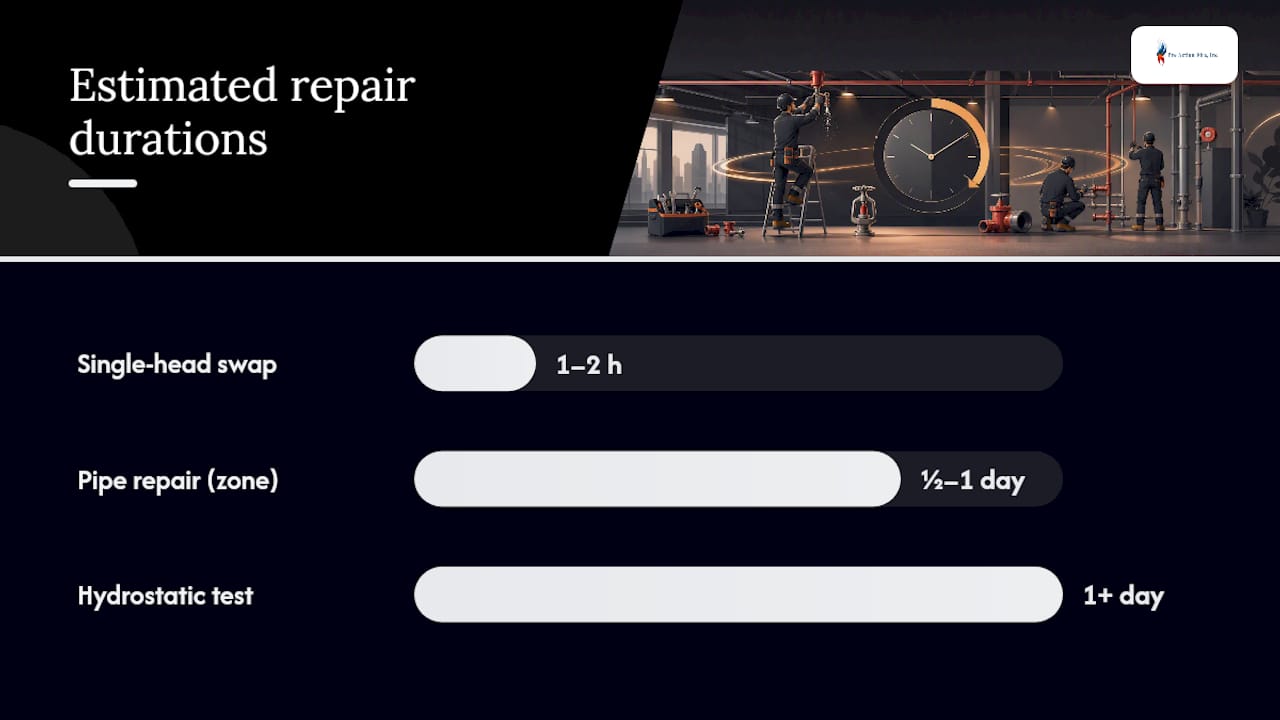
A single-head swap usually takes an hour or two, start to finish. Pipe repair or replacement on one zone typically runs a half day to a full day, depending on access. Full hydrostatic testing on a multi-zone system can stretch into a full working day or longer if multiple zones need isolation and refill.
Emergency response compresses that timeline but adds cost. Expect a premium for immediate dispatch, and expect the contractor to prioritize stopping the leak or isolating the zone over a full permanent fix on the first visit.
To limit disruption in occupied buildings:
- Schedule non-emergency repairs during off-hours or low-occupancy windows
- Notify your local fire authority if any portion of the system will be out of service, since impairments often require a temporary fire watch
- Confirm which zones stay protected during the repair so you’re not left with an unprotected floor without knowing it
What the Data Actually Tells Facility Managers
Most articles on this topic treat sprinkler repair like a home appliance fix: get three quotes, pick the cheapest, done. That advice misses the regulatory reality facility managers actually operate under. NFPA 25 doesn’t give you the option to defer a documented deficiency because the price felt high. Once it’s flagged, the clock is running, and “I got a lower bid but they couldn’t start for six weeks” is not a defense that holds up with an insurer or an AHJ.
The bigger blind spot is documentation. Facility managers often price-shop the repair itself and treat the paperwork as an afterthought. But a repair performed without a NICET-certified technician’s sign-off, without a post-repair hydrostatic test where one’s required, or without a written record leaves you exposed even if the physical fix was fine. The repair and the record are the same transaction, not two separate line items.
If there’s one thing worth doing differently: stop asking “what’s this going to cost” before you ask “what deficiency classification is this, and what does that require.” The classification determines your timeline and your legal exposure. The price follows from there, not the other way around.
Get an Itemized, NFPA-Compliant Repair Quote
Pre Action Fire has served the Denver Metro Area since 2009, and every repair quote comes itemized, permit-aware, and backed by NICET-certified technicians who document the work the way your insurer and your local AHJ expect to see it.
Plenty of contractors can swap a sprinkler head. Fewer can hand you a written repair record that holds up during your next fire marshal inspection or insurance audit, which is the part most budget comparisons skip entirely. Preactionfire handles inspection, repair, hydrostatic testing, permit coordination, and post-repair certification as one connected process, with 24/7 emergency response when a deficiency can’t wait for a scheduled visit. That means fewer surprise reinspection fees and a paper trail you can hand over without scrambling.
If you’re weighing quotes right now, request an itemized quote or emergency service and see exactly what a compliant repair actually costs before you commit to anyone.
Sources
- NFPA: NFPA 25 and properly maintaining a sprinkler system
- How Much Does Fire Sprinkler Head Replacement Cost? (2026)