
Prioritize life-safety autonomy first, then layer on event-based automation that connects fire alarms to access control, elevators, CCTV, and building management systems through UL-listed gateways and segmented networks. That order matters because a fire panel that depends on another system to function is a code violation waiting to happen.
Do this today:
- Confirm your fire alarm panel operates independently of any access control or security network fault.
- Pull your current cause-and-effect documentation (or start one) and identify which alarm events currently trigger which actions.
- Call your AHJ or fire alarm contractor if you’re not certain your last inspection covered integrated functions.
Key Takeaways
Successful fire and security integration depends on preserving fire alarm autonomy under NFPA 72 while automating door release, elevator recall, and HVAC response through UL-listed gateways and segmented networks.
| Point | Details |
|---|---|
| Life-safety stays autonomous | Fire alarm operation must never depend on another system’s uptime, per NFPA 72. |
| Build the matrix early | Map every event, triggered system, fail-safe behavior, and verification step before design. |
| Use UL-listed gateways | Avoid relay hacks; UL-listed protocol translation preserves compliance across Modbus, BACnet, and OSDP. |
| Segment the network | Keep fire alarm traffic on its own VLAN or physical path, backed by hardwired redundancy. |
| Test after every change | Re-run cause-and-effect verification whenever hardware or wiring changes, not just annually. |
Ready to scope an integration that satisfies your AHJ on the first inspection? Preactionfire’s fire alarm design and compliance team can build your cause-and-effect matrix, specify UL-listed hardware, and coordinate commissioning from design through sign-off.
Table of Contents
- Why Integrate Fire Alarm and Security Systems?
- What Conflicts Come Up Between Security and Fire Systems?
- How Do You Plan a Fire and Security Integration Project?
- Which Protocols and Gateways Connect Fire and Security Systems?
- What Should Automate When a Fire Alarm Activates?
- How Do You Secure the Network Behind an Integrated System?
- Which Codes and Standards Govern the Integration?
- How Should You Commission and Maintain an Integrated System?
- What Are the Most Common Integration Mistakes?
- What Belongs on a Fire and Security Design Checklist?
- How Long Does Integration Take and What Does It Cost?
- What Actually Determines Whether This Kind of Project Succeeds?
- Frequently Asked Questions
- Sources
Why Integrate Fire Alarm and Security Systems?
Integration speeds up egress and gives first responders a precise picture of where trouble started, not just that it started. When a smoke detector on the third floor trips, an integrated system can unlock that floor’s doors, pull up the nearest camera feed, and recall elevators, all before anyone dials 911.
Beyond life safety, integration cuts down on the operational drag of running separate systems: fewer nuisance alarms chasing security staff, one incident log instead of three, and faster root-cause review after every event. Engineers building ELV platforms that combine fire alarm, CCTV, and access control consistently find centralized visibility shortens response time, provided the fire alarm side stays isolated from failures elsewhere.
Pro Tip: Plan integration during the design phase of a new build or major renovation. Retrofitting a cause-and-effect matrix onto systems that were never meant to talk to each other costs far more than designing it in up front.
What Conflicts Come Up Between Security and Fire Systems?
Security wants doors locked. Fire code wants them open on alarm. That single tension causes more integration failures than any wiring problem. Add elevator logic (recall to a safe floor, not lockdown), network latency on IP-based triggers, and mismatched protocols between panels, and you have the standard list of friction points facility teams run into.
- Access control lockdown rules that conflict with required egress unlocking
- Elevator programs that don’t distinguish fire recall from security lockout
- Delayed automation because a security platform’s IP command took too long to register
- Protocol mismatches that leave two systems “connected” but not actually communicating
The non-negotiable rule: NFPA 72 requires that faults in non-fire systems never affect fire alarm operation. If your access control server crashes, your fire alarm still has to work. Life-safety functions must retain priority and autonomy over every other system in the building, full stop.
How Do You Plan a Fire and Security Integration Project?
A rushed integration plan is how facilities end up with doors that stay locked during a fire drill. Work the phases in order:
- Discovery. Inventory every panel, protocol, and wiring type currently in the building.
- Stakeholder alignment. Get fire protection, security, IT, and the AHJ in the same conversation before design starts.
- Design. Build the cause-and-effect matrix and select interface hardware.
- Procurement. Specify UL-listed components in every bid.
- Commissioning. Test every trigger, document every result.
- Maintenance. Schedule ongoing verification tied to your ITM program.
Discovery is where most projects lose time later if skipped. Confirm panel models, whether outputs are dry contacts or IP-based, current vendor relationships, and what your AHJ expects for documentation. Building a fire safety zone map at this stage makes the cause-and-effect matrix far easier to build.
Your integration matrix should track four columns for every scenario: the triggering event, every system it activates, the fail-safe behavior if a component fails, and how you’ll verify it worked.
Pro Tip: Bring your fire alarm contractor to the first stakeholder meeting, not the last one. Retrofitting their input after security and IT have already picked hardware creates rework nobody budgeted for.
Which Protocols and Gateways Connect Fire and Security Systems?
Fire panels talk in relay contacts. Security platforms talk in IP. Bridging those two worlds correctly is the entire game.
- Dry contacts and relays remain the most reliable trigger for critical actions like door release, because they don’t depend on network health.
- Serial connections (RS-485) link panels to older building automation systems where IP isn’t available.
- IP gateways let modern panels push data into a broader monitoring platform.
- UL-listed protocol gateways translate between fire alarm outputs and building protocols like Modbus and BACnet while preserving code compliance.
For access control hardware, plan around OSDP for reader-to-panel communication and ONVIF for camera interoperability, since both are the current standards most security vendors design to. When a fire panel and a BMS don’t speak the same language, a UL-listed gateway is the compliant answer, not a relay cobbled together by whoever’s on-site that day.
A shared software dashboard is not the same thing as a safe shared network. Fire alarm traffic needs physical or VLAN-based separation regardless of how integrated the interface looks on screen.
Addressable fire panels from major manufacturers, including Honeywell, Notifier, Edwards, Bosch, and GST, each offer IP modules and addressable loop capability worth verifying against your specific integration matrix rather than assuming feature parity across brands.
What Should Automate When a Fire Alarm Activates?
The moment a fire alarm goes into alarm state, a defined set of actions should fire automatically, without anyone touching a keyboard.
- Unlock all egress doors on the affected path and release electromagnetic door holders
- Recall elevators to the designated safe floor, away from the fire alarm zone
- Shut down or reconfigure HVAC per your smoke control sequence
- Push PA or EVAC messaging to the affected zone
- Pop up and begin recording the nearest CCTV feed
Every one of these actions needs a hardwired fallback. Access control override on alarm should combine a dry contact trigger with an IP confirmation message, so the door still unlocks even if the network connection drops.
| Alarm Event | Required Action | Verification Point |
|---|---|---|
| Smoke detected, Zone 3 | Doors unlock, camera pops up, HVAC shuts down | Confirm door contact status and camera timestamp match alarm log |
| Pull station activated, Lobby | Elevator recall, PA announcement | Verify elevator reaches safe floor before doors open |
| Sprinkler flow switch, Zone 5 | Door holders release, notification broadcast | Check holder release confirmation signal |
How Do You Secure the Network Behind an Integrated System?
Fire alarm traffic has no business sharing a switch with the office Wi-Fi. Segregate it physically or on its own VLAN, and never let a life-safety control path depend on the same infrastructure as guest network access.
- Run dual-path communication for critical actions: primary IP integration backed by hardwired relays
- Enforce least-privilege access on every device that can write to the fire alarm interface
- Patch firmware on a defined schedule, not reactively
- Log every configuration change and keep an incident response plan specific to your integrated systems
A 2024 workshop analysis of systems integrating fire protection (SIUP) found attack surfaces span human error, software, hardware, and both wired and wireless connections, and recommended dedicated training and audits as the strongest mitigations.
Pro Tip: Loop in your IT department during design, not after installation. A five-minute conversation about VLAN segmentation up front saves weeks of troubleshooting a “mystery” false alarm later.
Which Codes and Standards Govern the Integration?
NFPA 72 is the baseline, covering alarm signaling, acceptance testing, and ongoing inspection requirements. NFPA 101 and your local building code add occupancy-specific egress rules, and every interface device connecting fire alarm outputs to another system needs a UL listing.
- Reference NFPA 72, NFPA 101 where occupancy rules apply, UL listings for interface hardware, and your local AHJ’s specific requirements
- Document every cause-and-effect relationship for AHJ review before final acceptance
- Keep ITM (inspection, testing, maintenance) schedules current per NFPA 72 Chapter 14
Fire and life-safety functions must remain unimpaired by the failure of any non-fire system component. That single principle underlies almost every acceptance test your AHJ will run.
Facility teams preparing for inspection often find it faster to walk through fire alarm compliance requirements before finalizing a contractor scope.
How Should You Commission and Maintain an Integrated System?
Commissioning is where an integration plan either proves itself or falls apart in front of the inspector.
- Verify the integration matrix against actual installed hardware, line by line.
- Run every cause-and-effect scenario and log the result.
- Test redundancy paths by disconnecting the network and confirming hardwired fallbacks still work.
- Schedule AHJ witness testing before requesting final sign-off.
- Hand over complete documentation, including as-built matrices and wiring diagrams.
After commissioning, maintenance follows a rhythm: monthly visual checks, quarterly functional tests on a rotating sample, and a full annual cause-and-effect retest. Re-run the full matrix any time a system component changes, not just on the annual schedule.
Pro Tip: Insist on NICET-certified technicians for both installation and ongoing service. Certification isn’t paperwork, it’s the difference between a technician who understands why a fail-safe matters and one who’s just following a checklist.
What Are the Most Common Integration Mistakes?
Most integration failures trace back to a handful of repeat offenders.
- Running fire alarm circuits in the same conduit as data cabling, inviting interference and code violations
- Relying on IP commands alone for door release with no hardwired backup
- Programming fail-safe door logic backward, so doors lock instead of unlock on alarm
- Skipping AHJ consultation until after equipment is already purchased
If automation doesn’t behave as expected during a test, check the hardwired relay first, then the gateway configuration, then the network path. Call your fire alarm contractor before touching panel programming yourself.
What Belongs on a Fire and Security Design Checklist?
Give this list to any consultant before they draft a proposal.
- Define life-safety priorities and confirm they override every other system function
- List every system to integrate: access control, elevators, HVAC, CCTV, PA/EVAC
- Establish communication methods for each connection point
- Require UL-listed gateways for every protocol translation
- Define fail-safe behavior for each automated action
- Specify testing criteria and documentation requirements upfront
Start today by scheduling a stakeholder kickoff and collecting current panel model numbers plus wiring diagrams. Require contractors to submit an integration matrix, a redundancy plan, and a network segregation design as part of any proposal, not as an afterthought once the contract is signed.
- Integration matrix (event, systems triggered, fail-safe behavior, verification)
- Redundancy plan for every critical automated action
- Network segregation design reviewed by IT before installation
How Long Does Integration Take and What Does It Cost?
A small retrofit connecting an existing fire panel to access control typically runs 4 to 8 weeks. A medium upgrade adding CCTV and HVAC control stretches to 3 to 4 months. Full new-construction integration folds into the broader building timeline, often 6 months or more once commissioning and AHJ review are factored in.
- UL-listed gateways and interface hardware
- Labor for wiring, network changes, and commissioning
- Any AHJ-required component replacement discovered during acceptance testing
Phase the work if budget is tight: fund life-safety-critical automation (door release, elevator recall) first, then add CCTV pop-ups and reporting features in a second pass.
What Actually Determines Whether This Kind of Project Succeeds?
The projects that go smoothly all share one trait: fire, security, and IT sat in the same room before anyone picked hardware. The ones that drag on for months usually skipped that step and tried to reconcile conflicting requirements after equipment was already ordered. A documented cause-and-effect table, verified by NICET-certified technicians and signed off against NFPA 72, isn’t paperwork for its own sake. It’s the artifact that proves the system will do what it’s supposed to do when it matters.
Frequently Asked Questions
Does integrating security and fire systems violate NFPA 72?
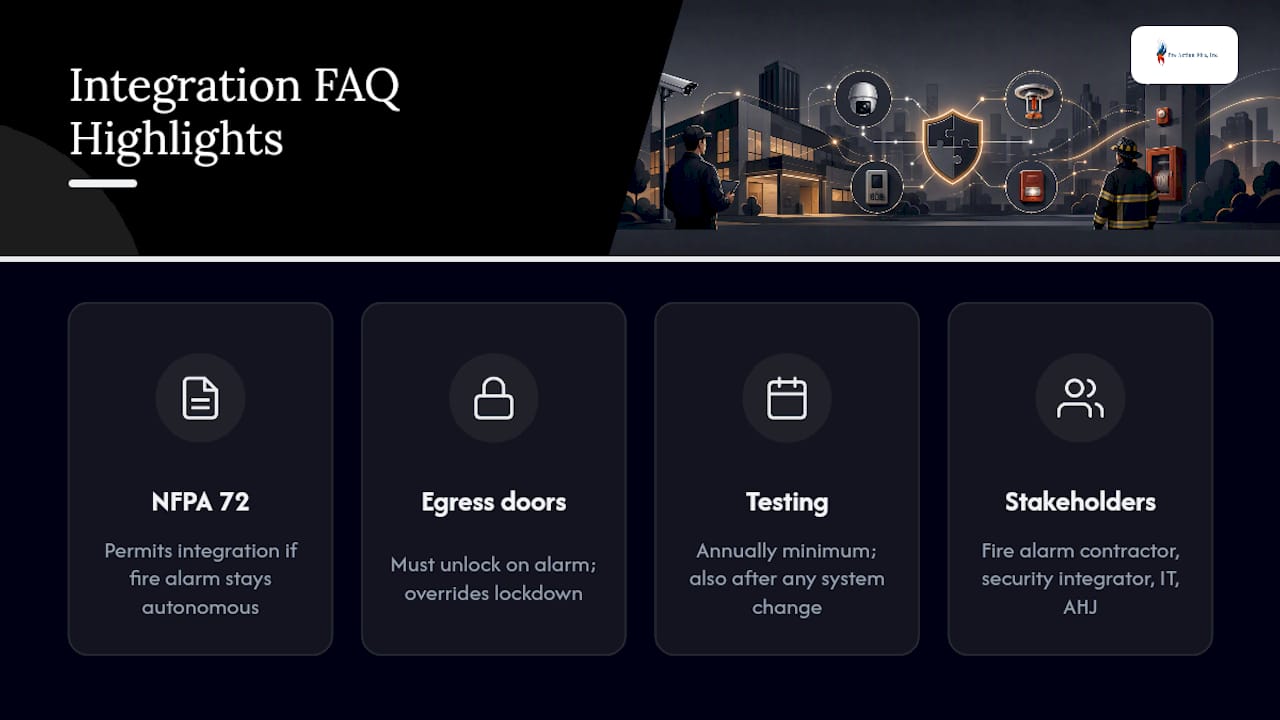
Not if designed correctly. NFPA 72 permits integration as long as fire alarm functions stay autonomous and unaffected by faults in the connected security or building systems.
Can access control lock doors during a fire alarm?
No. Egress doors must unlock automatically on alarm regardless of any security lockdown state, and this rule takes priority over every other access control instruction.
What’s the difference between a dry contact and a protocol gateway?
A dry contact is a simple hardwired relay trigger, reliable but limited to on/off signaling. A UL-listed protocol gateway translates richer data between systems using standards like BACnet or Modbus while preserving compliance.
How often should cause-and-effect testing be repeated?
Annually at minimum, aligned with NFPA 72 Chapter 14 ITM requirements, and immediately after any hardware, software, or wiring change to the integrated systems.
Who should be involved in planning a fire and security integration?
Your fire alarm contractor, security integrator, IT department, and the local AHJ should all weigh in during design, not after equipment has already been purchased.
Sources
- Fire alarm interface with elevator recall (NFPA 72 summary)
- Fire panel integration made easy with protocol gateways (FieldServer blog)
- NFPA (National Fire Protection Association)