
TL;DR:
- Fire risks in commercial buildings change with the seasons, requiring targeted safety precautions.
- Regular inspections, staff training, and documentation are essential to stay compliant and prevent fires throughout the year.
A guide to seasonal fire safety precautions is defined as a structured set of targeted actions that commercial property managers take to address fire risks as they shift throughout the year. NFPA standards 10, 25, 72, and 101 each govern specific systems in your building, from extinguishers and sprinklers to alarms and egress paths. Regulatory compliance is not optional. Failing a fire marshal inspection can trigger fines, mandatory shutdowns, and liability exposure that far exceeds the cost of prevention. This guide covers the specific hazards, inspection schedules, and audit methods that keep Denver-area facilities protected and compliant in 2026.
What seasonal fire hazards should you anticipate by season?
Fire risk does not stay constant. It shifts with temperature, occupancy patterns, and operational changes, and facility managers who treat fire safety as a once-a-year task consistently face the highest violation rates.

Winter hazards center on heating equipment and water-based suppression systems. Portable heaters placed near combustibles are a leading cause of commercial fires in cold months. Before winter, maintain a 3-foot clearance around all heating equipment and check dry sprinkler systems for air leaks that indicate compromised seals. Freezing pipes in unheated mechanical rooms can rupture sprinkler lines, causing water damage and leaving sections of your suppression system inactive.
Summer hazards shift toward electrical and mechanical systems. High ambient temperatures cause electrical panels to run hotter than their rated capacity. Before summer, test electrical panels for overheating and clear ventilation systems of accumulated dust and debris. Dust buildup on smoke detectors causes false alarms and, over time, alarm fatigue among your staff.
Holiday season hazards are the most underestimated. November and december carry the highest electrical fire risk in commercial buildings because of overloaded circuits powering seasonal lighting and displays. The specific culprit is daisy-chaining extension cords, which bypasses the circuit protection your panel was designed to provide. That risk compounds when seasonal inventory deliveries block exit corridors and stack product near electrical panels.
Transitional season hazards involve HVAC system strain during the switchover between heating and cooling modes. Filters clogged with winter debris restrict airflow, causing motors to overheat. Storage reorganization during spring and fall also creates temporary obstructions near sprinkler heads and exit paths.
Watch for these warning signs during any season:
- Outlet covers that feel warm to the touch
- Breakers that trip more than once per month on the same circuit
- Sprinkler heads with visible corrosion or paint overspray
- Exit signs with dim or flickering illumination
- Detector covers with visible dust accumulation
Pro Tip: Walk your facility with a thermal camera once per season. Electrical hot spots that are invisible to the eye show up immediately on infrared, and catching them early costs a fraction of what a panel fire does.
Which fire protection systems require seasonal maintenance?
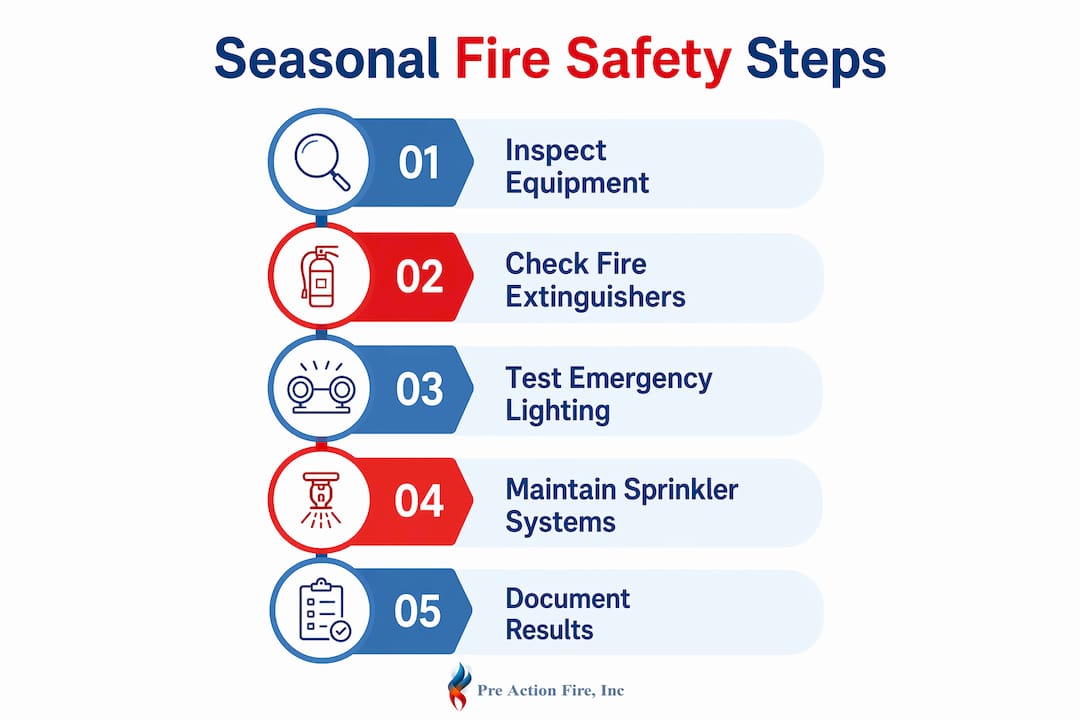
Commercial facilities must follow strict inspection cadences for every fire safety system under 2026 NFPA codes. The schedule is not uniform across systems, and mixing up frequencies is one of the most common compliance failures facility managers make.
Here is the inspection schedule by system and standard:
| System | Standard | Monthly | Quarterly | Annual |
|---|---|---|---|---|
| Fire extinguishers | NFPA 10 | Visual self-check | N/A | Professional inspection |
| Emergency lighting | NFPA 101 | 30-second test | N/A | 90-minute discharge test |
| Fire alarm system | NFPA 72 | Visual check | Self-test | Certified technician |
| Sprinkler system | NFPA 25 | Visual check | Self-test | Certified technician |
| Fire doors | NFPA 80 | Operational check | N/A | Annual inspection |
| Kitchen hood suppression | NFPA 96 | N/A | N/A | Semi-annual service |
Fire extinguishers require monthly visual checks and annual professional inspections under NFPA 10. That monthly check takes less than two minutes per unit and confirms the pressure gauge reads in the green zone, the pin is intact, and the unit is unobstructed.
Emergency lighting under NFPA 101 requires a 30-second monthly test and a full 90-minute discharge test annually. The annual test is the one most facilities skip. A battery that passes the 30-second test can still fail at the 45-minute mark, leaving your egress path dark during a real evacuation.
Sprinkler systems under NFPA 25 require quarterly self-checks and annual professional certification. Obstructions below sprinkler heads block spray patterns and are among the most cited code violations. Maintain a minimum 18-inch clearance below every head, year-round.
NFPA 25 mandates records for one year after the next inspection, but maintaining them for at least five years is the standard recommended practice for liability and insurance protection. That five-year window covers most statutes of limitation for property damage claims.
Pro Tip: Create a shared digital folder with a subfolder for each system. Every inspection report, technician certificate, and self-check log goes in immediately. When a fire marshal arrives unannounced, you hand them a tablet instead of searching filing cabinets.
How do you conduct a seasonal fire safety self-audit?
A monthly 47-point self-audit takes about 60 minutes and is the single most effective tool for avoiding code violations during annual fire marshal inspections. The audit covers five categories: egress, extinguishers, suppression systems, electrical hazards, and storage.
Follow this process for each audit:
- Start at the main entrance. Walk the primary egress path first. Confirm exit doors open freely, exit signs are illuminated, and the path to the public way is clear of obstructions.
- Check every extinguisher station. Verify pressure, pin, tamper seal, and mounting bracket. Note the last annual service tag date.
- Inspect suppression system components. Look for corrosion on sprinkler heads, check the control valve is in the open position, and confirm the 18-inch clearance below every head.
- Audit electrical areas. Electrical panel areas must maintain a minimum of 36 inches of clear working space. Seasonal load increases, especially in winter and during the holiday period, are when this clearance gets violated by temporary storage.
- Review storage and housekeeping. Confirm no combustibles are stored within 3 feet of heating equipment and that seasonal inventory has not blocked exit corridors or detector coverage zones.
Classify every finding into one of three categories before you leave the building:
- Fix immediately. Blocked exits, discharged extinguishers, inoperable emergency lights.
- Schedule a vendor call. Corroded sprinkler heads, alarm panel fault codes, hood suppression service overdue.
- Administrative correction. Missing log entries, unsigned inspection sheets, outdated emergency contact lists.
Documented, signed, and dated monthly self-audits are the strongest evidence you can present to an Authority Having Jurisdiction to reduce enforcement actions. A binder of consistent monthly records signals a proactive compliance program, not a reactive one.
Pro Tip: Photograph every deficiency you find and every correction you make. A timestamped photo of a blocked exit corrected the same day is far more persuasive than a written note during a post-incident investigation.
For a deeper look at how to structure your fire hazard check workflow, Preactionfire has published a step-by-step resource built specifically for commercial facility managers.
What behavioral and operational practices reduce seasonal fire risk?
Equipment maintenance addresses the physical side of fire risk. Human behavior and operational decisions drive the other half, and they are harder to control because they change with staffing, seasons, and business cycles.
Staff training is the foundation. Employees who understand why a specific rule exists follow it more consistently than those who see it as an arbitrary policy. Train staff at the start of each season on the specific hazards that season introduces. A 15-minute briefing before the holiday rush on extension cord policies prevents more fires than a posted sign.
Temporary storage and inventory spikes are a predictable seasonal risk. Retail and warehouse facilities see their highest inventory volumes in october and november, exactly when electrical fire risk peaks. Designate specific staging zones that are mapped away from electrical panels, sprinkler heads, and exit paths before the inventory arrives, not after.
Hot work permits are non-negotiable during summer renovation seasons. Any cutting, welding, or grinding on your property requires a written permit that identifies the work area, the fire watch duration, and the responsible supervisor. Enforce a 60-minute fire watch after all hot work stops, because smoldering materials can ignite an hour after the torch goes cold.
Seasonal changes cause nuisance alarms that lead to alarm fatigue. Proactive sensitivity testing before seasonal peaks reduces the desensitization that makes staff ignore alarms. A team that has heard 20 false alarms will hesitate during a real one. Schedule detector sensitivity checks before summer HVAC startup and before winter heating season begins.
Reviewing your building fire risks by type for your specific Colorado property category gives you a sharper picture of which behavioral risks apply most directly to your operations.
For facility managers who also manage construction scheduling alongside fire safety tasks, resources on construction task prioritization can help integrate fire safety milestones into broader project timelines.
Key Takeaways
Seasonal fire safety compliance requires a tiered, documented approach that addresses physical systems, human behavior, and regulatory records across all four seasons.
| Point | Details |
|---|---|
| Follow NFPA inspection cadences | Match monthly, quarterly, and annual checks to NFPA 10, 25, 72, 80, and 96 requirements by system. |
| Anticipate season-specific hazards | Address heating clearances in winter, electrical panels in summer, and circuit loads during the holiday period. |
| Conduct monthly 47-point self-audits | A 60-minute walk-through each month reduces code violations and builds a defensible compliance record. |
| Keep records for at least five years | NFPA 25 requires one year, but five years of signed records protects against liability and insurance disputes. |
| Train staff before each seasonal shift | A 15-minute seasonal briefing on specific hazards prevents more incidents than posted signage alone. |
Why reactive fire safety management costs more than it saves
Facility managers who wait for an inspection to reveal problems pay for it twice. They pay the fine, and they pay for the emergency repair on a timeline set by the fire marshal, not their budget cycle.
The pattern I see most often in commercial properties is a mismatch between inspection frequency and actual risk exposure. A manager will schedule the annual professional inspection and consider the job done, while the monthly self-checks, the ones that catch blocked exits and discharged extinguishers between visits, go undone for months.
The tiered prioritization approach changes that. Prioritize alarms and emergency lighting early in each season. Schedule suppression system checks mid-season. Use the final weeks of each quarter to close out documentation. That rhythm keeps every system current without creating a single overwhelming maintenance event.
Demonstrating proactive compliance to an Authority Having Jurisdiction is not just about avoiding fines. It builds a documented record that protects you in the event of a claim, a lawsuit, or an insurance dispute. A facility with five years of signed monthly audits and certified annual inspections is in a fundamentally different legal position than one with a single annual report.
Integrate seasonal fire safety into your broader facility management calendar the same way you schedule HVAC filter changes and roof inspections. It belongs on the same planning document, not in a separate binder that only comes out when the fire marshal calls.
— Results
Preactionfire: Seasonal fire safety services for Denver businesses
Preactionfire has served the Denver Metro Area since 2009, and seasonal compliance is one of the most common reasons facility managers call for a consultation.
Pre Action Fire’s NICET-certified technicians handle fire alarm system installation and compliance for commercial properties across Denver, Arvada, Westminster, and Commerce City. Services cover annual fire alarm certifications, sprinkler system inspections under NFPA 25, fire extinguisher programs, and full documentation packages built to satisfy Authority Having Jurisdiction requirements. If your property is approaching a seasonal inspection or you have not completed a professional system certification this year, contact Preactionfire directly to schedule a site assessment.
FAQ
What does a seasonal fire safety checklist include?
A seasonal fire safety checklist covers egress paths, fire extinguisher condition, sprinkler head clearance, electrical panel access, emergency lighting function, and detector sensitivity. The 47-point self-audit format addresses all five categories in approximately 60 minutes.
How often should commercial fire systems be professionally inspected?
Fire extinguishers require annual professional inspection under NFPA 10. Sprinkler systems require annual certification under NFPA 25. Fire alarm systems require annual certification under NFPA 72, with quarterly self-checks between visits.
What is the minimum clearance required below sprinkler heads?
NFPA 25 requires 18 inches of clearance below every sprinkler head. Obstructions within that zone block the spray pattern and constitute a code violation.
How long should fire inspection records be kept?
NFPA 25 mandates records for one year after the next inspection. Maintaining records for at least five years is the recommended practice for liability protection and insurance claim support.
What causes the most commercial fires during the holiday season?
Overloaded circuits from seasonal lighting and the misuse of daisy-chained extension cords are the primary causes. November and december carry the highest electrical fire risk in commercial buildings for exactly this reason.