
TL;DR:
- Most false fire alarms in commercial buildings result from detector sensitivity drift, dust, steam, or human error. Regular sensitivity testing, detector cleaning, and proper placement can significantly reduce nuisance activations. When fault codes persist, calling a NICET-certified technician ensures accurate diagnosis and effective resolution.
Most commercial false fire alarms trace back to a short list of root causes: detector sensitivity drift, dust or construction particulates, steam and cooking fumes, wrong detector type or placement, wiring and panel faults, aging devices, aerosols or insects, and human error at manual call points. If your panel is showing fault codes after an alarm, stop occupant troubleshooting immediately and call a certified technician.
- NFPA 72 requires sensitivity testing within one year of installation, then every two years, to catch detectors drifting outside their listed range before they cause chronic nuisance activations.
- U.S. fire departments respond to roughly 2.9 million false alarms annually, costing communities an estimated $350 million to $1.17 billion per year.
- If fault codes persist after a reset, do not let staff continue troubleshooting. Document the zone, time, and conditions, then escalate to a NICET-certified technician.
Table of Contents
- What causes most false alarms in commercial buildings?
- 1. Sensitivity drift in aging detectors
- 2. Dust and construction debris
- 3. Steam, cooking fumes, and humidity
- 4. Wrong detector type or poor placement
- 5. Wiring faults, ground faults, and power issues
- 6. End-of-life devices and firmware gaps
- 7. Aerosols, insects, and cleaning products
- 8. Accidental manual activation
- NFPA 72 sensitivity testing: what facility managers often miss
- What staff should do immediately after a false alarm
- A practical maintenance checklist to prevent nuisance alarms
- When to call a NICET-certified technician
- Liability and compliance risks you cannot afford to ignore
- Key Takeaways
- The pattern most facilities miss
- Preactionfire can help you stop the cycle
- Useful sources
What causes most false alarms in commercial buildings?
False alarm triggers fall into four broad categories, and knowing which bucket your problem fits helps you triage fast.
Environmental and airborne particulates cover dust from renovation work, steam from kitchens or restrooms, high humidity, and HVAC-driven contaminants. These are the most common culprits in active commercial buildings. A detector near a loading dock or above a breakroom stove is practically guaranteed to generate nuisance activations.
Operational and human causes include cleaning aerosols, accidental manual pull-station activation, hot work like welding, and maintenance activities that kick up fine particles. If your alarms cluster around shift changes or cleaning schedules, this category is worth investigating first.
Device age and contamination become significant once detectors pass the five-to-seven-year mark. Sensing chambers accumulate dust and debris over time, and the detector’s response drifts outside its listed sensitivity range without any obvious external trigger.
Electrical, panel, and communication faults produce intermittent or “ghost” alarms that seem random. Loose wiring, ground faults, power surges, and outdated firmware all fall here. Repeat patterns in the same zone at the same time of day often point to this category.
1. Sensitivity drift in aging detectors
Detectors do not fail all at once. They degrade gradually, and a device that still passes a functional test can be operating well outside its listed sensitivity range. That gap is exactly where nuisance alarms originate: the sensing chamber responds to ordinary airborne particles as if they were smoke.
NFPA and manufacturers commonly recommend replacement at or before 10 years, shorter in high-particulate environments like warehouses or kitchens. Scheduling replacements proactively, rather than waiting for repeated activations, is far cheaper than the alternative.
2. Dust and construction debris
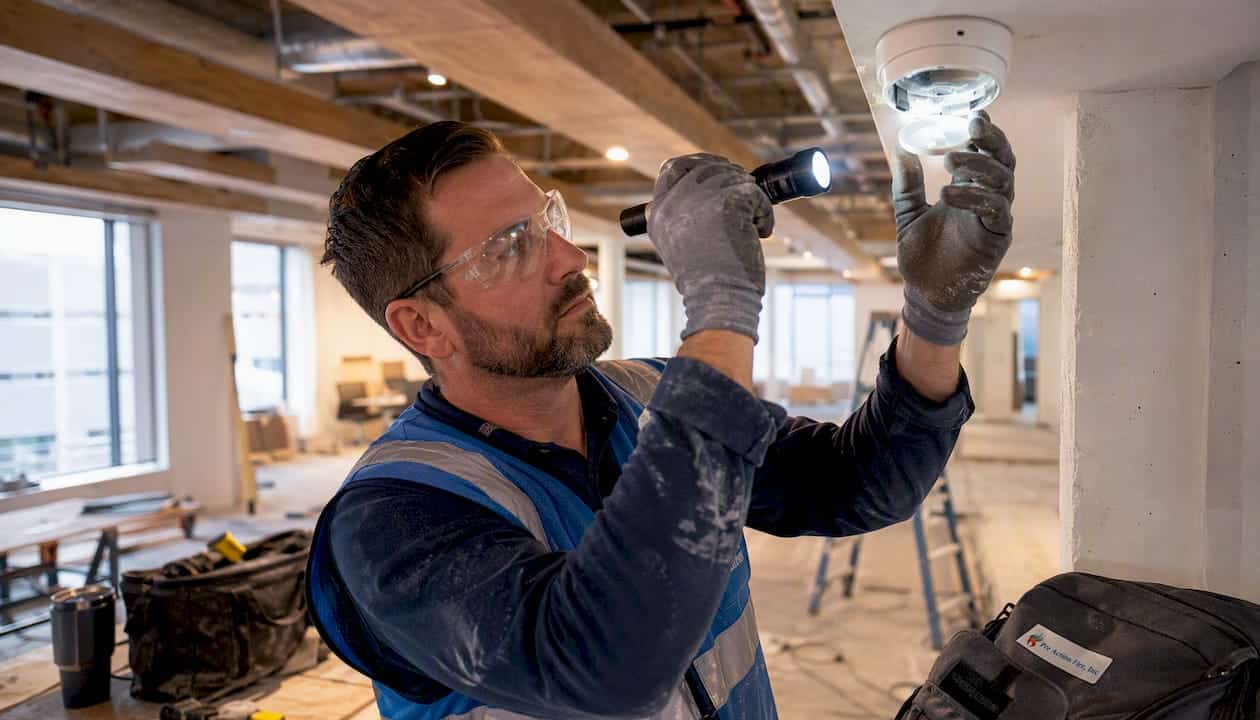
Renovation work is one of the most reliable false alarm triggers in commercial buildings. Drilling, drywall cutting, and ceiling work release fine particles that enter smoke chambers and mimic smoke behavior. HVAC systems then spread those contaminants across zones that were never near the work area.
Detector contamination from dust is a leading maintenance-related cause of nuisance activations. Temporary shielding or detector covers during construction, combined with a post-work cleaning and sensitivity check, prevents most of these events.
3. Steam, cooking fumes, and humidity
Commercial kitchens, boiler rooms, laundry areas, and restrooms produce steam that conventional optical sensors cannot easily distinguish from smoke. Photoelectric detectors are particularly vulnerable to humidity and aerosols near ventilation, which is why detector placement near kitchens or HVAC supply vents is a recurring problem in commercial settings.
Mitigation here is straightforward: improve local ventilation or hooding, keep breakroom doors closed, and relocate detectors that sit directly above cooking equipment where code permits.
4. Wrong detector type or poor placement
A detector installed in the right building but the wrong location will generate false alarms indefinitely. Common placement mistakes include positioning devices directly above air supply vents, near exhaust fans, above kitchen equipment, or close to loading dock doors where vehicle exhaust enters.
Airflow carries dust or combustion byproducts directly into the sensing chamber. If your false alarms spike when the HVAC cycles on, placement near a supply or return duct is the likely cause. A site survey that maps zones against HVAC flow and known particulate sources usually identifies these mismatches quickly.
5. Wiring faults, ground faults, and power issues
Loose connections, deteriorating insulation, and ground faults produce intermittent signals that the panel reads as alarm conditions. Older systems are most vulnerable, but any wiring disturbed during renovation work can introduce new faults. Power surges from the mains can also trigger panel activations without any detector involvement.
Pro Tip: Before calling a technician, note the exact zone, timestamp, and any recent maintenance or construction work in that area. Panel event logs are diagnostic gold, and that context cuts troubleshooting time significantly.
The panel will typically display trouble or supervisory codes alongside a fault-driven activation. Those codes are not noise — they are the system telling you the cause is electrical, not environmental.
6. End-of-life devices and firmware gaps
Aging detectors show progressive instability: more frequent random activations, slower response, and erratic sensitivity readings. A device that was installed during original construction and never replaced is a strong candidate for nuisance alarms, even if it has passed every annual functional test since. Functional tests only confirm that the device activates. They do not measure whether the sensing chamber is still within its listed sensitivity range.
Outdated panel firmware can also introduce communication errors that generate false alarm signals. Checking for manufacturer firmware updates is a quick step that is often overlooked during routine maintenance visits.
7. Aerosols, insects, and cleaning products
Aerosol sprays used during cleaning, pest control, or maintenance work introduce fine particles that photoelectric detectors read as smoke. Insects, particularly small ones that enter sensing chambers, account for a measurable share of nuisance activations. Scheduling cleaning activities outside occupied hours and using detector covers during spray applications reduces this risk significantly.
8. Accidental manual activation
Pull stations get bumped by equipment carts, activated by occupants who mistake them for light switches, or triggered during unauthorized testing. These events are logged in the panel and are easy to identify after the fact, but they still require a full evacuation response. Clear signage, physical guards on pull stations in high-traffic corridors, and staff training reduce accidental activations.
NFPA 72 sensitivity testing: what facility managers often miss
The single most common misconception in commercial fire alarm maintenance is treating a functional test as equivalent to a sensitivity test. They measure completely different things.
A functional test confirms that a detector activates when exposed to a test stimulus. A sensitivity test measures whether the detector’s sensing chamber responds within its listed range. A detector can pass a functional test while operating so far outside its sensitivity range that it triggers on ordinary dust or, conversely, might miss an actual fire.
NFPA 72 §14.4.3.2 requires initial sensitivity testing within one year of installation, then every two years. After two consecutive passing tests within the listed range, the interval may extend to a maximum of five years, provided the owner tracks nuisance alarm history. Sensitivity testing requires calibrated equipment or manufacturer-approved methods. Detectors found outside their listed range must be cleaned or replaced.
Scale of the problem: U.S. fire departments respond to roughly 2.9 million false alarms annually, costing communities an estimated $350 million to $1.17 billion per year. Most of those activations are preventable with proper sensitivity testing and maintenance.
| NFPA 72 Sensitivity Testing | Requirement |
|---|---|
| Initial test | Within 1 year of installation |
| Standard interval | Every 2 years |
| Extended interval | Up to 5 years after two consecutive passing tests |
| Out-of-range result | Clean or replace the detector |
Pro Tip: Only calibrated equipment or manufacturer-approved methods satisfy NFPA 72 sensitivity testing requirements. A visual inspection or standard functional test does not count.
For a deeper look at how regular system testing fits into a compliance program, Preactionfire’s testing guide covers the full commissioning and maintenance cycle.
What staff should do immediately after a false alarm
- Follow your evacuation policy. If building policy requires evacuation on any alarm activation, execute it. Do not assume it is a false alarm until the panel confirms it.
- Check the panel for zone and fault codes. Note the exact zone, timestamp, and any trouble or supervisory indicators displayed.
- Attempt a controlled silence and reset only if no trouble codes are present and your facility policy permits it.
- Ventilate the affected area if cooking, steam, or aerosol exposure is the suspected cause and it is safe to do so.
- Stop troubleshooting if the alarm reactivates after reset or if the panel shows persistent fault codes. Call a certified technician and notify your monitoring service per procedure.
- Log the event before memories fade. Capture: time, zone, suspected cause, weather or HVAC conditions, any recent maintenance or construction, actions taken, and who was notified.
If multiple zones activate simultaneously without an obvious environmental cause, treat it as a potential real emergency and contact the fire department per your emergency response plan.
A practical maintenance checklist to prevent nuisance alarms
Preventing false alarms is mostly a scheduling problem. Most causes are predictable and addressable before they generate an activation.
- Daily/weekly: Walk high-risk zones (kitchens, restrooms, loading docks, active construction areas) and check for visible dust accumulation on detector covers or HVAC vents nearby.
- Quarterly: Coordinate with housekeeping to avoid aerosol sprays near detectors; confirm detector covers removed during construction have been reinstalled and devices inspected.
- Annually (at minimum): Schedule a fire safety inspection that includes sensitivity testing per NFPA 72 intervals, cleaning of sensing chambers, and panel event log review.
- Every 10 years (or sooner): Replace detectors per manufacturer guidance and NFPA recommendations, shorter in high-particulate environments.
- Before and after construction: Coordinate temporary detector protection with your fire protection contractor; schedule a post-work sensitivity test for affected zones.
- HVAC coordination: Use the HVAC service checklist to time filter changes and duct cleaning so particulates are not introduced into detector zones without protection in place.
Pro Tip: Pull trend data from your panel’s event log and map activations against building activities. If alarms in Zone 4 cluster every Monday morning, look at what happens in that zone on Monday mornings — cleaning crew, HVAC startup, delivery traffic. The pattern is usually obvious once you look.
Do not use compressed air to clean sensing chambers unless the manufacturer explicitly approves it. Blowing air into a chamber can push contaminants deeper into the sensing element and worsen sensitivity drift.
When to call a NICET-certified technician
Some problems are beyond what facilities staff should handle. Call a certified technician when you see any of the following:
- The alarm reactivates immediately or within minutes after a reset
- The panel displays trouble, supervisory, or communication fault codes
- Multiple zones activate simultaneously without a clear environmental cause
- A single device keeps reactivating after cleaning
- Wiring work, renovation, or HVAC work has recently been completed in the affected zone
- The system has not had a sensitivity test within the NFPA 72 required interval
When you make that call, ask specifically for a NICET-certified technician with NFPA 72 experience. Request an event log download, sensitivity test results for affected devices, wiring continuity and supervision verification, and a written remediation plan with recommended parts and timelines. Collect device model and serial numbers, photos of the affected detectors, and copies of all test documentation for your records.
NICET certification matters because accurate diagnosis of wiring faults, sensitivity drift, and panel communication errors requires both calibrated equipment and code familiarity. A technician without that background may reset the system and leave without identifying the underlying cause, and the alarm will be back within days. For more on what to expect from a qualified technician visit, Preactionfire’s guide to certified fire technicians covers the diagnostic process in detail.
Liability and compliance risks you cannot afford to ignore
Repeated false alarms carry real financial and legal consequences for commercial property owners.
- Municipal fines escalate. Most jurisdictions impose escalating fines for repeat false dispatches, typically starting around $50–a few hundred dollars per incident and growing with each subsequent call. Chronic offenders can face permit suspension or mandatory system upgrades at their own cost.
- Occupant desensitization is a documented safety liability. When staff hear the alarm repeatedly and nothing happens, they stop evacuating promptly. People have died in real fires because occupants assumed it was another false alarm. NFPA guidance on maintenance exists precisely to prevent this outcome.
- Fire department response degrades. Crews responding to false alarms are unavailable for real emergencies, and departments in some jurisdictions deprioritize repeat offenders.
- Documentation gaps increase regulatory exposure. Keeping event logs, sensitivity test records, and remediation documentation demonstrates due diligence during AHJ inspections and reduces liability if an incident occurs.
Key Takeaways
Most commercial false fire alarms are preventable with NFPA 72-compliant sensitivity testing, consistent maintenance scheduling, and prompt technician dispatch when panel fault codes appear.
| Point | Details |
|---|---|
| Sensitivity testing is not optional | NFPA 72 requires it within 1 year of install, then every 2 years; functional tests do not substitute. |
| Document every activation | Log zone, time, conditions, and actions taken; event logs are the primary diagnostic tool for technicians. |
| Stop occupant troubleshooting on faults | Persistent fault codes or reactivation after reset require a NICET-certified technician, not a staff reset. |
| Replace aging detectors on schedule | NFPA and manufacturers recommend replacement at or before 10 years, sooner in high-particulate environments. |
| Preactionfire for Denver-area properties | Preactionfire provides NFPA 72 sensitivity testing, panel diagnostics, and NICET-certified technician dispatch across the Denver Metro Area. |
The pattern most facilities miss
The facility managers who call us after months of nuisance alarms almost always share one thing: they had been doing functional tests on schedule and assumed that covered them. It does not. A detector that activates when you hold a test to it is not the same as a detector operating within its listed sensitivity range. That gap is where chronic false alarms live, and it is exactly what NFPA 72 sensitivity testing is designed to close.
The other pattern worth naming: buildings that go through renovation without coordinating detector protection. Construction dust is predictable. Covering detectors, scheduling a post-work sensitivity test, and pulling the event log afterward costs a fraction of what repeated false dispatches and municipal fines will run you over a year.
If your building has had more than two nuisance activations in the past six months, the answer is not another reset. It is a methodical review of sensitivity test history, panel event logs, and device age. That review takes a few hours with the right technician and usually surfaces the cause immediately.
Preactionfire can help you stop the cycle
Chronic false alarms in a commercial building are a system problem, not a coincidence. Pre Action Fire has served the Denver Metro Area since 2009 with NICET-certified technicians who specialize in exactly this: NFPA 72 sensitivity testing, panel event log diagnostics, detector cleaning and replacement, and written remediation documentation your AHJ will accept.
If your building is generating repeat nuisance activations, the fastest path to resolution is a site visit from a technician who can pull your event log, run sensitivity tests on flagged devices, and give you a written plan. Preactionfire offers 24/7 emergency response for urgent situations and scheduled service for planned testing and maintenance. Contact Preactionfire to schedule a fire alarm system assessment for your Denver-area property.
Useful sources
- NFPA 72 Fire Alarm Code: Rules, Testing, and Penalties — LegalClarity: Covers NFPA 72 testing intervals, municipal fine structures, and owner obligations for sensitivity testing and documentation.
- NFPA 72 Fire Alarm Inspection Requirements — Up To Code: Detailed breakdown of functional vs. sensitivity testing requirements, the 2.9 million false alarm statistic, and detector replacement guidance.
- How To Prevent False Fire Alarms in Commercial Buildings — City Fire: Practical placement and ventilation guidance for reducing nuisance activations in commercial settings (UK-based source; placement principles apply broadly).
- Why False Fire Alarms Occur in Commercial Buildings — INNXEON: Engineering perspective on cause categories and prevention strategies.
- Common Causes of False Fire Alarms — Phil and Son: Practical overview of dirty sensors, HVAC interference, and human error triggers.