
TL;DR:
- Pre-action fire sprinkler systems are hybrid systems that delay water release until a detection event occurs, protecting high-value assets. They are ideal for environments like data centers, museums, and refrigerated warehouses where accidental discharge risks are unacceptable. Proper design, maintenance, and testing are essential to ensure their reliable operation and compliance with NFPA standards.
A pre-action fire sprinkler system is a dry-pipe hybrid that holds water back behind a pre-action valve and only admits it after a verified detection event, making it the right choice where accidental discharge would cause unacceptable damage. If your facility houses servers, archival collections, refrigerated inventory, or high-value electrical equipment, this is the system worth understanding in detail.
When to choose a pre-action system over wet or dry pipe:
- Water-sensitive assets: Data centers, server rooms, museums, and archival libraries where even a small unintended discharge causes catastrophic loss
- Freeze-risk spaces with high-value contents: Refrigerated warehouses and cold storage where both freeze protection and accidental-discharge prevention are required simultaneously
- Electrical and equipment rooms: Spaces where water contact with energized equipment creates secondary hazards
- When dry pipe is enough: If freeze protection is your only concern and accidental discharge is not mission-critical, a dry pipe system is simpler and less expensive
Table of Contents
- How a pre-action fire sprinkler system activates
- The three types of preaction sprinkler systems and how they differ
- Key components and what to specify during design
- Where pre-action systems make sense and how to choose
- Inspection, testing, and code obligations you need to budget for
- Benefits, drawbacks, and the risks owners underestimate
- What industry practitioners actually recommend
- Key Takeaways
- Why the conventional wisdom on pre-action systems gets it wrong
- Preactionfire handles pre-action systems from design through compliance
- Useful sources and further reading
How a pre-action fire sprinkler system activates
The core distinction from a standard dry pipe system is this: water cannot enter the piping until a detection device trips first. That single requirement drives every design and maintenance decision downstream.
Here is the activation sequence in order:
- Detection event: A smoke, heat, or flame detector on the releasing circuit activates and sends a signal to the fire alarm control panel.
- Pre-action valve opens: The releasing panel energizes a solenoid or pilot actuator on the pre-action valve, allowing water from the supply main to enter the dry piping.
- Pipe priming: Water fills the previously air- or nitrogen-supervised piping. In a double-interlock system, this step waits for both a detection signal and a sprinkler head operation.
- Sprinkler head activation: Individual sprinkler heads operate independently when the heat at their location melts the fusible link or shatters the glass bulb.
- Discharge: Water discharges only from heads that have physically opened, limiting water application to the fire area.
Throughout normal operation, the piping is maintained under supervisory air or nitrogen pressure, typically between 10 and 40 psi depending on the system design. Supervisory pressure switches monitor for leaks; a pressure drop triggers a trouble signal at the panel before it becomes a failure. Valve tamper switches confirm the pre-action valve remains in its open position, and alarm pressure switches confirm water has entered the system after valve actuation.
Detection placement is not optional engineering. In data centers, raised-floor plenums and overhead cable trays create airflow patterns that can delay smoke reaching a ceiling-mounted detector by minutes. NFPA 72 requires detectors to be placed where they will actually respond to the fire, not where they are easiest to install. In high-airflow spaces, that often means below cable trays or in the return air path.
Pro Tip: Specify nitrogen supervision instead of compressed air wherever possible. Nitrogen is inert and dramatically reduces internal pipe corrosion, which is a leading cause of pre-action system failures in humid or refrigerated environments.
One failure mode worth flagging: in a double-interlock system, the time between fire ignition and water discharge includes the air purge time needed to clear the piping after the valve opens. In large systems with long pipe runs, that can add 60 seconds or more to response time. That delay is the deliberate trade-off for accidental-discharge protection, and designers must account for it.
The three types of preaction sprinkler systems and how they differ
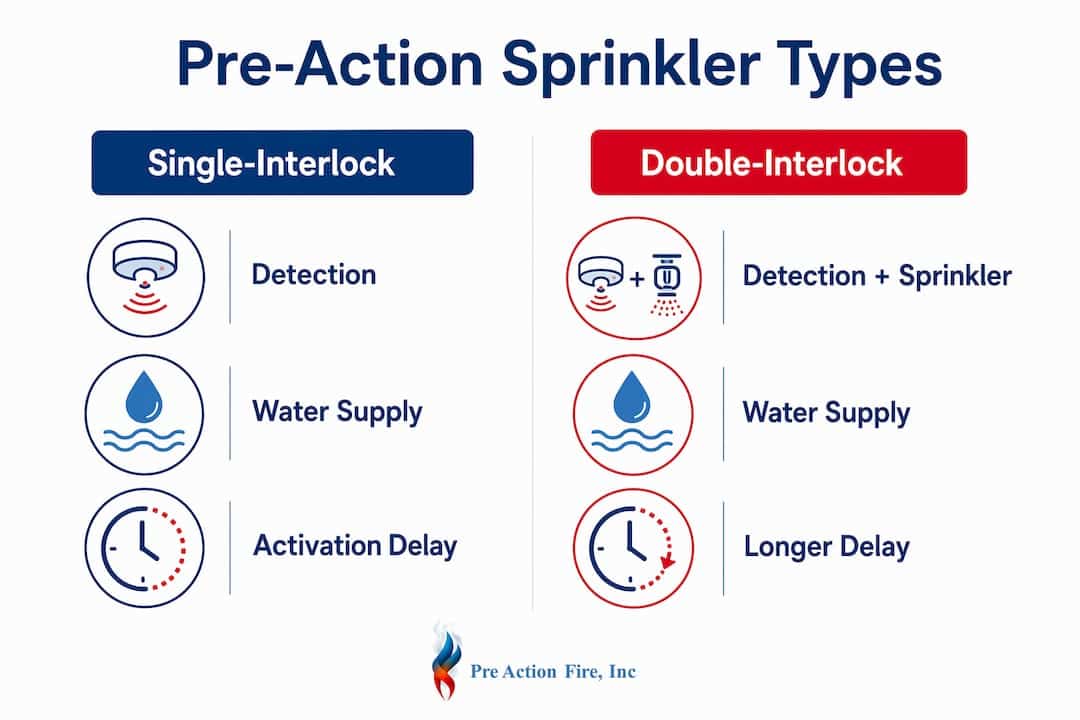
NFPA 13 defines three pre-action system configurations, and the choice between them is one of the most consequential decisions in the design process.
The core logic difference:
- Single-interlock: Requires only a detection event to open the pre-action valve and prime the piping. The sprinkler head then operates independently when heat activates it. Water reaches the fire faster than in a double-interlock arrangement.
- Double-interlock: Requires both a detection event and a sprinkler head operation before the valve opens. This is the most protective against accidental discharge but also the slowest to deliver water.
- Non-interlock: The pre-action valve opens on either a detection event or a sprinkler head operation, whichever comes first. It behaves similarly to a wet system once either condition is met, offering the least accidental-discharge protection of the three.
| System type | Best for | Activation logic | Accidental discharge risk | Complexity | Relative cost | Response speed |
|---|---|---|---|---|---|---|
| Single-interlock | Server rooms, electrical rooms where faster response matters | Detection event only | Low | Moderate | Moderate | Fast |
| Double-interlock | Freezer warehouses, data halls with strict no-water policies | Detection + sprinkler head | Very low | High | High | Slower |
| Non-interlock | Spaces needing detection-triggered priming with sprinkler backup | Either detection or sprinkler | Moderate | Low-moderate | Moderate | Fast |
Choosing the right type:
- Double-interlock systems were originally designed for freezer storage warehouses where water in the piping would freeze and cause pipe damage before any fire occurred. They remain the standard for below-freezing environments.
- Single-interlock systems suit spaces like electrical rooms or server rooms where the goal is accidental-discharge protection but faster water delivery is still desirable.
- Non-interlock systems are rarely the first choice for genuinely water-sensitive facilities; their protection profile is closer to a wet system.
Key components and what to specify during design
A pre-action system is more than a valve and some pipe. Getting the component list right at the specification stage prevents expensive retrofits later.
Core components every pre-action system requires:
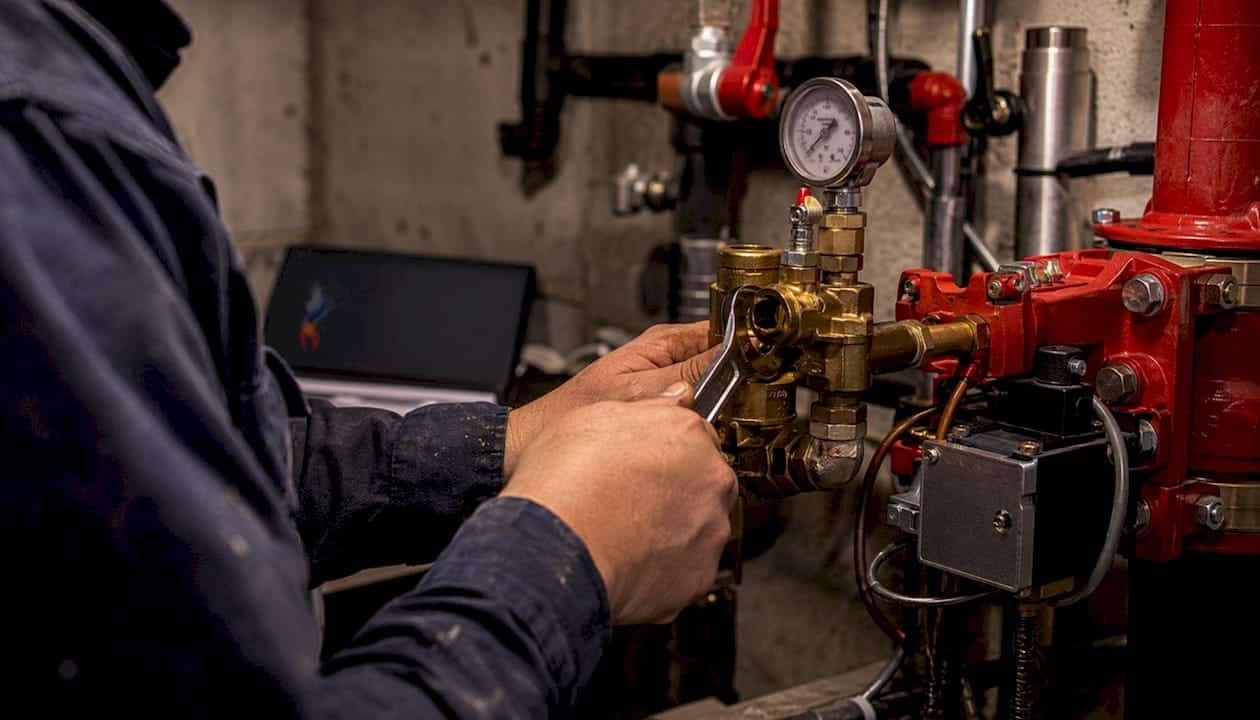
- Pre-action valve (deluge-style): The heart of the system. It must be a listed valve sized for the water supply demand. Specify trim kits that include manual release, automatic drain, and test connections.
- Solenoid or pilot actuator: Opens the valve on a signal from the releasing panel. Specify a normally-closed solenoid that opens on energization so a power failure does not inadvertently admit water.
- Air or nitrogen maintenance device: Maintains supervisory pressure in the piping. A nitrogen generator or dedicated supply cylinder is preferable to a shop-air connection in occupied facilities.
- Supervisory and alarm pressure switches: Monitor piping integrity and confirm valve actuation. Both must be listed and connected to the releasing panel.
- Listed sprinkler heads: Must match the hazard classification and spacing requirements of NFPA 13. Do not mix standard and quick-response heads without an engineering review.
- Releasing panel and fire alarm interface: The releasing panel must be listed for releasing service under NFPA 72. Integration with the building fire alarm system requires coordination between the sprinkler and alarm contractors.
Design checklist for spec writers and project owners:
- Confirm detection type and placement per NFPA 72 before finalizing the sprinkler layout
- Set minimum supervisory pressure per the valve manufacturer’s listing (typically 10–20 psi)
- Provide valve room access with adequate service clearance on all four sides of the trim
- Include low-point drum drips and daily drain valves for any refrigerated sections of piping
- Coordinate water supply sizing with the fire pump or municipal connection capacity; a fire pump inspection baseline is worth scheduling before design is finalized
- Specify seismic bracing for piping in areas subject to seismic activity or significant thermal cycling
Pro Tip: Specify a removable trim assembly and stock at least one spare solenoid valve on-site. Pre-action valve trim is the component most likely to need replacement after a trip test or an actual event, and lead times for specialty trim can run several weeks.
For refrigerated spaces specifically, detection devices must be fixed-temperature type rated for the ambient conditions, as recommended in this preventive roof maintenance guide that highlights building envelope integrity. Drum drips at low points need daily draining protocols to prevent condensate accumulation and freeze blockage, a requirement that often surprises facility managers encountering cold-storage systems for the first time.
Where pre-action systems make sense and how to choose
Pre-action systems carry a real cost premium over wet and dry pipe alternatives. That premium is justified in specific circumstances, not universally.
Common applications where the trade-off is worth it:
- Data centers and server rooms: A single accidental discharge can destroy millions of dollars in equipment and trigger extended downtime. The detection-triggered valve provides a meaningful barrier against mechanical head failure causing water damage.
- Museums and archival libraries: Irreplaceable collections cannot be replaced regardless of insurance. Pre-action systems are standard practice in climate-controlled collection storage.
- Refrigerated and freezer warehouses: Below-freezing temperatures make wet pipe impossible and dry pipe risky; double-interlock pre-action systems handle both constraints.
- Electrical and switchgear rooms: Water and energized equipment are a dangerous combination. The detection requirement reduces the chance of water reaching live equipment from a mechanical failure alone.
- Clean rooms and pharmaceutical manufacturing: Contamination from water is as damaging as fire in some production environments.
Decision checklist for owners and managers:
- Is freeze protection your only concern? If yes, evaluate dry pipe first — it is simpler and less expensive.
- Would accidental water discharge cause losses exceeding the cost premium of a pre-action system? If yes, pre-action is justified.
- Does your facility have the maintenance staff or service contract capacity to support a system that combines mechanical and electronic components? If no, factor that cost in before specifying.
- Use a structured fire system needs assessment to document the answers before committing to a system type.
Cost and timeline considerations:
Pre-action systems cost more than wet pipe systems and more than standard dry pipe, driven by the valve assembly, detection infrastructure, releasing panel, and commissioning complexity. Costs vary significantly by system size, interlock type, detection technology, and local labor rates. Double-interlock systems at the high end of complexity cost more than single-interlock arrangements of comparable size.
- Procurement lead times for listed pre-action valves and trim can run 8–16 weeks for large or specialty assemblies
- Commissioning requires coordinated testing between the sprinkler contractor and the fire alarm contractor, adding scheduling complexity
- Budget for acceptance testing by the authority having jurisdiction (AHJ), which may require a full trip test witnessed by an inspector
Inspection, testing, and code obligations you need to budget for
Three NFPA standards govern pre-action systems: NFPA 13 covers installation, NFPA 72 governs the detection and releasing logic, and NFPA 25 sets the inspection, testing, and maintenance schedule. Neglecting any one of the three undermines the whole system.

| Test or inspection item | Frequency | Standard | Notes |
|---|---|---|---|
| Visual inspection of valve, trim, gauges | Monthly | NFPA 25 | Confirm supervisory pressure, no visible leaks |
| Supervisory air/nitrogen pressure check | Weekly or per panel monitoring | NFPA 25 | Automated monitoring acceptable with listed panel |
| Alarm and supervisory device testing | Annually | NFPA 72 | Coordinate with alarm contractor |
| Full trip test of pre-action valve | Every 3 years | NFPA 25 | Witnessed test; confirm valve opens and water reaches inspectors test connection |
| Air leakage hold test | Per NFPA 25 schedule | NFPA 25 | 4-hour hold with air source off, or 2-hour test at 40 psi; loss greater than 3 psi requires corrective action |
| Sprinkler head inspection | Annually (visual); replace per age/type | NFPA 25 | Listed heads have defined replacement intervals |
| Detection device functional test | Annually | NFPA 72 | Each detector on the releasing circuit must be tested |
Practical coordination tips:
- Schedule the annual alarm test and the sprinkler inspection on the same day. Combined visits reduce downtime and catch integration failures that neither contractor would find working alone.
- Use NICET-certified technicians for commissioning and any service that involves the releasing panel or valve actuation. NICET certification is the industry benchmark for competency on systems this complex.
- Maintain a test log at the riser and a digital copy in your facility management system. AHJ inspectors expect to see documented test history, and gaps in records can trigger violations even when the system itself is functional. Fire safety documentation practices are worth standardizing before your first inspection.
- For Denver-area compliance reminders, local AHJ requirements may add to the NFPA baseline.
Benefits, drawbacks, and the risks owners underestimate
The genuine advantages:
- Accidental discharge from a single mechanical head failure cannot occur without a simultaneous detection event (single-interlock) or both detection and head operation (double-interlock)
- Suitable for freeze-risk environments where wet pipe is not viable
- Provides an early warning signal when the detection system activates, giving occupants and operators time to investigate before water is committed
- Compatible with water-sensitive assets where any unintended wetting is unacceptable
The real drawbacks:
- Higher initial cost than wet or dry pipe systems, driven by detection infrastructure and valve complexity
- More complex commissioning requiring coordination between two licensed contractors
- Potential delay in water application, particularly in double-interlock systems with long pipe runs
- Greater number of components means more points of potential failure if maintenance is deferred
Risk scenarios that actually happen in the field:
- Detection failure: A detector that fails to activate leaves the pre-action valve closed even when a sprinkler head opens. The system delivers no water. This is the most serious failure mode and the strongest argument for regular detector testing.
- Frozen condensate: In refrigerated spaces, condensate in low points of the piping can freeze and block water flow after the valve opens. Drum drips and daily drain protocols exist specifically to prevent this.
- Stuck or corroded valve: A pre-action valve that has not been trip-tested in years may fail to open when commanded. The 3-year full trip test requirement in NFPA 25 is not arbitrary.
- Incorrect detector placement: Detectors placed too far from likely ignition sources, or in locations where airflow carries smoke away, can delay valve actuation by minutes.
Pro Tip: In data centers, consider cross-zoned detection (requiring two detectors to activate before the valve trips) to reduce nuisance trips, but pair it with a single-interlock valve rather than double-interlock to avoid compounding the response delay.
What industry practitioners actually recommend
The most consistent advice from experienced fire protection engineers is also the least followed: specify the simplest system that meets your protection objectives.
The more interlocks you add, the more ways the system has to fail to deliver water when you need it. Double-interlock systems are the right answer for freezer warehouses and a handful of genuinely mission-critical data halls. For most electrical rooms and server closets, a single-interlock system provides adequate accidental-discharge protection without the operational penalties. Specifying double-interlock everywhere is a common and expensive mistake.
Misconceptions that lead to poor decisions:
- “More components means better protection.” More components means more maintenance, more testing, and more failure modes. A system that requires two independent events to deliver water can fail to deliver water in two independent ways.
- “Cross-zoned detection is the same as double-interlock.” Cross-zoning is a detection configuration that requires two detectors to activate before releasing the valve. Double-interlock requires both detection and a sprinkler head operation. They are not interchangeable, and confusing them leads to systems that are either over-specified or under-protected.
- “NFPA 25 testing is optional if nothing has gone wrong.” NFPA 25 testing is a code requirement, not a suggestion. Deferred testing voids the system’s compliance status and can affect insurance coverage.
- Underestimating maintenance costs: Because pre-action systems combine mechanical and electronic components, they require coordinated service from both sprinkler and alarm contractors. Budget for both, annually.
For cold-storage spaces specifically, fixed-temperature detectors rated for the ambient temperature must be used. Rate-of-rise detectors do not function reliably in environments that are intentionally cold, and using them in a freezer is a specification error that will not be caught until the system fails to trip.
Key Takeaways
Pre-action fire sprinkler systems are the right choice for water-sensitive, freeze-risk, or high-value facilities, but they require disciplined maintenance across both mechanical and electronic components to remain reliable.
| Point | Details |
|---|---|
| Choose pre-action for water-sensitive spaces | Data centers, museums, freezer warehouses, and electrical rooms justify the cost premium. |
| Match interlock type to your risk profile | Double-interlock for below-freezing or strict no-water environments; single-interlock where faster response matters more. |
| NFPA 25 mandates a full valve trip test every 3 years | Air leakage tests require a 4-hour hold or 2-hour test at 40 psi; loss greater than 3 psi triggers corrective action. |
| Coordinated maintenance is non-negotiable | Pre-action systems need both a sprinkler contractor and an alarm contractor testing together annually. |
| Preactionfire | Preactionfire provides design, installation, NFPA 25 testing, and emergency repair for pre-action systems across the Denver metro area. |
Why the conventional wisdom on pre-action systems gets it wrong
The standard advice you will find almost everywhere frames pre-action systems as a premium upgrade, implying that more protection is always better and that double-interlock is the gold standard. That framing is wrong in a specific and costly way.
Double-interlock systems are the right answer for a narrow set of applications: below-freezing environments where water in the piping would cause damage before any fire, and a small number of genuinely mission-critical data halls where the owner has explicitly accepted slower suppression in exchange for near-zero accidental-discharge risk. Outside those cases, the added complexity creates failure modes that a simpler system avoids entirely.
The more interesting question for most facility managers is not “pre-action or wet pipe” but “which pre-action type, and is pre-action even necessary here?” A single-interlock system in a server room gives you meaningful accidental-discharge protection without the response delay of double-interlock. A wet system in a climate-controlled electrical room with no freeze risk gives you faster suppression and a fraction of the maintenance burden. The decision should follow the asset risk, not the assumption that complexity equals protection.
What practitioners in the field see repeatedly is over-specification driven by liability anxiety rather than engineering analysis. The result is systems that are harder to maintain, more expensive to test, and statistically more likely to fail to deliver water when needed. The NFPA standards exist precisely to prevent that outcome. Use them as a floor, not a ceiling.
Preactionfire handles pre-action systems from design through compliance
Specifying a pre-action system is only the beginning. The systems that actually protect your facility are the ones that get commissioned correctly, tested on schedule, and repaired by technicians who understand both the mechanical valve and the releasing panel behind it.
Pre-Action Fire has served Denver-area commercial and industrial facilities since 2009, with NICET-certified technicians who handle the full lifecycle: needs assessments, design and specification review, sprinkler installation for new construction and retrofits, NFPA 25 inspection and documentation, commissioning witnessed by the AHJ, and 24/7 emergency repair. The team also manages fire alarm system integration for pre-action releasing panels, which is the coordination point most facilities get wrong. If your facility is in the Denver metro area and you need a site survey, a service agreement, or a second opinion on an existing system, contact Preactionfire directly to schedule an assessment.
Useful sources and further reading
Designers, compliance officers, and facility managers working through a pre-action system specification or maintenance program should consult these primary sources directly:
- NFPA 13 — Standard for the Installation of Sprinkler Systems: The governing installation standard. Chapter 8 covers preaction and deluge systems, including the three interlock types and detection/release requirements.
- NFPA 72 — National Fire Alarm and Signaling Code: Governs the detection and releasing logic that actuates the pre-action valve. Required reading for anyone specifying or testing the alarm interface.
- NFPA 25 — Standard for the Inspection, Testing, and Maintenance of Water-Based Fire Protection Systems: Sets the testing schedule, trip test intervals, air leakage thresholds, and documentation requirements for pre-action systems.
- NFPA Sprinkler System Types Overview: A plain-language introduction to system types from NFPA, useful for briefing non-technical stakeholders.
- Engineered Fire Systems technical guide: Covers wet, dry, pre-action, and deluge systems with operational comparisons and maintenance considerations.
- PHCP Pros: Specifying Preaction Systems: Practitioner-focused guidance on avoiding over-specification and managing detection placement in challenging environments.
- Preactionfire local service pages: The Preactionfire website includes service pages for NFPA compliance inspections, installation, and testing across the Denver metro area, with documentation resources for AHJ submissions.