
The fire safety equipment lifecycle has seven stages: planning/design, procurement, installation/commissioning, monitoring/operation, inspection/testing/maintenance (ITM), repair/upgrade, and replacement/decommissioning. Your immediate next step is to map every asset in your facility to its NFPA or OSHA inspection clock and log it in a CMMS (computerized maintenance management system).
That mapping exercise is not optional. NFPA 25 governs ITM intervals for water-based systems, and OSHA 1910.157 governs portable extinguishers. Together they set the legal floor for what you must inspect, how often, and what you must document. Miss a tier on either standard and your system can be recorded as impaired by the Authority Having Jurisdiction (AHJ), with insurance and liability consequences that follow.
- Stage 1: Planning/Design
- Stage 2: Procurement
- Stage 3: Installation/Commissioning
- Stage 4: Monitoring/Operation
- Stage 5: Inspection/Testing/Maintenance (ITM)
- Stage 6: Repair/Upgrade
- Stage 7: Replacement/Decommissioning
Pro Tip: Before reading further, pull your asset register and check whether every entry has an install date, a governing standard, and a next-ITM-due date. If any of those three fields are blank, you have a compliance gap today.
Key Takeaways
A complete fire equipment lifecycle program requires a current asset register, CMMS-enforced ITM schedules, and licensed technicians performing the tasks that standards require of them.
| Point | Details |
|---|---|
| Seven lifecycle stages | Every fire asset moves through planning, procurement, installation, operation, ITM, repair/upgrade, and decommissioning. |
| CMMS is the operational backbone | Map each asset’s NFPA/OSHA inspection tier to a recurring work order; a single annual template misses quarterly and semiannual tasks. |
| Nonrefillable extinguishers retire at 12 years | Age alone is the trigger; no hydrostatic test can extend service life for nonrefillable units under OSHA 1910.157. |
| Repair vs. replace heuristic | If repair cost exceeds 40–50% of replacement cost and the asset is past 70% of expected life, replacement is usually the stronger financial and safety decision. |
| Preactionfire as your lifecycle partner | Preactionfire’s NICET-certified technicians provide asset surveys, NFPA ITM inspections, and documented reports that feed directly into your compliance record. |
Table of Contents
- What are the fire equipment lifecycle stages and what happens at each one?
- What are the typical lifespans and replacement triggers for common fire assets?
- What do NFPA 25, NFPA 72, and OSHA require for inspection and testing intervals?
- How does the extinguisher lifecycle work from first use to retirement?
- How do you decide whether to repair, overhaul, or replace a fire asset?
- How do you build and run a fire equipment lifecycle program?
- What does a 12-month fire equipment inspection schedule look like?
- What facility managers actually get wrong about lifecycle programs
- Preactionfire handles the lifecycle work your team cannot
- Sources
What are the fire equipment lifecycle stages and what happens at each one?
The seven stages below are not just a conceptual framework. Each one has a responsible owner, a deliverable, and a set of standards that govern what must happen before the next stage begins.
- Planning/Design — A licensed fire protection engineer or design-build contractor sizes the system, selects equipment types, and specifies components to meet the applicable edition of NFPA 13 (sprinklers), NFPA 72 (alarms), or the relevant suppression standard. The deliverable is a stamped set of drawings and a hydraulic calculation. Owner: design engineer or fire protection contractor.
- Procurement — Equipment is sourced against the approved specification. Substitutions require engineering review; off-spec components can void listings and create code violations at inspection. Owner: procurement or project manager.
- Installation/Commissioning — A licensed contractor installs per the approved drawings. Code-compliant installation requires a pre-commission acceptance test witnessed by the AHJ. Record the test date, inspector name, and pass/fail results in your asset register before the system goes live. Owner: installing contractor and commissioning agent.
- Monitoring/Operation — The system is in service. Central station monitoring (for alarms) and routine visual checks by trained facility staff begin. Any change in occupancy, hazard classification, or building configuration that affects the system triggers a design review. Owner: facilities team and monitoring provider.
- Inspection/Testing/Maintenance (ITM) — This is the longest and most compliance-intensive stage. NFPA 25 and OSHA 1910.157 set recurring intervals from weekly to 12-year cycles. Licensed technicians perform most tests; trained staff can handle some visual checks. Owner: licensed fire protection technicians and facilities staff (delineated by contract).
- Repair/Upgrade — Defects found during ITM generate corrective work orders. Upgrades triggered by code changes, occupancy shifts, or technology obsolescence may require a return to Stage 1 (new design review). Owner: licensed technicians, with engineering sign-off for scope changes.
- Replacement/Decommissioning — Assets that exceed their useful life, fail hydrostatic testing, or cannot be maintained to current standards are retired. Decommissioning requires AHJ notification for suppression systems and proper disposal of agents and cylinders. Owner: asset manager and licensed contractor.
Pro Tip: Treat any major repair or upgrade as a lifecycle reset. NFPA 3 (commissioning) and NFPA 4 (integrated testing) require that modified systems be retested as a whole — not just the replaced component — to confirm alarms, sprinklers, and smoke control still operate together. Log the new commissioning date as the asset’s effective install date going forward.
What are the typical lifespans and replacement triggers for common fire assets?
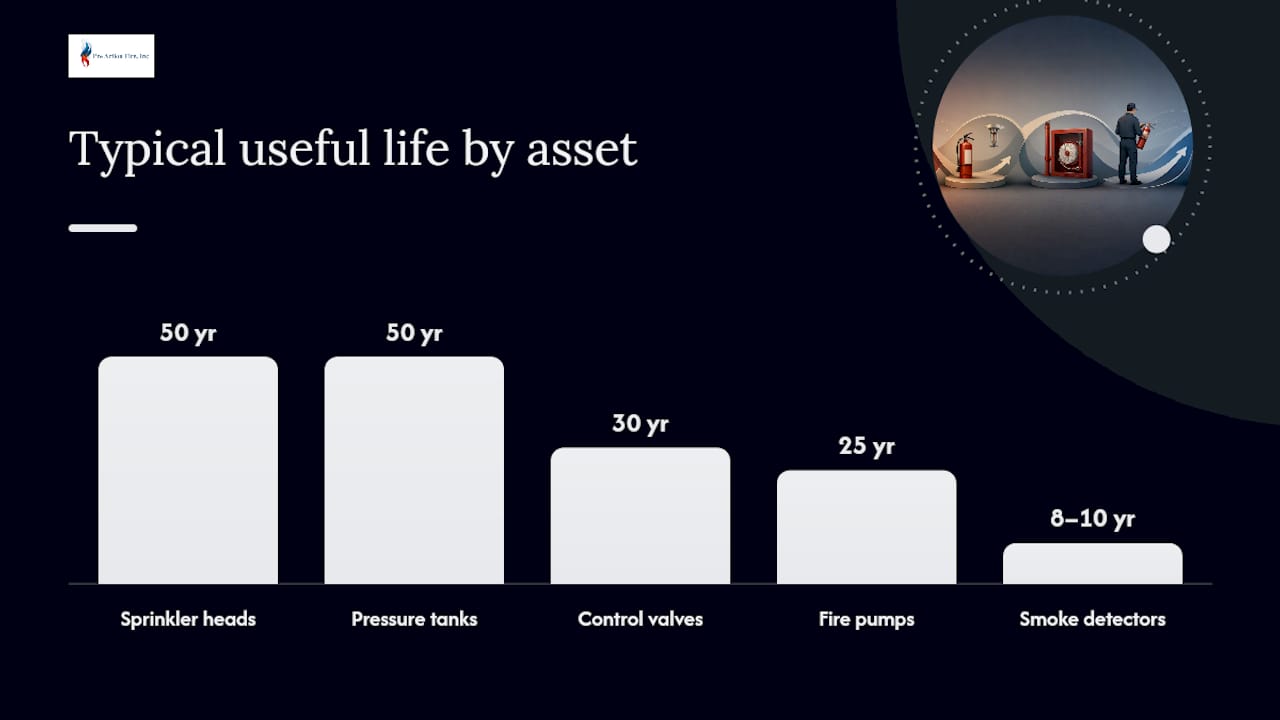
Lifespan ranges vary by asset type, environment, and maintenance history. The table below reflects generally accepted guidance from NFPA standards and fire protection engineering practice. It is a planning reference, not a substitute for the governing standard for each asset.
| Asset | Typical Useful Life | Key Replacement Triggers | Governing Standard |
|---|---|---|---|
| Sprinkler heads (standard response) | 50 years (dry/corrosive: 25 years) | Corrosion, paint/coating, physical damage, failed sample test | NFPA 25 |
| Smoke detectors (ionization/photoelectric) | 8–10 years | Repeated nuisance alarms, failed sensitivity test, manufacturer EOL | NFPA 72 |
| Heat detectors | 15 years | Failed calibration test, physical damage, obsolete listing | NFPA 72 |
| Fire pumps | 25 years | Repeated churn-test failures, bearing wear, parts unavailability | NFPA 25 |
| Control valves | 30 years | Seat leakage, corrosion, non-interoperable with current panel | NFPA 25 |
| Pressure tanks / suction tanks | 50 years | Corrosion, failed hydrostatic test, liner failure | NFPA 25 |
| Portable extinguishers (refillable) | 12+ years (service-dependent) | Failed hydrostatic test, damaged shell, obsolete agent | OSHA 1910.157 / NFPA 10 |
| Nonrefillable extinguishers | 12 years (hard limit) | Age alone — retire at 12 years regardless of condition | OSHA 1910.157 / NFPA 10 |
A few replacement triggers deserve extra attention because they are often missed in routine walk-throughs:
- Corrosion on sprinkler heads or piping found during internal inspection. Even surface corrosion on a head warrants replacement; pitting on piping may require a full section replacement and engineering review.
- Repeated failures on the same asset. Two consecutive failed tests on a pump or valve is a strong signal that repair is no longer cost-effective.
- Obsolete technology or non-interoperable parts. A control panel that cannot communicate with a newer alarm system is a replacement trigger even if the panel itself still functions.
- Failed hydrostatic test on an extinguisher cylinder. The cylinder must be condemned and removed from service immediately; it cannot be returned to use.
Log every trigger event in your CMMS with a photo, the inspector’s name, and the date. That record is your defense during an AHJ audit or an insurance investigation.
What do NFPA 25, NFPA 72, and OSHA require for inspection and testing intervals?
Fire safety compliance does not run on a single calendar. It runs on several overlapping clocks, each tied to a different asset type and a different standard. Missing one tier can cause the entire system to be recorded as impaired by the AHJ. The NFPA 25 blog describes this clearly: minimum ITM requirements for water-based systems span from weekly checks to multi-year component tasks, and every interval is mandatory, not advisory.
NFPA 25 ITM tiers for water-based systems
- Weekly: Control valve position checks (open/closed), fire pump status indicators, water level in gravity tanks
- Monthly: Gauges on wet-pipe systems, waterflow alarm devices, supervisory signal devices
- Quarterly: Waterflow alarm test, valve supervisory alarm test, antifreeze solution concentration (where applicable)
- Semiannual: Dry-pipe valve trip test, deluge valve trip test, fire pump churn test (no-flow)
- Annual: Full waterflow test, main drain test, sprinkler head sample inspection (where required), internal inspection of select components
- 5-year: Internal pipe inspection, obstruction investigation, full valve inspection
- 12-year: Sprinkler head replacement or representative sample testing for heads 50 years old or older (standard response); 25-year threshold for dry or corrosive environments
OSHA 1910.157 requirements for portable extinguishers
OSHA 1910.157 sets parallel requirements for portable extinguishers in workplaces:
- Monthly: Visual inspection (pressure indicator, pin, tamper seal, physical condition)
- Annual: Maintenance performed by a qualified person; record the date and the person who performed it
- 6-year: Internal examination and recharge for stored-pressure dry-chemical units
- 12-year: Hydrostatic test for most extinguisher types; nonrefillable units must be retired at this point
Impairment consequences: When a system or extinguisher is taken out of service for testing, repair, or a missed inspection, the AHJ must be notified, a fire watch must be established per NFPA 25 Chapter 15, and your insurer may require notification. An undocumented impairment discovered during an audit or after an incident is a liability exposure that no amount of after-the-fact paperwork can fix.
Automating recurring work orders in a CMMS aligned to these overlapping clocks is the most effective way to avoid missed tiers. A CMMS that generates a work order 30 days before a quarterly test is due gives your team time to schedule a licensed technician rather than scrambling after the deadline passes.
Pro Tip: Map each asset’s governing standard and inspection tier to a separate recurring work order template in your CMMS. Do not use a single “annual inspection” template for all assets — the clocks are different, and a single template will miss quarterly and semiannual tasks.
Regular system testing is not just a compliance checkbox. It is the mechanism that surfaces defects before a fire event does.
How does the extinguisher lifecycle work from first use to retirement?
Portable fire extinguishers have one of the most precisely regulated lifecycles in fire safety management, with distinct obligations at every interval. Here is the practical timeline:
- Monthly (visual inspection): Check pressure gauge, pull pin, tamper seal, and physical condition. No tools required; trained facility staff can perform this. Log the date and inspector name on the tag and in your CMMS.
- Annual maintenance: A qualified person disassembles, inspects internal components, recharges if needed, and replaces any worn parts. This is not a visual check — it requires hands-on service. The service tag must show the date and the technician’s name.
- 6-year internal examination (stored-pressure dry-chemical units): Every six years, the unit must be emptied, internally examined, and recharged. If the shell shows corrosion, pitting, or mechanical damage, the unit is condemned.
- 12-year hydrostatic test: The cylinder is pressure-tested to verify structural integrity. Nonrefillable units cannot be hydrostatically tested and must be retired at 12 years, period.
- Retirement/disposal: Condemned or end-of-life units must be rendered inoperable (typically by removing the valve) before disposal. Halon units require certified recycling.
For extinguisher selection and compliance, the type of unit determines which hydrostatic interval applies. Stored-pressure water, AFFF, and loaded-stream units follow a 5-year hydrostatic cycle; dry-chemical and CO2 units follow the 12-year cycle. Confirm the specific interval for each unit type with NFPA 10 and OSHA 1910.157.
Recordkeeping fields auditors expect
Every extinguisher service event should capture the following in your CMMS or on a durable tag:
| Field | What to Record |
|---|---|
| Asset tag / serial number | Manufacturer serial and your internal asset ID |
| Location | Building, floor, room, or floorplan reference |
| Service date | Month and year at minimum |
| Service type | Visual, annual maintenance, 6-year, 12-year hydrostatic |
| Inspector name | Technician name and license number where required |
| Test pressure | For hydrostatic tests: test pressure in PSI and result |
| Findings | Any defects noted, parts replaced, or condemnation reason |
| Next service due | Pre-populated in CMMS based on service type |

OSHA 1910.157 requires that maintenance records be retained for at least one year after the most recent entry. Keep hydrostatic test records for the life of the cylinder.
How do you decide whether to repair, overhaul, or replace a fire asset?
The repair-vs.-replace decision is where budgets and safety intersect, and it is one of the most common places facility managers make expensive mistakes in both directions. Replacing too early wastes capital; repairing too long creates liability.
A consistent decision framework keeps those calls defensible:
- Safety impact first. If the asset is in a critical protection zone (a pump serving a high-rise, a suppression system over a data center), the threshold for replacement is lower. A marginal repair on a non-critical extinguisher in a low-hazard area is a different risk profile than the same repair on a pump serving a hospital wing.
- Repair cost relative to replacement cost. A commonly used facility management heuristic considers repair costs and asset age to decide on replacement, although no specific numeric thresholds are mandated. Such heuristics guide financial decisions but are not regulatory requirements.
- Failure frequency. A valve that has failed twice in 18 months is telling you something. Repeated failures on the same asset, even if each individual repair is inexpensive, signal an underlying condition that a repair will not fix.
- Parts availability. If the manufacturer has discontinued replacement parts or the control panel is no longer supported by the vendor, repair is a dead end regardless of cost.
- Code and compatibility. An older suppression panel that cannot communicate with a newer alarm system is not just inconvenient — it may be non-compliant under the current edition of NFPA 72. Upgrading one component without addressing the interface is a common source of integrated-system failures.
Practical examples of replacement triggers:
- Corroded piping found during a 5-year internal inspection that shows pitting beyond surface level. A patch repair may pass the next inspection; it will not address the root cause.
- A fire pump that fails its annual churn test two years in a row. Bearing replacement may buy another cycle, but if the pump is 22 years old and parts lead times are extending, a capital replacement plan is the more defensible path.
- An obsolete addressable fire alarm control panel that cannot accept current-generation detectors. Replacing detectors without replacing the panel creates a compatibility gap that the AHJ will flag.
Pro Tip: Any repair that changes the system’s listed configuration — replacing a sprinkler head with a different response type, swapping a valve for a different pressure rating — requires engineering sign-off and may require AHJ notification before the system is returned to service. Do not let a technician make substitutions in the field without a documented review.
How do you build and run a fire equipment lifecycle program?
Moving from reactive repairs to a proactive, auditable program requires three things: a complete asset register, a CMMS that enforces the inspection schedule, and clearly defined contractor responsibilities. FacilitiesNet’s lifecycle strategy guidance frames this well: the shift from reactive to proactive starts with integrating fire assets into a CMMS that enforces scheduled ITM work orders and tracks remediation with an audit-ready history.
Step 1: Build a complete asset register
Every fire protection asset needs a record with these fields at minimum:
- Asset tag (your internal ID) and manufacturer serial number
- Asset type and model
- Location (building, floor, room — ideally tied to a floorplan reference)
- Install date and commissioning date
- Governing standard and edition (e.g., NFPA 25 2026, OSHA 1910.157)
- Next ITM due date for each applicable tier
- Last inspector name and license number
- Photo of the asset in place
A spatially referenced asset register — one that ties each asset to a floorplan location rather than a flat list — significantly reduces premature retirements and speeds up remediation response. When an inspector flags a defect, a location-aware register tells the next technician exactly where to go.
Step 2: Configure recurring work orders in your CMMS
Map each asset’s ITM tiers to a separate recurring work order template. A single “annual inspection” template will miss quarterly and semiannual tasks. CMMS automation aligned to NFPA inspection clocks is the single most effective operational change for reducing missed inspections and AHJ impairments.
Step 3: Define contractor responsibilities in writing
Mixing who performs inspections without clear delineation invalidates the audit trail. Your service contracts should specify:
- Which tasks are permitted for trained facility staff (monthly visual checks, weekly valve position checks)
- Which tasks require a licensed fire protection technician (annual maintenance, hydrostatic tests, pump tests)
- NICET certification requirements for technicians performing system-level work
- Test data submission format and timeline (paper tags are not sufficient for a CMMS-based program)
- Defect-to-corrective-work-order workflow: how a finding becomes a documented repair order with a close-out date
Step 4: Manage the defect workflow
When a technician flags a defect, the CMMS should automatically generate a corrective work order, assign it to the appropriate contractor, and set a resolution deadline based on the severity classification. Critical defects (a non-functional suppression system) require immediate AHJ notification and a fire watch. Non-critical defects (a gauge reading slightly out of range) require a documented repair within a defined window.
A commercial facility maintenance workflow that integrates fire assets alongside HVAC, electrical, and plumbing work orders gives facility managers a single dashboard for all compliance-driven maintenance, reducing the chance that a fire ITM task gets buried under competing priorities.
NICET-certified technicians are the credential standard for fire protection system inspection and testing. Level II NICET certification covers inspection and testing of water-based systems; Level III covers special hazard suppression. Require proof of current certification in every service contract and verify it before work begins.
What does a 12-month fire equipment inspection schedule look like?
The schedule below is a starting template. Adjust intervals to match your specific asset types, occupancy classification, and the edition of NFPA 25 or NFPA 72 adopted by your AHJ.
Monthly tasks (every month, all 12):
- Visual inspection of all portable extinguishers (pressure, pin, seal, physical condition)
- Control valve position verification (open/closed per system design)
- Gauge readings on wet-pipe systems
- Waterflow alarm device visual check
- Fire pump status indicator check
- Log results in CMMS with inspector name and date
Quarterly tasks (January, April, July, October):
- Waterflow alarm test (flow water through inspector’s test connection)
- Valve supervisory alarm test
- Antifreeze concentration check (where applicable)
- Fire pump no-flow (churn) test — semiannual per NFPA 25; confirm your AHJ’s adopted edition
- Update CMMS with test results and any defects noted
Semiannual tasks (January and July):
- Dry-pipe or deluge valve trip test (where applicable)
- Fire pump full-flow test (annual per NFPA 25; schedule in one of the two semiannual windows)
- Sprinkler system main drain test
Annual tasks (schedule in Q1 or Q4 to align with budget cycles):
- Full waterflow test and main drain test
- Annual extinguisher maintenance by a qualified technician
- Sprinkler head sample inspection (where age or environment requires)
- Fire alarm system annual test per NFPA 72
- Backflow preventer test (required annually in most jurisdictions)
- Review and update asset register: confirm install dates, next-due dates, and technician credentials
Extended-cycle tasks (schedule by asset age):
- 5-year: Internal pipe inspection and obstruction investigation
- 6-year: Extinguisher internal examination (stored-pressure dry-chemical)
- 12-year: Sprinkler head replacement or sample testing; extinguisher hydrostatic test or retirement
Logging fields for every inspection event:
- Asset tag and location
- Inspection type and date
- Inspector name and license/NICET number
- Pass/fail result and any defects noted
- Photo evidence (attach to CMMS work order)
- Next inspection due date (auto-populated by CMMS)
- Digital sign-off by inspector and facility manager
A fire hazard check workflow that incorporates these fields into a standardized form gives you consistent, audit-ready records across multiple buildings and technicians. Photo evidence attached to each work order is particularly valuable when an AHJ asks for proof of a specific test.
What facility managers actually get wrong about lifecycle programs
The lifecycle framework above looks clean on paper. In practice, the failure modes are predictable and almost always the same.
The most common one: the asset register exists, but it is incomplete. Install dates are missing for assets that were in place before the current facility manager arrived. Without an install date, you cannot calculate when a 12-year hydrostatic test is due or when a sprinkler head sample test becomes mandatory. You are not managing a lifecycle; you are managing a list.
The second failure mode is treating the annual inspection as the whole program. Facility managers who rely on a single annual visit from a fire protection contractor are systematically missing quarterly and semiannual tasks. Those missed tiers accumulate quietly until an AHJ inspection or an insurance audit surfaces them all at once.
There is also a subtler problem that does not get enough attention: the boundary between what trained facility staff can do and what requires a licensed technician is not always obvious, and contractors do not always volunteer to clarify it. A monthly visual check on an extinguisher is a staff task. An annual maintenance service is not. Blurring that line does not just create a compliance gap — it can invalidate the entire inspection record if the AHJ determines that a required task was performed by an unqualified person.
The operational change that makes the biggest difference in the next 30 days is simple: audit your asset register for missing install dates. Pull every asset without one, cross-reference installation records or commissioning reports, and fill the gaps. If records do not exist, treat the asset as having an unknown age and schedule a condition assessment. That single audit will surface more actionable information than any amount of policy revision.
Preactionfire handles the lifecycle work your team cannot
Preactionfire has served the Denver Metro Area since 2009, and the pattern we see most often is not a lack of intent — it is a lack of infrastructure. Facility managers who want to run a compliant lifecycle program often lack a complete asset register, a CMMS configured for NFPA clocks, or a contractor who submits test data in a format that feeds the record system.
Pre Action Fire’s NICET-certified technicians cover the full lifecycle: fire alarm system design and compliance, sprinkler installation and ITM, extinguisher services, fire pump inspection, and emergency repairs. Every inspection generates a documented report that maps directly to your CMMS or asset register. For facilities that need a starting point, Preactionfire offers asset surveys that produce a complete, location-referenced inventory with install dates, governing standards, and next-due ITM dates — exactly the foundation a lifecycle program requires.
To get started, schedule a compliance audit or asset survey with Preactionfire’s team. For Denver-area fire safety inspections, contact Preactionfire directly to discuss your facility’s current ITM status and build a schedule that keeps every asset on its correct clock.
Sources
The sources below are the canonical references for U.S. fire equipment lifecycle compliance. Bookmark the normative standards; use the practitioner guides for implementation.
Normative standards (legally binding where adopted by your AHJ):
- Standard for the Inspection, Testing, and Maintenance of Water-Based Fire Protection Systems
- 1910.157 – Portable fire extinguishers. | Occupational Safety and Health Administration
- NFPA 25 and properly maintaining a sprinkler system
- 5 Keys to a Fire and Life Safety Lifecycle Strategy
Practitioner resources (guidance, not regulation):