
TL;DR:
- A systematic fire equipment inventory process ensures compliance, audit readiness, and insurance protection. Digital tools and a structured four-week approach improve asset tracking, documentation, and corrective actions, reducing errors and inspection time. Organizing records in layered folders and maintaining recovery plans help address record gaps and sustain ongoing fire safety compliance.
The fire equipment inventory process is a systematic method for tracking, inspecting, and documenting every fire safety asset in a building. Done correctly, it keeps you audit-ready under NFPA standards, satisfies fire marshal requirements, and protects your insurance position. Done poorly, it leaves you exposed. NFPA 25 mandates permanent retention of original manufacturer installation literature and operations and maintenance manuals for the life of the system. Losing those documents can force expensive recreation during an audit. The formal industry term for this practice is “fire safety asset management,” and the fire equipment inventory process is its operational backbone.
What does a fire equipment inventory process require to start?
Before you walk a single floor, you need the right tools and data in hand. Showing up with a clipboard and no equipment list wastes time and produces gaps. The preparation phase is where most facility managers cut corners, and it shows up later during audits.
Physical tools you need:
- Asset tags (QR or NFC labels rated for heat and moisture)
- A camera or smartphone for date-stamped photos
- Blank inspection forms or a field app loaded with your building’s equipment list
- Measuring tape for verifying clearance distances around extinguishers and panels
- A label printer if you are tagging new assets on the spot
Data you need before starting:
- Your existing equipment list or the closest thing to one
- Building floor plans showing system locations
- Manufacturer manuals for each system type (sprinklers, alarms, extinguishers, emergency lighting)
- Local fire marshal codes and any previous inspection reports
Establish naming conventions before you begin. Every asset needs a unique ID that follows a consistent format, such as “EXT-B2-04” for the fourth extinguisher on the second basement floor. Inconsistent naming is the single fastest way to create duplicate records and miss assets during audits.
Pro Tip: Set up your digital inventory folder structure before the first walkthrough. Create three top-level folders: Master Inventory, Inspection Reports, and Service Logs. Populating them as you go is far easier than sorting a pile of photos and forms after the fact.

Digital inventory management systems outperform paper from day one. Cloud-based platforms let multiple team members update records in real time, flag overdue inspections automatically, and store photos alongside each asset record. Entry-level field apps handle small buildings well. Enterprise platforms add workflow routing, contractor access controls, and integration with building management systems.
| Tool Category | Paper-Based | Digital System |
|---|---|---|
| Record access | Manual retrieval | Instant search by asset ID |
| Inspection scheduling | Calendar reminders | Automated alerts |
| Photo storage | Physical binders | Linked to asset record |
| Audit preparation | Hours of sorting | Minutes of export |
How to execute the fire equipment inventory process step by step
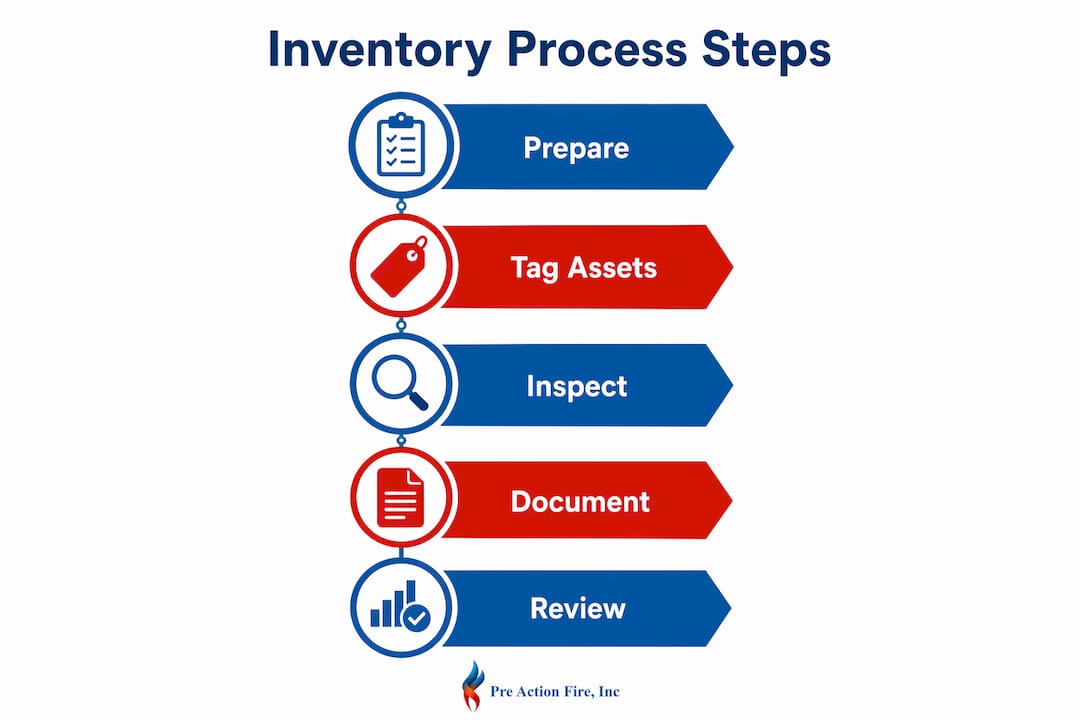
The most reliable approach follows a four-week audit cadence. Week 1 focuses on asset tagging and mapping, week 2 on naming standardization, week 3 on corrective action logs, and week 4 on a mock audit that checks three random records per system. That structure forces you to verify your work before a real auditor does.
Week 1: Asset tagging and physical mapping
- Walk every floor with your building plan. Mark each fire safety asset on the plan as you locate it physically.
- Apply a QR or NFC tag to each asset. Record the tag ID, asset type, location, manufacturer, model number, and installation date in your inventory system.
- Group assets by type: fire extinguishers, sprinkler heads and control valves, fire alarm panels and detectors, emergency lighting units, and fire doors.
- Photograph each asset with the tag visible. The photo timestamp becomes your proof of presence.
Week 2: Naming standardization
- Audit every record for naming consistency. Rename any asset that does not follow your convention.
- Cross-reference your inventory against building plans. Flag any asset on the plan that you did not physically locate.
Week 3: Corrective action logs
- For every deficiency found during tagging, create a corrective action entry. Assign it to a named owner with a due date.
- Inspection documentation must include the date, inspector identity, equipment ID, findings, corrective actions, and follow-up re-inspection dates.
Week 4: Mock audit
- Pull three random records per system type. Verify that each record contains a complete inspection history, corrective action entries, and current status.
- Identify gaps and document them openly. Auditors prefer a documented recovery plan over a backfilled log.
Pro Tip: Link every corrective action to a specific asset ID, not just a location description. “EXT-B2-04 pressure gauge low, replaced march 14, 2026, by J. Torres” is audit gold. “Extinguisher in basement fixed” is not.
Inspection frequencies are well defined: monthly visual checks by trained staff, quarterly inspections by qualified persons, and annual full testing by licensed contractors. Each level requires its own documentation. Monthly checks focus on gauges, signage, and physical access. Annual tests include functional testing and certifications. Missing any level creates a compliance gap that auditors will find.
How does digital tracking improve fire safety inventory management?
QR and NFC asset tagging reduces inspection time by 45% and virtually eliminates missed compliance checks. That time saving compounds across a large facility with hundreds of assets. A technician scans a tag, the system pulls the asset’s full history, and the inspector records findings directly into the record without transcribing from paper.
The core advantages of a digital fire equipment tracking system are:
- Single source of truth. Every inspection, photo, and corrective action lives in one place. No more hunting through binders from three different contractors.
- Automated scheduling. The system flags assets due for monthly, quarterly, or annual inspection without anyone manually tracking dates.
- Tamper-proof presence verification. QR scans are timestamped and geolocated. You can prove a technician was physically at the asset.
- Instant audit export. Most platforms generate a compliance report by system type, date range, or inspector in seconds.
Common implementation challenges are worth knowing before you start. Tag adhesion fails on rough concrete or painted surfaces without surface preparation. NFC tags can be disrupted by metal proximity, so test placement before bulk installation. Staff training on the field app takes one to two sessions but pays back immediately in data quality.
A structured fire hazard check workflow pairs well with digital tracking. The workflow defines what to look for; the tracking system records what you found. Together they close the loop that paper logs leave open.
Pro Tip: Run a pilot on one floor before deploying tags building-wide. You will catch naming convention errors, tag placement problems, and app configuration issues before they multiply across 200 assets.
Facility managers who rely on structured inspection schedules for other building systems often find the same discipline transfers directly to fire equipment tracking. The logic is identical: define the interval, assign the owner, document the result.
How should you organize fire equipment documentation for audits and insurance?
Organizing documentation into three layers enables rapid audit responses: a system master inventory with drawings, scheduled test reports, and service and repair logs. That structure lets you answer “when did this device last pass and what happened since?” in seconds rather than hours.
Retention periods by document type
Retention requirements vary by document type. Fire extinguisher reports require 3–5 years, fire alarm test records require 3 years, annual sprinkler inspection reports require 5 years, and internal sprinkler inspection records require 7 years. Fire marshal reports and building design documents warrant permanent retention. Many insurance carriers now expect documentation retained for the full life of the system, which exceeds the regulatory minimums.
Store critical documents in at least two locations. A cloud folder with restricted access covers your primary storage. A local backup on an encrypted drive covers the scenario where internet access fails during an audit. Annual, date-stamped photographs of system components stored in an off-site cloud solution provide critical insurance evidence that survives catastrophic events like fires or floods.
Handling gaps in your records
Gaps happen. A contractor changes, records get lost, a system gets upgraded without documentation. Auditors prefer documented recovery plans over perfect backfilled logs. Document the gap explicitly: note what is missing, why it is missing, and what steps you have taken to restart the inspection cadence. Assign ownership to a named person. An ongoing corrective action log demonstrates compliance intent, which carries real weight with auditors.
Pro Tip: Keep a “documentation gap register” as a permanent file. Every time you identify a missing record, log it with a date and a resolution plan. That register itself becomes evidence of a mature compliance program.
For key fire inspection documents specific to regulatory and insurance requirements, your records should include the original installation drawings, the current as-built drawings if modifications were made, all contractor certification letters, and every corrective action log with closure dates. Insurance providers treat fire equipment documentation as part of asset value. Digital photos and stored files prove essential when a claim is filed.
Key Takeaways
A well-executed fire equipment inventory process is the foundation of audit readiness, insurance protection, and ongoing NFPA compliance for any facility.
| Point | Details |
|---|---|
| Start with preparation | Gather building plans, equipment lists, and manufacturer manuals before the first walkthrough. |
| Follow the four-week cadence | Tag assets, standardize naming, log corrective actions, and run a mock audit in sequence. |
| Use digital tracking | QR and NFC tagging cuts inspection time by 45% and creates tamper-proof compliance records. |
| Organize in three layers | Keep a master inventory, scheduled test reports, and service logs as separate, searchable folders. |
| Document gaps honestly | Auditors reward transparent recovery plans over incomplete backfilled records. |
What I have learned from years of fire inventory audits
The most common failure I see is not a missing extinguisher. It is a fragmented paper trail spread across three contractors, two spreadsheets, and a filing cabinet nobody has opened in four years. When an auditor asks for the last five years of sprinkler inspection reports, that fragmentation becomes a very expensive problem very quickly.
Corrective action logs are underrated. Facility managers treat them as administrative overhead. Auditors treat them as the clearest signal of a mature compliance program. A log that shows a deficiency was found, assigned, fixed, and re-inspected tells a story of accountability. An empty log tells a story of neglect, even if the equipment is in perfect condition.
The detail most managers overlook is manufacturer documentation. NFPA 25 requires permanent retention of original installation literature and operations and maintenance manuals. I have seen facilities spend thousands of dollars recreating documentation for systems installed 15 years ago because nobody kept the original paperwork. Scan every manual the day it arrives and store it in your master inventory folder.
The cultural habit that sustains compliance is simple: treat every inspection like a future auditor will read it. That mindset changes how technicians fill out forms, how managers review records, and how quickly corrective actions get closed. It costs nothing and prevents almost every audit failure I have encountered.
— Results
Preactionfire supports your fire safety compliance program
Facility managers in the Denver Metro Area have relied on Preactionfire since 2009 for inspection services, documentation support, and fire system installations that hold up under audit scrutiny.
Pre Action Fire’s NICET-certified technicians handle the full scope of fire safety inventory management, from initial asset tagging through annual testing and fire alarm system compliance documentation. Every inspection generates the date-stamped, inspector-identified records that auditors and insurance carriers require. If your current documentation has gaps, Preactionfire can help you build a recovery plan and restart your inspection cadence with a clean, organized record set. Contact Preactionfire to schedule a compliance review for your facility.
FAQ
What is the fire equipment inventory process?
The fire equipment inventory process is a systematic method for locating, tagging, inspecting, and documenting every fire safety asset in a building. It produces the records required for NFPA compliance, fire marshal audits, and insurance claims.
How often should fire equipment be inspected and documented?
Monthly visual checks by trained staff, quarterly inspections by qualified persons, and annual full testing by licensed contractors are all required. Each level of inspection requires its own documentation to avoid non-compliance.
How long should fire safety inspection records be kept?
Retention periods vary: fire extinguisher reports require 3–5 years, fire alarm test records require 3 years, and annual sprinkler inspection reports require 5 years. Fire marshal reports and building design documents should be kept permanently.
Does QR tagging actually reduce inspection time?
QR and NFC asset tagging reduces inspection time by 45% by eliminating manual transcription and enabling instant access to each asset’s full history during a walkthrough.
What should I do if my fire safety records have gaps?
Document the gap explicitly with a date, a reason, and a resolution plan. Auditors prefer a transparent recovery plan over a backfilled log, and an ongoing corrective action log demonstrates compliance intent.