
TL;DR:
- A fire watch procedure is a mandatory safety measure that involves continuous human oversight during system impairments or hot work. It requires dedicated personnel, a documented plan, and immediate notification to authorities to ensure compliance and safety. Failure to follow fire watch protocols can lead to legal, financial, and operational consequences, including denied insurance claims and building shutdowns.
A fire watch procedure is a mandatory protective measure that requires continuous human monitoring of a facility whenever fire protection systems are impaired or high-risk operations such as hot work are underway. NFPA 1, NFPA 25, NFPA 72, and OSHA 29 CFR 1910.252 each define specific triggers, personnel requirements, and documentation standards that govern this practice. The Authority Having Jurisdiction (AHJ), typically the local fire marshal, holds broad authority to mandate fire watch beyond baseline code thresholds. For facility managers and safety officers, a working fire watch procedure guide is not optional. It is the difference between a defensible compliance record and a building shutdown.
When is a fire watch procedure required?
Fire watch triggers fall into three distinct categories: fire alarm system outages, sprinkler system impairments, and hot work operations. Knowing which threshold applies to which system is not a minor detail. Confusing these thresholds creates dangerous gaps in compliance that inspectors and insurers will find.
Fire alarm system outages require a fire watch when the system has been down for more than four hours in any 24-hour period. That threshold reflects how quickly an undetected ignition can escalate without automatic notification.
Sprinkler system impairments carry a longer tolerance. NFPA 25 requires fire watch when a sprinkler system has been out of service for more than 10 hours in a 24-hour period. The extended window exists because sprinklers suppress fire directly, while alarms only detect it. Both thresholds demand the same response: deploy trained personnel immediately.
Hot work operations such as welding, cutting, and grinding require fire watch during the work and for a defined period afterward. Sparks travel farther than most workers expect, and smoldering materials can ignite well after the torch goes cold.
Key triggers that mandate fire watch include:
- Fire alarm system outage exceeding four hours in 24
- Sprinkler system impairment exceeding 10 hours in 24
- Any hot work operation in or near combustible materials
- AHJ-mandated watch for unusual fire risk conditions
- Partial system shutdowns during maintenance or renovation
The AHJ holds broad authority to require fire watch for any impairment or elevated risk, even when code thresholds have not been reached. Notify the local fire department and your property insurer as soon as a watch is initiated. Delayed notification is one of the most common and costly compliance failures.
Pro Tip: Contact your insurer before a planned system outage, not after. Many protective safeguard endorsements require advance notice, and a retroactive call may not preserve your coverage.
What are the core responsibilities of fire watch personnel?
Fire watch personnel carry legal and operational authority that most facilities underestimate. OSHA 29 CFR 1910.252 requires that fire watch personnel be dedicated solely to fire watch duties, trained in the use of fire suppression equipment, and authorized to stop work or order an evacuation. That last point matters. A fire watch officer who hesitates to halt a welding crew because of production pressure is a liability, not a safeguard.
The responsibilities of qualified fire watch personnel include:
- Maintain continuous presence in the designated watch area throughout the entire watch period, including all concealed spaces and unoccupied zones.
- Carry appropriate equipment at all times, including a portable fire extinguisher and a working communication device such as a radio or phone.
- Monitor for ignition sources including smoldering materials, hot surfaces, and smoke in areas adjacent to hot work or impaired systems.
- Stop work immediately if a fire risk is identified and cannot be controlled with available suppression tools.
- Initiate evacuation and contact emergency services when a fire or imminent threat is confirmed.
- Continue monitoring after hot work ends. NFPA 51B recommends a minimum of 30 minutes post-work, and 60 minutes or longer when combustible materials or concealed spaces are involved.
Fire watch personnel cannot perform other duties simultaneously. Assigning a maintenance worker to “keep an eye out” while completing other tasks does not meet OSHA or NFPA requirements. That approach fails inspections and voids insurance claims.
Pro Tip: Verify that your fire watch personnel have completed documented training on the specific extinguisher types present on site. A CO2 extinguisher and a dry chemical unit require different handling, and the wrong choice in an emergency costs critical seconds.

How do you develop an effective fire watch plan?
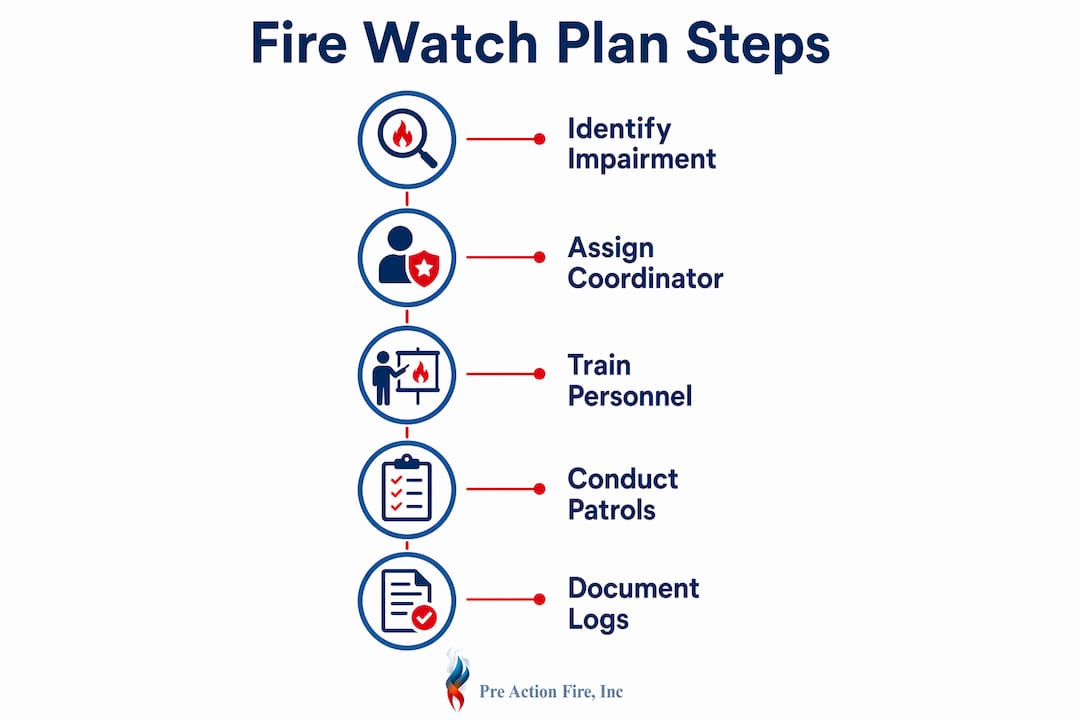
A written fire watch plan is the operational backbone of your compliance program. Without one, even well-intentioned personnel make inconsistent decisions. Assigning an impairment coordinator is the first structural step. This person owns the entire process from system outage notification through watch deployment and system restoration.
Follow these steps to build a plan that holds up to AHJ inspection:
- Identify and tag impaired systems. Use NFPA-compliant impairment tags on all affected equipment. Tags signal to every person on site that the system is offline and a watch is active.
- Notify the AHJ and insurer immediately. Document the time, method, and recipient of each notification. This record is your first line of defense in any compliance review.
- Deploy trained fire watch personnel. Assign dedicated individuals. Confirm their training records are current before the watch begins.
- Define patrol routes and coverage areas. Every floor, concealed space, and adjacent zone must be included. Gaps in coverage are gaps in compliance.
- Establish patrol frequency. Many AHJs mandate patrols every 30–60 minutes. Confirm the specific interval required by your local fire marshal before the watch starts.
- Coordinate with hot work permits. Every hot work permit should reference the fire watch plan. The permit and the watch log must align in timing and coverage.
- Monitor system restoration. The impairment coordinator tracks repair progress and confirms the system is fully operational before terminating the watch.
| Plan element | Requirement |
|---|---|
| Impairment coordinator | Named individual with documented authority |
| System tagging | NFPA-compliant impairment tags on all offline equipment |
| Notification record | Time, method, and recipient logged for AHJ and insurer |
| Patrol frequency | Per AHJ requirement, typically every 30–60 minutes |
| Hot work coordination | Permit and watch log must align in timing and scope |
For facilities managing active construction, the fire safety rules for contractors published by Preactionfire provide additional guidance on integrating fire watch into site safety protocols. Facilities with complex construction quality control programs benefit from embedding fire watch requirements directly into their quality management documentation.
What should fire watch logs contain?
Documentation, not mere presence, is what fire watch compliance actually requires. Inspectors do not take your word for it. They review the log. A patrol that was not recorded did not happen in the eyes of the AHJ.
Every fire watch log entry must include:
- Timestamp for each patrol start and end
- Patrol area covered during that round, described specifically
- Personnel name and signature or initials
- Observations noted, including “no issues found” when the area is clear
- Any incidents or anomalies, with follow-up actions documented
The most common documentation failures are gaps between entries, vague location descriptions such as “checked building,” and log entries that appear to have been written in batches rather than in real time. Inspectors focus heavily on patrol logs, and any irregularities can trigger an immediate compliance failure even when no fire occurred.
Retain fire watch logs for the period required by your AHJ, typically a minimum of one year, and store them where they can be produced during an inspection without delay. Digital logs with automatic timestamps offer a clear advantage over handwritten records because they are harder to alter and easier to retrieve. The fire safety documentation examples from Preactionfire show what compliant log formats look like in practice.
Pro Tip: Run a monthly internal audit of your fire watch logs. Review for gaps, vague entries, and timing inconsistencies before an inspector does. Self-auditing is the fastest way to find and fix problems before they become violations.
What are the consequences of skipping fire watch requirements?
Non-compliance with fire watch requirements carries consequences across three categories: legal, financial, and operational. Each one is serious on its own. Together, they can end a facility’s operations.
The most immediate risk is enforcement action by the fire marshal. AHJs can issue stop-work orders, impose fines, and in serious cases, order a building evacuation until the impairment is resolved and a compliant watch is in place. These actions are not rare. They happen at facilities that treat fire watch as a formality rather than a genuine safety function.
The financial risk is equally direct. Failure to notify insurers or conduct a required fire watch can invalidate an insurance claim during a system impairment. Insurance protective safeguard endorsements require prompt notification and active fire watch implementation. A fire that occurs during an undocumented or improperly staffed watch may result in a denied claim, regardless of the cause.
Common mistakes that lead to these outcomes include:
- Treating fire watch as a “check-the-box” task rather than active monitoring
- Allowing personnel to perform other duties during the watch
- Terminating the watch before the AHJ-required period ends
- Leaving the site too early after hot work before the post-work monitoring period is complete
- Failing to document patrols in real time
Fire watch is essential risk mitigation. It bridges the safety gap when automatic systems are impaired, and it is the primary factor that determines whether an insurance claim survives scrutiny after a loss event. Cutting corners on fire watch does not save time. It transfers risk directly to the facility and its ownership.
The fire hazard check workflow developed for facility managers provides a practical framework for identifying these risk points before they become violations.
Key Takeaways
A compliant fire watch procedure requires trained, dedicated personnel, a written plan with documented patrols, and immediate notification to both the AHJ and insurer when a system impairment occurs.
| Point | Details |
|---|---|
| Know your thresholds | Fire alarm outages trigger watch after four hours; sprinkler impairments after 10 hours in 24. |
| Dedicate personnel | Fire watch staff cannot perform other duties; OSHA 29 CFR 1910.252 requires sole focus. |
| Document every patrol | Logs must include timestamps, locations, names, and observations to survive inspection. |
| Extend post-hot-work monitoring | NFPA 51B recommends 60 minutes or more after hot work ends to catch delayed ignition. |
| Notify early | Contact the AHJ and insurer immediately at the start of any impairment to protect coverage. |
What facility managers get wrong about fire watch
The most persistent problem I see is the gap between what a fire watch plan says on paper and what actually happens on the floor. Facilities write solid procedures, train their people once, and then assume the system runs itself. It does not.
The cultural shift that matters most is moving from minimal compliance to active safety management. A fire watch is not a staffing inconvenience. It is the only layer of protection standing between an impaired building and an undetected fire. When I review incident reports and near-misses, the pattern is consistent: someone left early, someone was doing two jobs at once, or the log was filled in after the fact.
My strongest recommendation is to audit your fire watch logs quarterly, not just after incidents. Look for timing patterns that suggest backfilling, vague location entries, and gaps that exceed your AHJ-mandated patrol interval. Those are the signals that your program is drifting toward checkbox compliance. Confirm your local AHJ’s specific requirements at least annually. Requirements vary by jurisdiction, and what was acceptable last year may not meet current expectations.
Invest in personnel quality over cost minimization. A trained, attentive fire watch officer who documents thoroughly is worth far more than a warm body with a clipboard. Pair that with a fire safety inspection program that keeps your systems in service as much as possible, and you reduce the frequency and duration of watches significantly.
— Results
Preactionfire’s fire safety compliance services
When your fire alarm or sprinkler system goes offline, the clock starts immediately. Preactionfire has served the Denver Metro Area since 2009, and its NICET-certified technicians understand exactly what facility managers need during a system impairment: fast restoration, clear documentation support, and systems that stay compliant between outages.
Pre Action Fire provides fire alarm system installation and compliance services designed to minimize downtime and reduce the frequency of required fire watches. Their team also supports sprinkler system maintenance and sprinkler installation for commercial and industrial facilities across the Denver region. If your facility needs a compliance review, a system upgrade, or guidance on building a fire watch plan that satisfies your AHJ, contact Preactionfire directly for a consultation.
FAQ
What is fire watch and when is it required?
Fire watch is a continuous human monitoring program deployed when fire protection systems are impaired or during hot work operations. NFPA standards require it after a fire alarm outage exceeding four hours or a sprinkler impairment exceeding 10 hours in a 24-hour period.
Can fire watch personnel perform other duties during a watch?
No. OSHA 29 CFR 1910.252 requires fire watch personnel to be dedicated solely to fire watch duties. Assigning other tasks to a fire watch officer violates federal standards and invalidates the watch for compliance purposes.
How long must fire watch continue after hot work ends?
NFPA 51B recommends a minimum of 30 minutes after hot work concludes, and 60 minutes or longer when combustible materials or concealed spaces are present. Early departure is one of the most cited compliance failures in post-incident reviews.
What must a fire watch log include to pass inspection?
Every log entry must record the timestamp, specific patrol area, personnel name, and observations made. Inspectors flag gaps between entries, vague location descriptions, and entries that appear to have been written after the fact rather than in real time.
Can an insurer deny a claim if fire watch was not conducted?
Yes. Insurance protective safeguard endorsements require prompt notification and active fire watch implementation during system impairments. Failure to conduct or document a required fire watch can invalidate a claim, even when the fire itself was unrelated to the impairment.