
TL;DR:
- Code-compliant fire protection systems conform to NFPA standards and local regulations before building occupancy.
- Maintaining ongoing compliance involves regular inspections, documentation, and engagement with authorities throughout the building’s life.
Code-compliant installation is defined as the design, installation, and commissioning of fire protection systems in full conformance with applicable NFPA standards, local building codes, and Authority Having Jurisdiction (AHJ) requirements. For construction professionals and facility managers, understanding what is code-compliant installation is not optional. Buildings with properly installed and maintained fire alarm systems experience 50% fewer fire-related deaths and gain 2–4 minutes of additional evacuation time. Those extra minutes determine whether occupants escape safely. NFPA 13, NFPA 72, and NFPA 101 form the regulatory backbone of every compliant fire protection project in the United States.
What is code-compliant installation for fire protection systems?
Code-compliant installation means every component of a fire protection system meets the specific design, material, placement, and testing requirements set by adopted codes before the building receives occupancy approval. The term “code-compliant” is the industry-standard phrase used by AHJs, fire marshals, and insurers. It is not a marketing label. It is a legal threshold.
Three NFPA standards govern the majority of fire protection installations:
- NFPA 13 covers the design and installation of automatic sprinkler systems, specifying pipe sizing, sprinkler head selection, water supply requirements, and obstruction rules for commercial and industrial occupancies.
- NFPA 72 governs fire alarm and signaling systems, covering initiating devices, notification appliances, control panel placement, wiring methods, and documentation requirements.
- NFPA 25 mandates the inspection, testing, and maintenance of water-based fire protection systems after installation, creating the ongoing compliance obligation that follows every project.
- NFPA 101, the Life Safety Code, addresses fire barriers, exit paths, emergency lighting, and ongoing compliance schedules for the entire life of the building.
The International Building Code (IBC) also references NFPA standards directly. Most jurisdictions adopt the IBC and layer local amendments on top of it. That layering is where most compliance failures begin.
What standards and codes govern fire protection installations?
NFPA standards are model codes. They carry no legal force until a state or local government formally adopts them. That distinction matters enormously in practice.
Colorado, like most states, adopts specific NFPA editions and may amend them. A jurisdiction might enforce NFPA 13 (2019 edition) while the current published edition is newer. Local amendments and code editions vary, and ignoring edition discrepancies is a leading cause of inspection failures. Professionals must verify the exact adopted edition with the local AHJ before design begins.
The IBC integrates fire protection requirements into the broader building permit process. It triggers sprinkler requirements based on occupancy type, building height, and square footage. When a building crosses those thresholds, NFPA 13 compliance becomes mandatory, not discretionary.
NFPA 101 adds a layer that many facility managers underestimate. It requires ongoing compliance for exit paths, fire barriers, and testing throughout the building’s operational life. Passing the initial inspection does not satisfy NFPA 101. The standard follows the building indefinitely.
How does the Authority Having Jurisdiction (AHJ) influence compliance?
The AHJ is the organization, office, or individual responsible for enforcing the requirements of a code. In practice, the AHJ role may be filled by a fire marshal, building official, insurance underwriter, or a combination of agencies depending on the system type and jurisdiction.
AHJ approval is legally required for occupancy, insurance coverage, and property transfer. A building without AHJ sign-off cannot legally be occupied, financed, or sold. That single fact makes AHJ coordination the most consequential task on any fire protection project.
Effective AHJ coordination follows a clear sequence:
- Identify the correct AHJ contacts early. The AHJ is a functional role that may span multiple officials across agencies. Confirm which office governs sprinklers, alarms, and suppression systems separately.
- Submit design documents for pre-approval. Most AHJs require stamped drawings before installation begins. Submit early to allow time for revision requests.
- Schedule inspections proactively. AHJ inspection calendars fill quickly. Build inspection milestones into the project schedule from day one.
- Attend the acceptance test with the AHJ. Acceptance testing is a mandatory, AHJ-witnessed event that must occur before occupancy. It is not the same as an annual maintenance inspection.
- Document every AHJ communication. Written records of approvals, rejections, and code interpretations protect the project team if disputes arise later.
Pro Tip: Early AHJ engagement prevents costly redesigns and schedule delays. Request a pre-application meeting before finalizing design documents. Most AHJs welcome this and will flag local amendment issues before they become expensive problems.
One critical boundary: AHJ enforcement authority does not extend beyond adopted codes without documented local amendments or proven hazards. If an inspector requests work outside the adopted code, ask for the specific code section and amendment reference. This is not confrontational. It is professional practice.
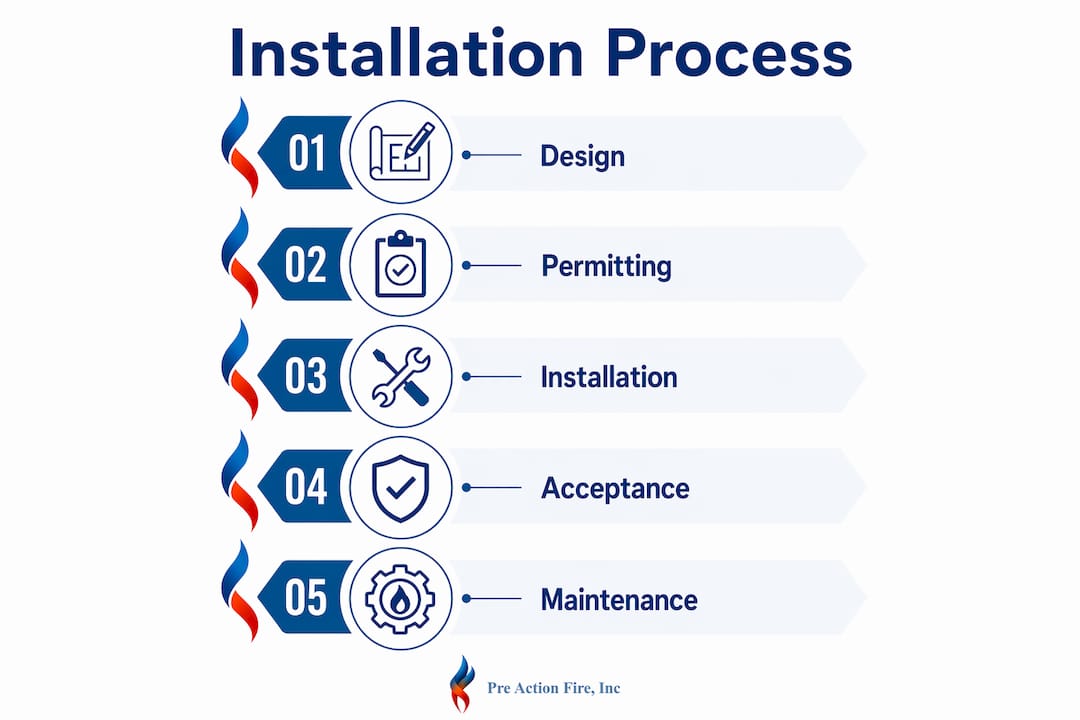
What are the key steps in the code-compliant installation process?
The installation code requirements for fire protection systems follow a defined sequence. Skipping or compressing any phase creates compliance risk.
Design phase
Fire alarm designers must hold NICET certifications, and installers require jurisdiction-specific licensing. Preactionfire employs NICET-certified technicians for this reason. Credentialed designers produce drawings that reflect actual code requirements, not approximations.
The design must account for occupancy classification, hazard level, ceiling height, obstructions, and water supply data. For sprinkler systems, hydraulic calculations determine pipe sizing and head selection. For alarm systems, the design specifies initiating device placement, notification appliance coverage, and control panel location.
Permitting and AHJ approval
Permit applications require stamped engineering drawings, hydraulic calculations, equipment cut sheets, and a site plan. The AHJ reviews these documents against the adopted code edition. Approval authorizes installation to begin. Work started before permit issuance is a code violation in virtually every jurisdiction.
Installation requirements
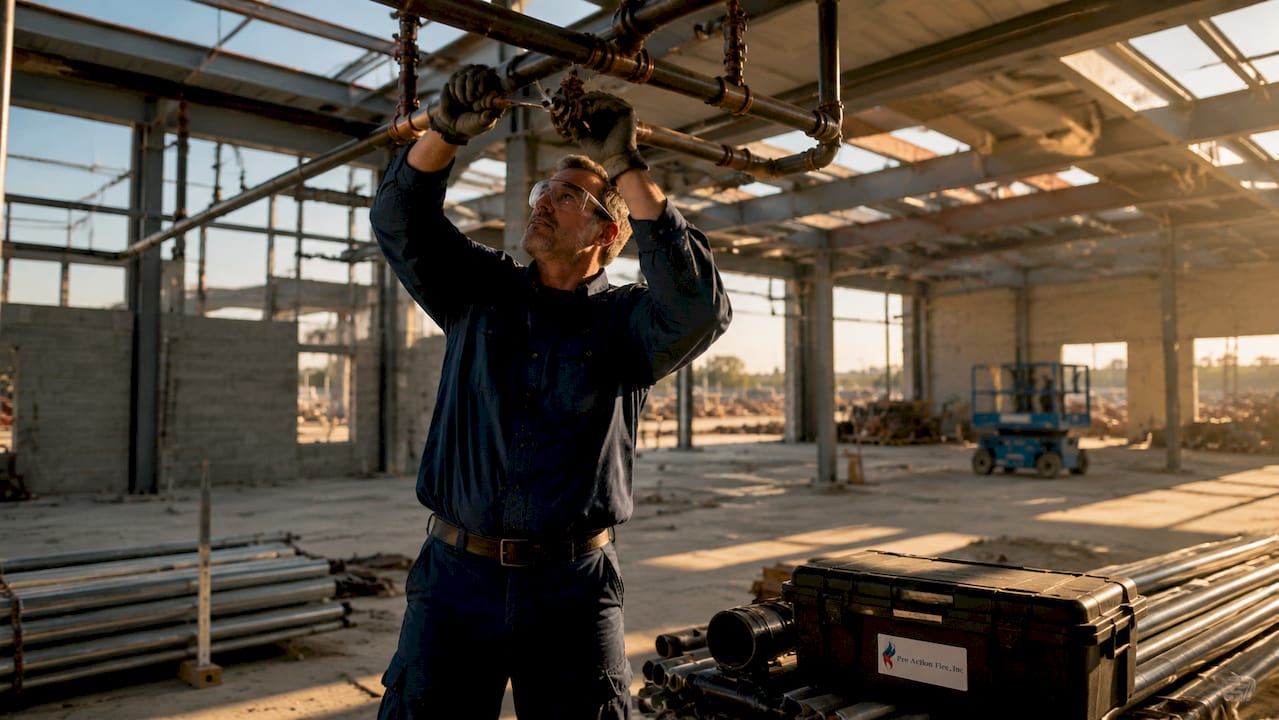
- Sprinkler heads must be selected for the correct temperature rating, coverage area, and obstruction clearance per NFPA 13.
- Wiring for fire alarm systems must use listed wire in the correct gauge, with proper supervision and circuit integrity per NFPA 72.
- Control panels must be mounted in accessible, climate-controlled locations with adequate clearance.
- All equipment must carry a Listing Mark from a nationally recognized testing laboratory such as UL or FM Approvals.
Acceptance testing
Acceptance testing is a one-time, AHJ-witnessed commissioning event that occurs before the building receives its certificate of occupancy. Every initiating device, notification appliance, and sprinkler zone must be tested and documented. The test record becomes a permanent compliance document.
Pro Tip: Prepare a complete as-built drawing package before the acceptance test. AHJs frequently reject tests when as-built drawings do not match installed conditions. Correcting discrepancies after the test adds weeks to the schedule.
Ongoing maintenance
NFPA 25 mandates inspection, testing, and maintenance intervals for sprinkler systems. NFPA 72 sets equivalent schedules for alarm systems. These are not optional. Facility managers who treat post-occupancy maintenance as discretionary create liability exposure and risk losing insurance coverage.
What common challenges affect fire safety code compliance?
Most compliance failures trace back to a small set of recurring mistakes. Recognizing them in advance is the most direct path to avoiding them.
“Compliance is an ongoing building lifecycle obligation. Passing inspections is not a one-time guarantee of compliance over time.” This principle, grounded in NFPA 101, is the single most misunderstood aspect of fire protection management.
The most common pitfalls include:
- Ignoring local amendments. The NFPA standard adopted locally may differ from the current published edition. Designing to the wrong edition produces drawings the AHJ will reject.
- Confusing acceptance testing with annual inspections. Acceptance testing happens once, before occupancy, and is witnessed by the AHJ. Annual inspections under NFPA 25 and NFPA 72 happen throughout the building’s life. They serve different purposes and have different documentation requirements.
- Assuming final approval means permanent compliance. A certificate of occupancy confirms the system met code on the day of the test. It does not certify future compliance. Systems degrade, occupancies change, and codes are updated.
- Overlooking occupancy change triggers. Changes in building use that trigger fire protection requirements require retrofitting to current code, not patch repairs. Converting a warehouse to a data center, for example, triggers a full NFPA 13 compliance review.
- Underestimating renovation impacts. Tenant improvements that relocate walls, ceilings, or HVAC systems frequently invalidate existing sprinkler coverage. Any renovation that affects the fire protection system requires a new permit and AHJ review.
Staying current on code changes requires a deliberate process. Subscribe to NFPA update notifications, attend local fire marshal briefings, and build code review into every project kickoff. For Colorado-specific requirements, Preactionfire’s guide to Colorado fire code compliance provides current, jurisdiction-specific detail.
How can professionals maintain code compliance over a building’s lifecycle?
Compliance management after occupancy requires the same discipline as the installation phase. The building lifecycle approach treats fire protection as a continuous obligation, not a project milestone.
- Maintain thorough documentation. Every inspection report, test record, maintenance log, and AHJ correspondence belongs in a permanent file. Fire safety documentation is the first thing an AHJ or insurer requests after an incident.
- Schedule NFPA 25 and NFPA 72 inspections on a written calendar. Quarterly, semi-annual, and annual inspection intervals are not suggestions. Missing them voids compliance status and creates insurance exposure.
- Engage qualified contractors for all work. Any modification to a fire protection system requires a licensed contractor and a new permit. Facility maintenance staff cannot legally perform system modifications in most jurisdictions.
- Build a proactive relationship with the AHJ. Notify the AHJ before any renovation that affects fire protection systems. Surprises during inspections create delays. Early disclosure builds credibility and often accelerates approvals.
- Conduct internal audits annually. Walk the facility against the as-built drawings. Verify that sprinkler heads are unobstructed, alarm devices are accessible, and exit paths are clear. Document the audit and correct deficiencies before the next scheduled inspection.
Pro Tip: Engage a third-party fire protection consultant for a compliance audit every three to five years. An outside perspective catches code drift that internal teams normalize over time. The cost of an audit is a fraction of the cost of a failed inspection or an insurance claim.
For new construction projects, Preactionfire’s resource on fire protection for new construction outlines the documentation and compliance steps from permit to occupancy.
Key Takeaways
Code-compliant installation requires adherence to NFPA 13, NFPA 72, NFPA 101, and local AHJ requirements from design through the entire building lifecycle, not just at the point of initial occupancy.
| Point | Details |
|---|---|
| Standards govern every phase | NFPA 13, NFPA 72, and NFPA 25 each cover a distinct phase: installation, alarm systems, and ongoing maintenance. |
| AHJ approval is legally required | Without AHJ sign-off, a building cannot be legally occupied, insured, or sold. |
| Acceptance testing is a one-time event | AHJ-witnessed acceptance testing before occupancy is distinct from annual NFPA 25 and NFPA 72 inspections. |
| Local amendments override model codes | Always verify the specific NFPA edition and local amendments adopted by your jurisdiction before design begins. |
| Compliance is a lifecycle obligation | Occupancy changes and renovations trigger new compliance reviews; passing the initial inspection does not guarantee ongoing compliance. |
The compliance gap most professionals don’t see coming
After years of working on fire protection projects across Colorado, the pattern I see most often is not ignorance of NFPA standards. Most construction professionals know NFPA 13 and NFPA 72 exist. The real gap is the assumption that compliance is a finish line rather than a continuous condition.
I have watched facility managers operate buildings for years after a successful acceptance test, never scheduling a single NFPA 25 inspection, and genuinely believing the system was “compliant.” When an insurer or AHJ finally reviewed the records, the liability exposure was significant. The system itself was often functional. The documentation was not. That distinction matters enormously in a claim or enforcement action.
The other issue I see consistently is AHJ coordination treated as a bureaucratic obstacle rather than a technical resource. AHJs see hundreds of projects. They know which local amendments catch contractors off guard. They know which equipment submittals get rejected. Engaging them early, asking direct questions, and treating their feedback as design input rather than interference shortens every project timeline I have worked on.
Prescriptive codes like NFPA 13 exist precisely because they provide a consistent, reliable baseline. Performance-based design has its place for specialized occupancies, but defaulting to prescriptive compliance keeps projects on schedule and gives AHJs a clear review framework. Save the performance-based approach for cases where prescriptive requirements genuinely cannot be met.
The professionals who manage compliance well share one habit: they treat the as-built drawing package as a living document, not a closeout deliverable. When the building changes, the drawings change. When the drawings change, the compliance review restarts. That discipline is what separates buildings that pass inspections from buildings that generate claims.
— Results
Preactionfire’s code-compliant fire protection services for Colorado
Pre Action Fire has served the Denver Metro Area since 2009, installing and maintaining fire alarm and sprinkler systems that meet NFPA standards and Colorado’s specific AHJ requirements.
Preactionfire’s NICET-certified technicians manage every phase of the compliance process, from design document preparation and AHJ coordination through acceptance testing and ongoing NFPA 25 and NFPA 72 maintenance. For commercial and industrial facilities in Denver and surrounding communities, Preactionfire provides code-compliant sprinkler installation and fire alarm compliance services built around your specific occupancy, code edition, and AHJ requirements. Contact Preactionfire to schedule a compliance consultation.
FAQ
What is code-compliant installation in fire protection?
Code-compliant installation means a fire protection system is designed, installed, and tested in full conformance with applicable NFPA standards (NFPA 13, NFPA 72) and approved by the local Authority Having Jurisdiction before occupancy.
What is the difference between acceptance testing and annual inspections?
Acceptance testing is a mandatory, one-time, AHJ-witnessed event before occupancy. Annual inspections are ongoing maintenance requirements under NFPA 25 and NFPA 72 that continue throughout the building’s operational life.
Does passing the final inspection guarantee ongoing code compliance?
No. A certificate of occupancy confirms the system met code on the test date. NFPA 101 requires ongoing compliance for the life of the building, and occupancy changes or renovations can trigger new compliance requirements.
What credentials are required for fire alarm system designers and installers?
Fire alarm designers should hold NICET certifications, and installers require jurisdiction-specific licensing. Credential requirements vary by state and local jurisdiction.
Can an AHJ require work beyond what the adopted code specifies?
AHJ enforcement authority does not extend beyond the adopted code without documented local amendments or proven hazards. Any request for additional work should be supported by a specific code section or amendment reference.
Recommended
- Industrial fire safety standards: Colorado compliance guide
- Fire protection for new construction: compliance and safety
- Industrial fire protection for Colorado sites: A compliance guide
- Colorado building fire protection: 5-step compliance guide
- Denver Commercial Fire Protection
- Denver Emergency Fire Protection