
TL;DR:
- NICET certification is a voluntary, nationally recognized credential that verifies a technician’s knowledge and field skills in fire protection. It consists of four levels, each requiring passing exams and verified work experience, with higher levels demanding recommendations and complex projects. Certification enhances career prospects, credibility, and ensures compliance with safety codes through rigorous documentation and technical competence.
NICET certification is defined as a voluntary, nationally recognized credential that validates an engineering technician’s job-related knowledge and field performance. Established in 1961 by the National Society of Professional Engineers, the National Institute for Certification in Engineering Technologies awards this credential across more than a dozen technical fields, with fire protection being one of the most in-demand. Unlike a course completion certificate, NICET certification requires passing proctored exams and submitting supervisor-verified work history. For fire protection professionals, it is the clearest signal to employers that your skills meet life-safety standards.
What is NICET certification and how is it structured?
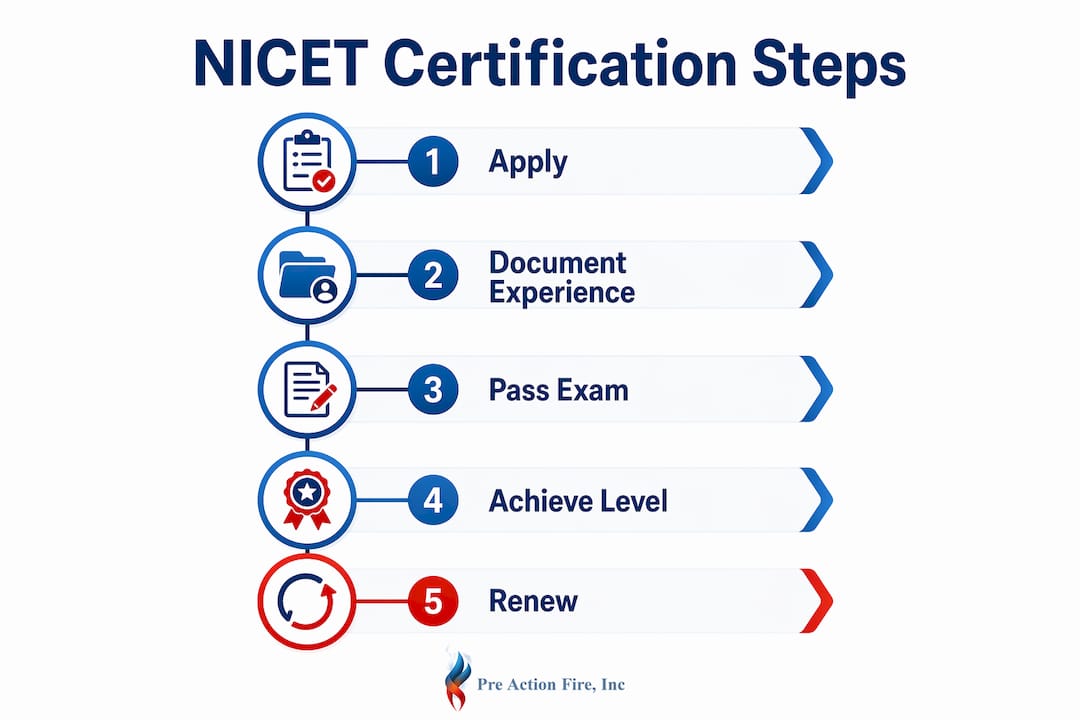
NICET certification spans four progressive levels, each building on the last. The four-level structure requires candidates to pass written exams and submit verified work history at every stage. Higher levels add personal recommendations and, at Level IV, a Major Project Write-Up that documents complex technical leadership. Exams require a score of 500 out of 700 to pass. Certification renewal happens every three years through Continuing Professional Development.
The table below shows what each level demands:
| Level | Exam Required | Work Experience | Additional Requirements |
|---|---|---|---|
| Level I | Yes | Entry-level field experience | None |
| Level II | Yes | Verified intermediate experience | None |
| Level III | Yes | Substantial verified experience | Personal recommendations |
| Level IV | Yes | Extensive verified experience | Recommendations and Major Project Write-Up |
One fact that surprises many candidates: certification is not granted by training attendance. You must pass a proctored test and have a supervisor confirm your field performance. That distinction separates NICET from most professional development programs.
- Level I is the entry point, suitable for technicians new to fire protection.
- Level II confirms intermediate competence and opens doors to more complex project work.
- Level III signals senior-level technical ability and requires peer endorsement.
- Level IV is the pinnacle, demanding proof of project leadership and advanced problem solving.
Pro Tip: Start documenting your field projects from day one. Even at Level I, detailed records of your work build the foundation for every level that follows.
What are the career benefits of NICET certification?
NICET certification directly increases promotion prospects and access to specialized roles in fire protection and engineering technology. Employers across the industry prioritize certified professionals because life-safety code compliance carries serious legal and financial risk. A certified technician removes uncertainty for hiring managers. That reduced risk translates into salary increases and faster career advancement.
The credential also functions as a risk mitigation tool for employers. Certified technicians provide consistent, audit-ready documentation that reduces the chance of code violations and costly project rework. Hiring managers know that a NICET-certified professional will approach inspections, testing, and maintenance with documented rigor. That reliability has real dollar value on commercial and industrial projects.
Top benefits of earning NICET certification include:
- Higher earning potential and faster promotion timelines
- Access to specialized fire protection and engineering technology roles
- Stronger credibility with property managers, contractors, and code officials
- Reduced inspection surprises and fewer project delays
- Alignment with NFPA standards and local life-safety codes
- Employer confidence in your documentation and technical judgment
Pro Tip: When negotiating salary or a new role, lead with your NICET level. Employers in fire protection understand exactly what each level represents, and it signals far more than years of experience alone.
Understanding the role of certified fire technicians in property safety makes the career case even clearer. Certification is not just a resume line. It changes how employers, clients, and code officials treat you on every project.
How can you prepare and succeed in getting NICET certified?
Preparation for NICET certification is a long-term effort, not a sprint. Higher levels, particularly Levels III and IV, require years of documented work experience and supervisor verification that cannot be rushed. The most common mistake candidates make is treating NICET like a standard exam they can cram for in a few weeks. That approach fails at Level II and becomes impossible by Level III.
A practical preparation timeline looks like this:
- Level I: Begin studying NFPA codes and basic fire protection principles within your first year on the job. Sit for the exam once you have six to twelve months of field experience.
- Level II: Spend at least one to two years building intermediate field skills. Keep detailed records of every project, including system types, scope, and your specific role.
- Level III: Plan a two to four year runway. Secure supervisor relationships early, since personal recommendations are required. Study code interpretation and inspection methodology deeply.
- Level IV: Preparation effectively begins at career start. The Major Project Write-Up demands comprehensive documentation of complex projects and technical leadership. Candidates who wait until Level IV to start documenting almost always struggle.
Documentation is the skill most candidates underestimate. Every challenging project, every code interpretation decision, every instance of technical leadership belongs in a running log. That log becomes the raw material for your Level IV submission.
Pro Tip: Create a simple project journal at the start of your career. Record the system type, the challenge you solved, and the outcome. After five years, that journal is worth more than any study guide.
Reviewing fire safety rules for contractors also helps candidates understand the code environment they will be tested on, particularly for Levels III and IV where code interpretation carries significant weight.
What does NICET certification mean on the job?
NICET certification changes how a technician approaches every task in the field. Certified technicians adopt rigorous inspection, testing, and maintenance processes that directly improve fire protection system reliability. The credential is not a badge you earn and then forget. It shapes how you read a code, write an inspection report, and respond when a system behaves unexpectedly.
Documentation quality is one of the most visible differences between certified and non-certified technicians. Certified professionals produce records that hold up under audit, satisfy authority-having-jurisdiction reviews, and reduce the risk of callbacks. That consistency matters enormously on commercial properties where a failed inspection can trigger fines or occupancy issues.
“NICET certification is not just a credential but a process that fundamentally elevates technicians’ ability to interpret codes and document inspections professionally. It bridges the gap between academic knowledge and practical field proficiency, enabling employers to validate job-ready skills in technicians without engineering degrees.”
Consider a practical scenario: a NICET Level III technician inspects a suppression system in a high-rise and identifies a pressure discrepancy that falls within tolerance but trends toward failure. A non-certified technician might pass the system and move on. The certified technician documents the trend, flags it for the property manager, and schedules a follow-up. That decision prevents a system failure and protects the building owner from liability. That is what the credential means in practice.
Key ways NICET certification shows up on the job:
- Structured approach to NFPA-compliant inspection and testing procedures
- Clear, defensible documentation that satisfies code officials and auditors
- Confident code interpretation when field conditions do not match textbook scenarios
- Proactive identification of system issues before they become failures
- Professional communication with engineers, contractors, and property managers
For professionals moving into specialized roles, fire system certification work in the Denver area illustrates how certified technicians operate within local compliance frameworks every day.
Key Takeaways
NICET certification is the fire protection industry’s most trusted measure of verified technical competence, requiring both proctored exams and supervisor-confirmed field experience across four progressive levels.
| Point | Details |
|---|---|
| Four-level structure | Levels I through IV build progressively, with higher levels requiring recommendations and a Major Project Write-Up. |
| Exam and experience required | Passing a proctored exam and submitting verified work history are mandatory at every level. |
| Career advancement | Certified professionals gain access to specialized roles, higher salaries, and faster promotions. |
| Documentation is critical | Consistent project records from career start are the foundation for Level III and IV success. |
| Real-world job impact | Certified technicians produce audit-ready documentation and catch system issues before they become failures. |
Why NICET certification is worth every year it takes
Professionals sometimes ask whether NICET certification is worth the time investment. My answer, after years of working alongside certified technicians in fire protection, is unambiguous: yes, and the earlier you start, the more it pays off.
The credential does something that no training course can replicate. It forces you to connect what you know to what you have actually done, under verification. That process builds a different kind of technical confidence. Certified technicians do not just know the code. They know how to apply it when conditions are messy, documentation is incomplete, and the authority having jurisdiction is asking hard questions.
The biggest mistake I see is professionals treating NICET as a finish line. It is better understood as a professional standard you maintain. Renewal every three years through Continuing Professional Development keeps your knowledge current with evolving NFPA standards. That ongoing commitment is exactly what employers and clients are paying for when they hire certified professionals.
Start early. Document everything. Build relationships with supervisors who can verify your work. The credential will follow.
— Results
How Preactionfire supports fire protection compliance in Denver
Pre Action Fire has served the Denver Metro Area since 2009, and NICET-certified technicians are central to every service the company delivers.
Whether your property needs fire alarm system installation, inspection, or compliance review, Preactionfire brings verified technical expertise to every job. Working with a team of certified professionals means your systems are inspected, documented, and maintained to NFPA standards. That level of rigor protects your property, satisfies code officials, and reduces your liability. Contact Preactionfire to discuss your fire protection needs and put certified expertise to work on your next project.
FAQ
What is the difference between NICET certification and a training certificate?
NICET certification requires passing a proctored exam and submitting supervisor-verified field experience. A training certificate only confirms course attendance, with no performance verification.
How long does it take to get NICET certified?
Level I can be achieved within the first year of field work. Level IV typically requires many years of documented experience and cannot be rushed.
Do employers require NICET certification for fire protection roles?
Many employers in fire protection strongly prefer or require NICET certification, particularly for roles involving life-safety code compliance and inspection work.
How often does NICET certification need to be renewed?
NICET certification renews every three years through Continuing Professional Development requirements set by the National Institute for Certification in Engineering Technologies.
Can you get NICET certified without a college degree?
Yes. NICET certification validates job-related knowledge and field performance, making it accessible to skilled technicians who do not hold engineering degrees.