
TL;DR:
- Certified technicians have passed rigorous, third-party exams verifying their competence, reducing safety and compliance risks. Hiring verified professionals ensures code adherence, maintains warranties, and improves system efficiency, which saves costs over time. Verification of individual credentials is quick and critical to avoid substandard work and potential legal or financial liabilities.
Certified technicians are defined as professionals who have passed rigorous, third-party examinations that verify their competence against a recognized industry standard. For facility managers and business owners, the question of why choose certified technicians is not abstract. It directly affects compliance status, warranty validity, and the physical safety of everyone in your building. In fire protection, the stakes are especially high. Credentials like NICET certification and NATE certification exist precisely because unverified skill in a high-stakes technical field creates measurable financial and legal risk. This article breaks down what those credentials mean, what they protect, and how to verify them before you sign a contract.
Why choose certified technicians: what the credentials actually mean
Certification in technical fields is not a participation award. It is an objective, third-party verification that a technician has demonstrated specific competencies through standardized testing and, in most programs, ongoing renewal requirements. That distinction matters because it removes subjective judgment from the hiring process.
NATE, the National Institute for Automotive Service Excellence of the HVACR world, is the most widely recognized credentialing body for heating, ventilation, air conditioning, and refrigeration technicians in the United States. NATE has certified over 35,000 HVACR technicians through rigorous multiple-choice exams, with a network spanning over 5,000 testing organizations and 5,500 registered contractors nationwide. That scale reflects how seriously the industry treats verified competence. In fire protection, NICET (the National Institute for Certification in Engineering Technologies) serves a parallel function, credentialing technicians in fire alarm systems, water-based suppression, and special hazards.
Certifications are earned through written exams, practical assessments, and documented field experience. They are maintained through continuing education requirements, which means a certified technician’s knowledge stays current as codes and technologies evolve. Professional certifications provide an objective measure of competence that is especially critical in high-stakes roles where experience alone is hard to verify from the outside.
Pro Tip: Ask any technician to show their individual certification card, not just a company brochure. Certification belongs to the person, not the business.
The difference between company-level and individual-level certification is one of the most misunderstood points in facility management. A company can market itself as “certified” while employing technicians who hold no credentials at all. Individual certifications are verifiable through registries like natex.org for NATE or directly through NICET’s online lookup tool. Always verify at the technician level.
How certified technicians improve compliance, safety, and installation quality
Certified technicians follow code-compliant procedures because their training is built around those codes. For fire protection, that means adherence to NFPA 72 for fire alarm systems, NFPA 13 for sprinkler systems, and local amendments adopted by Colorado jurisdictions. A technician who has not been tested against those standards is working from memory and habit, not verified knowledge.

The compliance benefits extend directly to fire protection certifications required for Colorado businesses. Inspections that fail because of improper installation or inadequate documentation create fines, reinspection costs, and potential liability. Certified technicians document their work in formats that satisfy Authority Having Jurisdiction (AHJ) requirements, reducing the chance of a failed inspection.
Four specific quality advantages stand out when you hire certified professionals:
- First-time fix rates improve. Certified technicians perform methodical diagnostics rather than guesswork, reducing unnecessary part replacement and callbacks. That translates directly to lower service costs over time.
- Warranty protection stays intact. Using uncertified labor voids manufacturer warranty on day one. Manufacturers explicitly require certified professionals for installation and warranty repairs in specialized sectors including fire protection.
- Rebate program eligibility is preserved. State and utility rebate programs, including Mass Save and NYSERDA, mandate certified installers for eligibility. Uncertified work can disqualify a project from rebates before the equipment is even turned on.
- Efficiency losses are avoided. Uncertified work leads to 15–40% efficiency losses in specialized equipment installations. That range represents real operating cost increases that compound over the life of a system.
Fire safety during renovation projects adds another layer of complexity. Structural changes can compromise existing suppression and alarm coverage, and only a credentialed technician can assess and document those changes correctly. Resources covering fire safety in renovation confirm that certification requirements apply equally to new construction and retrofit work.
What are the financial and operational advantages of hiring certified experts?
The labor premium for a certified technician runs roughly 5–10% above an uncertified counterpart. That number looks different when you set it against the 15–40% efficiency losses and warranty voids that uncertified installations produce. The math consistently favors certification.
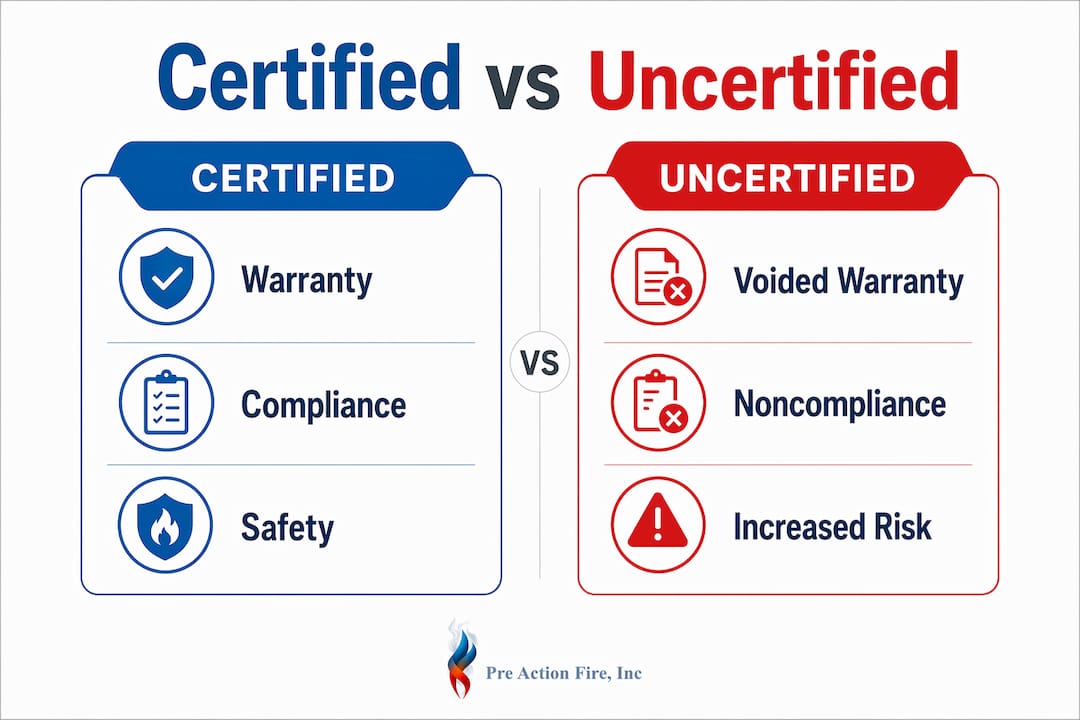
Employer data makes the ROI case clearly. Organizations that require certification report a 93% positive return on investment and a 70% competitive advantage over peers who do not. That data comes from IT workforce studies, but the underlying principle applies directly to any technical field where skill gaps create operational or safety risk.
| Financial factor | Uncertified technician | Certified technician |
|---|---|---|
| Warranty status | Voided on installation | Preserved per manufacturer terms |
| Efficiency loss risk | 15–40% on specialized systems | Minimal with code-compliant work |
| Rebate eligibility | Disqualified in most programs | Eligible for state and utility rebates |
| Callback frequency | Higher due to diagnostic guesswork | Lower with methodical diagnostics |
| Labor cost premium | Baseline | Approximately 5–10% above baseline |
Certified teams also close skills gaps more effectively. Certified teams close skills gaps at 65% versus 56% for non-certified teams. In a field where smart-building systems and integrated fire suppression technology are growing more complex each year, that gap widens.
Pro Tip: When budgeting for fire protection services, factor in the cost of a failed inspection or a voided warranty. That calculation almost always makes the certified option the cheaper one.
Certified fire technicians in property safety also reduce your liability exposure. If a fire protection system fails and the installation record shows uncertified labor, your insurance carrier and legal counsel will both have questions you do not want to answer.
How do you verify technician certification and avoid hiring pitfalls?
Verification is a two-minute process that most facility managers skip. That oversight creates the single largest quality gap in technical hiring. Here is how to close it.
- Check individual credentials, not company claims. A company certificate on the wall does not tell you which technicians are certified. Ask for the name and certification number of the specific person doing the work.
- Use official registries. NATE credentials are searchable at natex.org. NICET credentials are verifiable through NICET’s online directory. Both are free and take under two minutes.
- Confirm the certification scope matches the job. A NATE certification in air conditioning does not cover commercial refrigeration. A NICET Level II in fire alarm systems does not cover water-based suppression. Match the credential to the specific task.
- Ask for proof of continuing education. Certifications that have lapsed or are not renewed are not valid. Ask for the expiration date on the credential.
- Watch for red flags. Vague answers about credentials, reluctance to provide a certification number, or a company that only offers company-level documentation are all signals worth taking seriously.
Facility managers often trust company-level certifications without verifying individual technician credentials. That gap between company marketing and individual competence is where compliance failures and substandard work originate. The Thornton fire system certification process illustrates how individual technician credentials map to specific system types, which is the level of specificity you need before approving any fire protection work.
Key Takeaways
Certified technicians protect your facility’s compliance status, warranty coverage, and operational efficiency in ways that uncertified labor cannot replicate.
| Point | Details |
|---|---|
| Certification is individual, not company-wide | Always verify the specific technician’s credentials through official registries like natex.org or NICET’s directory. |
| Uncertified work voids warranties | Manufacturers require certified professionals for installation and repairs; uncertified labor eliminates warranty protection immediately. |
| Efficiency losses are measurable | Uncertified installations risk 15–40% efficiency losses on specialized systems, far exceeding any labor cost savings. |
| ROI strongly favors certification | Organizations requiring certification report a 93% positive return on investment and a 70% competitive advantage. |
| Rebate eligibility depends on certification | State and utility programs like Mass Save and NYSERDA require certified installers; uncertified work disqualifies projects before they start. |
The uncomfortable truth about certification in fire protection
After years of working alongside certified technician teams in fire protection, the pattern I see most often is not malicious corner-cutting. It is uninformed trust. Facility managers sign contracts with companies that use “certified” as a marketing adjective, then never ask which technician is showing up on-site or whether that person’s credentials are current.
The fire protection industry has a specific problem that other technical fields do not face as acutely: the consequences of a failure are not gradual. A poorly installed HVAC system wastes energy for years before it fails. A poorly installed fire suppression system works fine until the one moment it needs to perform, and then it does not. That asymmetry makes certification verification in fire protection more urgent than in almost any other technical discipline.
Employers increasingly treat certification as a strategic investment to keep pace with smart-building systems and evolving code requirements. That trend is correct. The complexity of integrated fire alarm and suppression systems in 2026 is meaningfully higher than it was a decade ago. A technician who passed a certification exam five years ago and has not renewed it is working with outdated knowledge in a field where the codes have changed.
My practical advice: build credential verification into your vendor onboarding checklist as a non-negotiable step. Treat an expired or unverifiable certification the same way you would treat an expired contractor license. The two-minute registry check is the cheapest risk management tool available to you.
— Results
Preactionfire’s certified technicians serve Denver facilities
Pre Action Fire has served the Denver Metro Area since 2009 with NICET-certified technicians who specialize in fire alarm systems, sprinkler installations, and inspection services. Every technician’s credentials are verifiable, and every installation is documented to meet NFPA standards and local Colorado code requirements.
Facility managers who need confidence in their fire protection compliance can start with Preactionfire’s fire alarm safety and compliance services, which cover new installations, upgrades, and ongoing inspections for commercial and industrial properties across the Denver Metro Area. Preactionfire also offers sprinkler installation benefits for commercial properties, with certified technicians handling every phase from design through inspection. Contact Preactionfire directly to confirm technician credentials and schedule a compliance consultation.
FAQ
What does a certified technician mean in fire protection?
A certified technician in fire protection holds a credential from a recognized body such as NICET, verifying competence in a specific system type through standardized testing and documented field experience. Certification must be held at the individual technician level, not just the company level.
Does hiring uncertified technicians void my warranty?
Manufacturers require certified professionals for installation and warranty repairs in specialized sectors, and using uncertified labor voids manufacturer warranty on day one. That warranty loss creates direct financial risk for facility owners beyond the initial installation cost.
How do I verify a technician’s certification before hiring?
NATE credentials are searchable at natex.org, and NICET credentials are verifiable through NICET’s online directory. Always ask for the individual technician’s certification number and confirm the credential scope matches the specific job being performed.
Are certified technicians required for rebate programs?
State and utility rebate programs including Mass Save and NYSERDA mandate certified installers for eligibility. Projects completed by uncertified technicians are disqualified from rebates regardless of equipment quality.
What is the ROI of requiring certified technicians?
Organizations that require or prioritize certification report a 93% positive return on investment and a 70% competitive advantage over organizations that do not. The efficiency and warranty protections from certified work consistently outweigh the 5–10% labor premium.