
TL;DR:
- An Emergency Mass Notification System (EMNS) broadcasts urgent alerts to large groups through multiple communication channels. Its effectiveness relies on accurate data, redundant channels, and regular testing to ensure quick, reliable response during crises.
An Emergency Mass Notification System (EMNS) is a specialized platform that broadcasts life-saving alerts to large predefined groups across multiple communication channels to enable immediate protective action. Safety managers and decision-makers who understand this technology gain a critical advantage when seconds determine outcomes. EMNS platforms are distinct from general communication tools because they are built specifically for crisis speed, scale, and reliability. Standards from FEMA, NFPA, and the Department of Homeland Security all recognize mass notification as a core component of any credible emergency response plan.
What is emergency mass notification and how does it differ from other systems?

Emergency mass notification is the process of delivering urgent alerts to thousands of recipients simultaneously through channels like SMS, voice calls, email, push notifications, desktop alerts, and public address systems. The industry term for the platform that executes this process is an Emergency Mass Notification System, or EMNS. Understanding what separates EMNS from similar tools prevents costly misapplication.
The key distinction lies in audience scale and communication infrastructure. ENS vs. MNS differ fundamentally in scope: an Emergency Notification System (ENS) targets a specific internal audience such as employees in one building, while a Mass Notification System (MNS) reaches thousands or millions, often through public infrastructure like FEMA’s Integrated Public Alert and Warning System (IPAWS). That scale difference changes everything from compliance requirements to channel selection.
| Feature | Emergency Notification System (ENS) | Emergency Mass Notification System (EMNS) |
|---|---|---|
| Audience | Internal staff or defined groups | Large populations, public-facing |
| Scale | Hundreds of recipients | Thousands to millions |
| Channels | Email, SMS, internal apps | SMS, voice, PA, IPAWS, desktop alerts |
| Compliance context | Internal policy | FEMA IPAWS, NFPA, DHS standards |
| Typical use case | Building evacuation, shift alerts | Natural disasters, campus lockdowns, public emergencies |
Pro Tip: If your organization serves a campus, industrial site, or multi-building facility, you likely need EMNS capabilities rather than a basic ENS. The channel breadth and recipient scale are non-negotiable during a major incident.
What are the core components of an effective EMNS?
An effective EMNS is built on five functional layers: detection, alert creation, distribution, recipient action, and follow-up updates. Each layer must work without failure under pressure. Missing any one of them creates a gap that can cost lives.
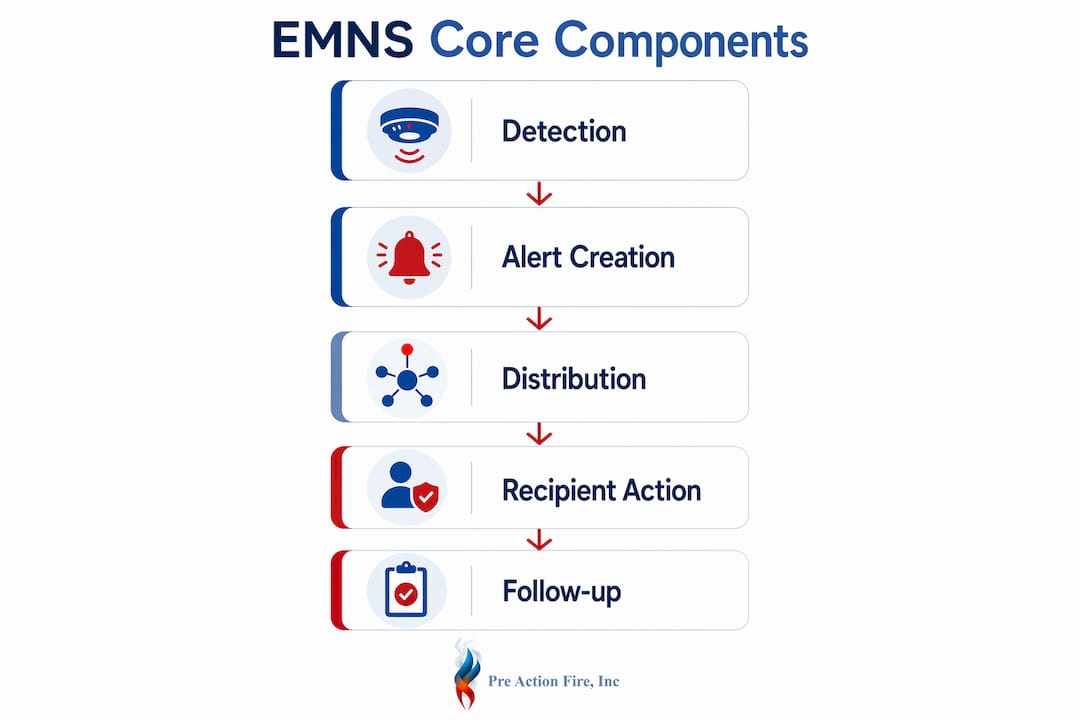
The distribution layer is where most organizations underinvest. Redundant communication paths are a standard design requirement because network failures are common during large-scale emergencies. SMS may be congested during a regional disaster. A PA system may be inaudible in a loud industrial facility. Combining SMS, email, voice calls, desktop alerts, and physical PA systems ensures the message reaches recipients regardless of which channel fails.
The workflow for a well-designed EMNS follows this sequence:
- Event detection. A trigger is identified, either manually by a responder or automatically through integrated sensors or fire alarm systems.
- Alert creation. A pre-approved message template is selected and customized with incident-specific details. Pre-approved templates reduce cognitive load on responders during high-stress situations and prevent errors under pressure.
- Distribution. The system broadcasts the alert simultaneously across all configured channels to the defined recipient groups.
- Recipient action. Recipients receive the alert and take protective action. Two-way communication features allow recipients to acknowledge receipt or report their status.
- Follow-up updates. The system sends status updates as the situation evolves, keeping recipients informed and reducing panic-driven behavior.
Roles matter as much as technology. Every EMNS deployment needs a designated alert administrator, a backup administrator, and clear authorization protocols for who can send which type of alert.
Pro Tip: Sync your EMNS contact database directly with your HR system. Outdated contact data renders even the fastest platform ineffective. A quarterly audit is the minimum; real-time HR integration is the standard.
How can organizations integrate EMNS into broader emergency communication strategies?
EMNS does not operate in isolation. The most effective deployments connect the notification platform to physical security systems, business continuity plans, and evacuation protocols. That integration creates a unified response rather than a fragmented series of disconnected actions.
Leadership involvement is not optional. Senior leadership in emergency communications produces clearer, faster, and more consistent crisis messaging. Organizations that assign communication authority to a specific executive or safety director avoid the delays caused by unclear chains of command during an incident. That clarity is the difference between a 30-second alert and a 10-minute internal debate.
Practical integration steps for safety managers include:
- Connect EMNS to fire alarm systems. When a fire alarm activates, the EMNS should trigger automatically, sending alerts to all building occupants and emergency contacts without requiring manual input.
- Map recipient groups before an incident. Define groups by floor, department, building, or role so alerts reach only the relevant population. Sending a building-wide lockdown alert to off-site staff creates confusion.
- Build two-way communication into the protocol. Two-way capabilities improve accountability and situational awareness. Knowing which employees have acknowledged an alert tells responders who may still be at risk.
- Schedule regular drills. Test the full system at least twice per year. Drills reveal database gaps, channel failures, and procedural confusion before a real emergency exposes them.
- Document and improve after every test. Capture what failed, what was slow, and what confused recipients. Update templates, contact lists, and protocols accordingly.
Effective fire safety communication requires the same discipline as any other safety system: documented procedures, trained personnel, and regular verification.
What innovations are shaping the future of mass alert systems?
The next generation of EMNS platforms moves beyond simple alerting into proactive, automated response. AI and sensor integration now allow systems to detect events and generate alerts in seconds rather than minutes. That speed difference is meaningful when a fire or active threat is developing in real time.
Key innovations safety managers should evaluate include:
- AI-driven event detection. Machine learning models analyze sensor data, camera feeds, and environmental signals to identify threats before a human observer would notice them.
- Automated message generation. AI drafts initial alert messages based on detected event type, reducing the time between detection and distribution.
- Multilingual and accessible messaging. People-centered messaging that accounts for language barriers and accessibility needs is now a recognized best practice. Facilities with diverse workforces must send alerts in multiple languages and formats, including visual alerts for hearing-impaired occupants.
- Physical security integration. EMNS platforms now connect directly to access control systems, cameras, and fire alarm panels, creating a single coordinated response across all safety infrastructure.
“Inclusivity in emergency messaging is not a courtesy. It is a functional requirement. A message that cannot be understood cannot save a life.”
The shift toward human-centered design in emergency communication reflects a broader recognition that technology alone does not protect people. The message must reach every person in a form they can act on.
Key Takeaways
An EMNS is the most critical tool in any organization’s crisis communication plan, and its effectiveness depends entirely on accurate data, redundant channels, and tested protocols.
| Point | Details |
|---|---|
| EMNS vs. ENS distinction | EMNS serves large-scale or public audiences; ENS targets internal staff only. |
| Multichannel redundancy | Use SMS, voice, email, PA, and desktop alerts together to prevent single-channel failure. |
| Contact database accuracy | Integrate with HR systems to keep recipient data current and avoid failed deliveries. |
| Leadership involvement | Assign clear communication authority to a named leader before any incident occurs. |
| Testing and improvement | Run full system drills at least twice per year and update protocols after every test. |
What I’ve learned from watching organizations get this wrong
Safety managers often treat EMNS as a technology purchase rather than a communication program. They buy the platform, configure the basics, and assume the system will perform when needed. It rarely does without the operational discipline behind it.
The most common failure I see is outdated contact data. An organization invests in a capable platform, then sends a critical alert during a drill and discovers that 20% of the recipient list bounces. That is not a technology problem. That is a process problem. The fix is simple: connect the EMNS to your HR system and make contact verification a standing agenda item in your safety reviews.
The second failure is single-channel dependence. Organizations that rely exclusively on email for emergency alerts are exposed. Email is the slowest channel in a crisis. SMS and voice calls reach people faster, and PA systems reach people who are not looking at a screen. Build redundancy into the design from day one.
Pre-approved message templates are underused. Responders under pressure make mistakes. A library of clear, pre-written templates for common scenarios, fire, lockdown, severe weather, chemical spill, removes that risk. The responder selects, customizes minimally, and sends. That process takes seconds. Writing from scratch under stress takes minutes you do not have.
— Results
How Preactionfire supports your emergency notification readiness

A fire alarm system is the most common trigger for an EMNS in commercial and industrial facilities. If the alarm system is unreliable, the entire notification chain breaks down at the first step. Pre Action Fire designs, installs, and inspects fire alarm systems for Denver Metro businesses, ensuring the detection layer of your emergency response is NFPA-compliant and fully functional. Preactionfire’s NICET-certified technicians also provide fire alarm notification devices that integrate with building-wide communication systems. Contact Preactionfire to assess whether your current fire safety infrastructure supports the rapid, reliable triggering your EMNS requires.
FAQ
What is an emergency mass notification system?
An Emergency Mass Notification System (EMNS) is a platform that delivers real-time alerts to large predefined groups through multiple channels, including SMS, voice, email, and PA systems, to enable immediate protective action during a crisis.
How does mass notification work during an emergency?
The system detects or receives a trigger, selects a pre-approved message template, and simultaneously broadcasts the alert across all configured channels to defined recipient groups, often within minutes of the triggering event.
What are the benefits of emergency notifications for organizations?
Emergency notifications reduce response time, improve accountability through two-way communication, and ensure all occupants receive consistent, accurate information during a crisis, which directly reduces injury and confusion.
What is the difference between ENS and EMNS?
An ENS targets a specific internal audience such as building staff, while an EMNS reaches thousands or millions of recipients, often through public infrastructure like FEMA IPAWS, with broader channel support and compliance requirements.
What are best practices for emergency alerts?
Best practices include maintaining accurate contact databases through HR integration, using redundant communication channels, deploying pre-approved message templates, involving senior leadership in protocol development, and testing the full system at least twice per year.